Category: Global politics || Posted Jul 05, 2026
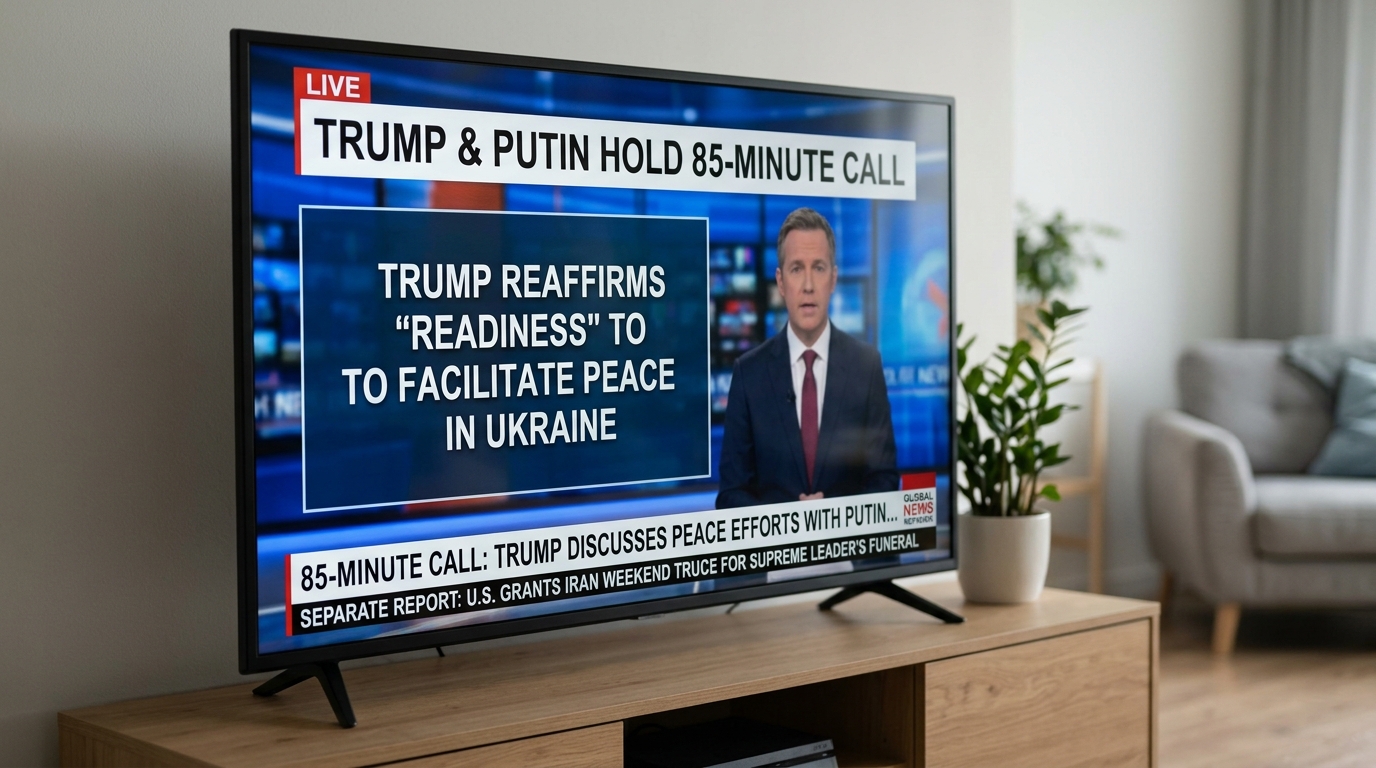
The 85-Minute Kremlin Call: Trump Reaffirms "Readiness" to Facilitate Peace in Phone Call with Putin as U.S. Grants Iran Weekend Truce for Supreme Leader's Funeral
The diplomatic track to resolve the multi-theater crisis has taken on an expanded global dimension. Amid the fragile 60-day transitional stabilization window established by the Bürgenstock breakthrough, Washington has engaged in high-level diplomacy with Moscow while simultaneously authorizing a critical humanitarian pause on the ground in West Asia. On Saturday evening, U.S. President Donald Trump held an extensive 85-minute telephone conversation with Russian President Vladimir Putin, reaffirming his readiness to facilitate a rapid end to international hostilities. This intensive call occurred just as the United States implemented a structured, weekend-long operational truce to allow Iran to conduct state funeral ceremonies for its late Supreme Leader, Ayatollah Ali Khamenei.
The lengthy conversation between Trump and Putin—their fourth formal exchange of the year—began with the Russian president extending personal congratulations to the American people on the occasion of the United States’ landmark 250th Independence Day. According to Kremlin presidential aide Yury Ushakov, the dialogue quickly shifted into a businesslike and highly constructive assessment of pressing global flashpoints. During the 85-minute call, President Trump explicitly reaffirmed his readiness to work toward a swift end to the fighting in Ukraine and find diplomatic solutions to overcome the broader international security crisis. Trump emphasized that stabilizing these overlapping conflicts as soon as possible is essential to restoring the full potential of global trade networks and bilateral economic cooperation.
The fluid situation surrounding Iran was a central pillar of the bilateral discussion. President Putin expressed optimism regarding the ongoing negotiation process born from the Washington-Tehran memorandum of understanding, noting his hope that the current framework will yield mutually acceptable, long-term solutions for the region. The Kremlin signaled its explicit readiness to provide practical assistance to reinforce the de-escalation momentum. Trump formally thanked his Russian counterpart for Moscow’s balanced position and constructive proposals, particularly ahead of the upcoming NATO summit in Ankara, Turkey, where the post-war security architecture of the Middle East is expected to dominate closed-door sessions.
While the superpower leaders finalized their call, a profound, solemn quiet fell over the Persian Gulf. In an unprecedented humanitarian concession designed to insulate the peace track from emotional volatility, the Trump administration authorized a comprehensive weekend truce. The pause effectively suspended all forward reconnaissance operations, defensive maritime positioning, and enforcement patrols to allow millions of Iranians to gather at the Imam Khomeini Grand Mosalla Mosque in Tehran for the start of week-long funeral rites for Ayatollah Ali Khamenei, who was killed in the opening strikes of the war.
The public funeral, which had been indefinitely delayed during the height of the active 107-day conflict, drew hundreds of thousands of mourners to the capital's central complex. Foreign dignitaries and official delegations from nearly thirty countries arrived in Tehran under the protection of the temporary truce, while domestic political leaders—including Iranian President Masoud Pezeshkian and Parliament Speaker Mohammad Bagher Ghalibaf—converged to observe the state ceremonies.
By granting this brief window of diplomatic oxygen, the White House has signaled a deliberate intent to keep Tehran's pragmatic negotiators engaged. However, the political atmosphere remains fragile. As the casket draped in the Iranian tricolor flag was displayed, hardline factions and crowds within the Grand Mosalla openly chanted demands for ultimate vengeance, highlighting the immense friction facing the newly established transition. With the weekend truce concluding and U.S. Special Envoy Steve Witkoff and Jared Kushner preparing follow-up diplomatic missions to Moscow and regional capitals, the 85-minute Kremlin call has solidified a coordinated push by global powers to transition West Asia away from the precipice of an unrestricted, generational war.