Category: Tutorials & Guides || Posted Jul 06, 2026
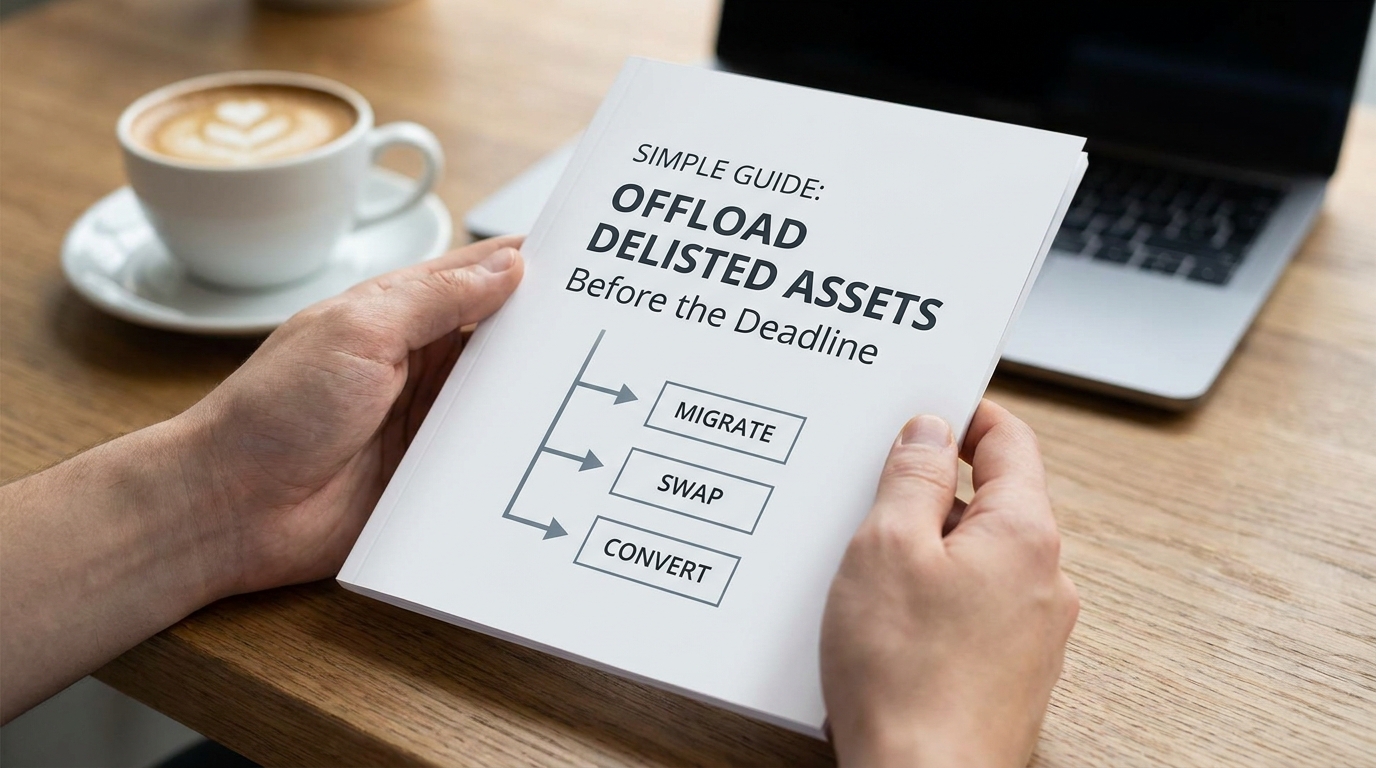
How to Offload Delisted Assets Before the Deadline: A Step-by-Step Guide on How to Securely Migrate, Swap, or Convert Restricted Non-MiCA Stablecoins Prior to Exchange Offramping Blocks
The regulatory landscape in Europe has completely shifted. With the final transition window for the European Union’s Markets in Crypto-Assets (MiCA) regulation closing, centralized exchanges (CEXs) and fintech neobanks operating across the European Economic Area (EEA) are enforcing strict compliance measures.
The biggest casualty of this new era? Non-compliant stablecoins.
Popular assets like Tether (USDT), DAI, FDUSD, and fractional algorithmic stablecoins that do not hold a valid electronic money institution (EMI) or asset-referenced token (ART) license are being systematically wiped from European order books. Major trading hubs like Binance, Kraken, and Coinbase have heavily restricted these assets, and fintech giants like Revolut have initiated phased delistings—cutting off deposits and implementing forced automated fiat conversions for remaining user balances.
If you are holding restricted, non-MiCA stablecoins on a regulated exchange, you need a proactive offloading strategy before offramping blocks freeze your trading capability. Here is your step-by-step guide to securely migrating, swapping, or converting your assets.
The Risk Matrix: What Happens If You Do Nothing?
Ignoring exchange delisting notices exposes your portfolio to unnecessary operational friction:
- Liquidity Freezes (Spot Block): Once an exchange hits its compliance deadline, all spot trading pairs for non-compliant stablecoins (e.g., BTC/USDT) are permanently deactivated. You cannot use those tokens to trade into other crypto assets.
- Forced Liquidation: Platforms that integrate banking infrastructure (like neobanks) will activate an automated forced-sell mechanism on the deadline date, automatically converting your tokens into fiat (like EUR) at the prevailing market rate, regardless of whether it is financially advantageous for you.
- The Custody Trap: While some platforms allow prolonged custody and withdrawals after trading halts, you lose all financial utility—you cannot stake, earn yield, or use those assets as collateral.
Step-by-Step Playbook to Offload Restricted Stablecoins
To maintain full agency over your capital, execute one of the following transition paths immediately.
Option 1: Direct On-Chain Migration to Self-Custody (DeFi Preserved)
The most important thing to remember is that MiCA rules apply to centralized service providers operating in the EU, not the underlying blockchains. Your USDT or DAI is perfectly valid on-chain. If you want to keep holding your current assets, move them off the exchange entirely.
1.Establish an On-Chain Self-Custodial Wallet:Step 1.Set up a secure hardware wallet (like a Ledger or Trezor) or an independent multi-chain software wallet (like MetaMask, Trust Wallet, or Phantom). Ensure you back up your recovery seed phrase entirely offline.
2.Copy the Exact Blockchain Network Address:Step 2.Open your self-custodial wallet, select your target network (e.g., Ethereum, Arbitrum, Solana, or Polygon), and copy your native deposit address.
3.Initiate the Exchange Withdrawal Routing:Step 3.Navigate to your exchange’s withdrawal portal. Select your restricted stablecoin, paste your self-custodial address, and double-check that the network selection matches on both ends (e.g., withdrawing USDT via Arbitrum to an Arbitrum destination wallet) to minimize network gas fees.
4.Confirm Blockchain Ledger Processing:Step 4.Execute the transfer, complete your two-factor authentication (2FA), and track the transaction on a block explorer until the assets settle safely in your private wallet.
Option 2: The CEX Conversion Route (Swap for MiCA-Compliant Assets)
If you want to keep your funds inside a centralized exchange environment but need to stay compliant with local trading rules, you must convert your non-compliant assets into recognized, fully licensed e-money tokens (EMTs).
The Compliant Alternative Lineup
As the regulatory framework takes full effect, the stablecoin landscape has effectively split. You can trade out of your restricted positions and move into these authorized options:
| Restricted / Non-MiCA Tokens | Approved, Fully Compliant Alternatives | Core Licensed Issuer |
| USDT, DAI, FDUSD, TUSD, FRAX | USDC (US Dollar Pegged) | Circle SAS (Licensed by ACPR France) |
| EURT, EURS, AGEUR | EURC (Euro Pegged) | Circle SAS (Licensed by ACPR France) |
| Legacy Euro Stables | EURI (Euro Pegged) | Banking Circle (Licensed by CSSF Lux) |
Log into your exchange profile, access the basic Convert or Spot Trading module, and execute a direct zero-fee trade from your restricted stablecoin into an approved pair (e.g., swapping USDT straight to USDC).
Option 3: Capitalize on Decentralized Exchanges (DEXs)
If you missed your platform's internal conversion deadline and find that spot trading pairs are already greyed out, check if external blockchain transfers remain active. If withdrawals are still open, you can bypass centralized restrictions using Decentralized Finance (DeFi) primitives.
- Withdraw your restricted stablecoins to your self-custodial web3 wallet.
- Navigate to an on-chain automated market maker or aggregator (such as Uniswap, 1inch, or Jupiter).
- Connect your wallet and execute a permissionless swap. Because these platforms run on smart contracts without centralized intermediaries, you can trade your non-MiCA stablecoins for wrappers, native Layer-1 assets (like Ethereum or Solana), or compliant stablecoins like USDC without hitting compliance walls.
Action Checklist for European Traders
Before the clock runs out on your specific exchange's offramping schedule, run through this final operational audit:
- [ ] Review Email Notifications: Audit your registered exchange inbox for any explicit localized geofencing dates or asset wind-down deadlines.
- [ ] Cancel Open Spot Orders: Manually terminate any open limit orders containing restricted stablecoins; otherwise, the exchange matching engine will automatically cancel them post-deadline, leaving your assets in limbo.
- [ ] Audit Web3 DApp Connections: If you have capital deployed in centralized yield earning programs or exchange-run Web3 web wallets, withdraw them back to your main account to prepare for conversion or external migration.
By taking control of your stablecoin allocation early, you protect your trading capital from abrupt conversions and position your portfolio safely within the boundaries of the updated digital asset landscape.