Category: Opinion & Analysis || Posted Jul 15, 2026
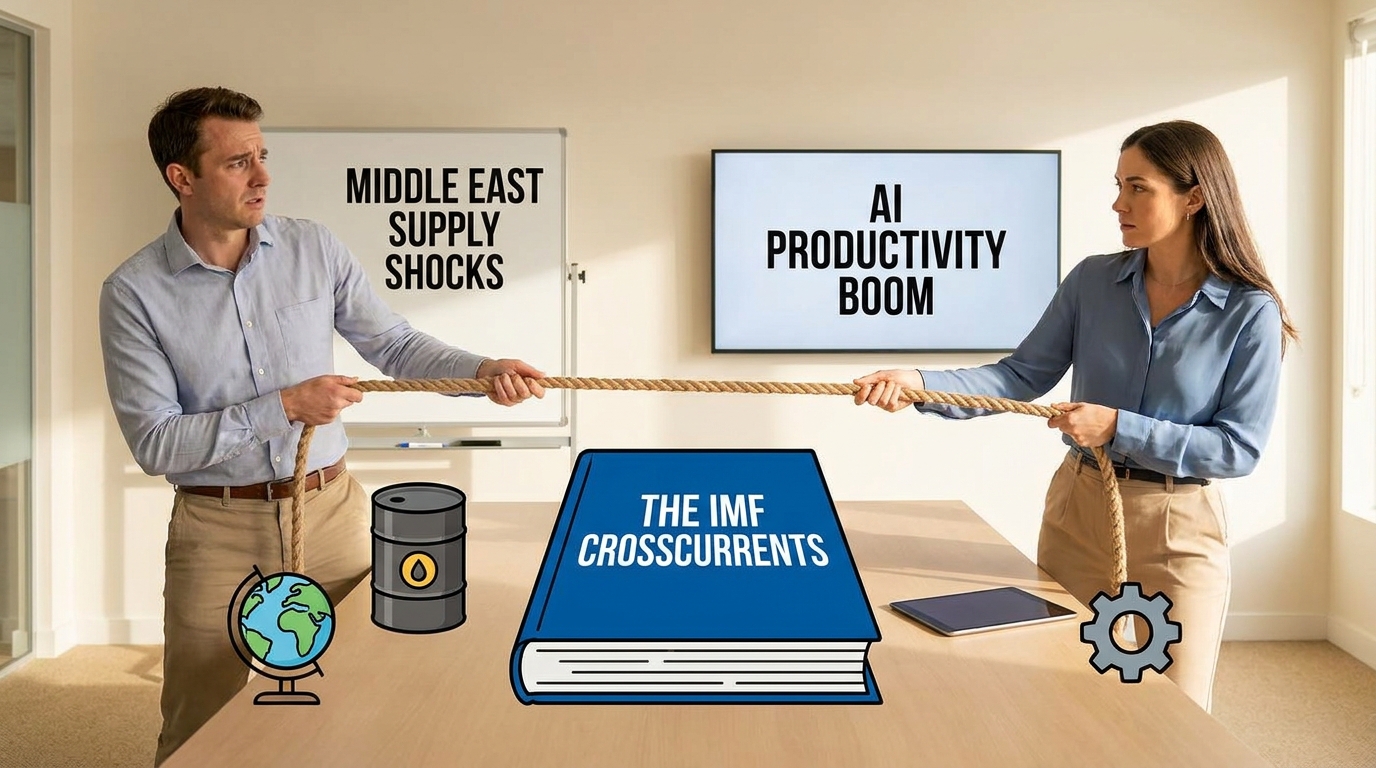
The IMF Crosscurrents: Why the Global Economy is Caught in a Tug-of-War Between Middle East Supply Shocks and the AI Productivity Boom
If you’ve been looking at the global economy lately and feeling a sense of whiplash, you aren't alone. One day, we are reading about soaring energy prices, shipping bottlenecks, and persistent inflation. The next, tech stocks are surging to new heights on the back of an unprecedented artificial intelligence boom.
The International Monetary Fund (IMF) perfectly captured this bizarre, dual-speed reality in its newly released July 2026 World Economic Outlook (WEO) Update. Aptly titled "Global Economy in Crosscurrents of War and Technology," the report diagnoses a global economic backdrop that is being violently tugged in opposite directions.
On one side of the rope is a bruising, negative supply shock from ongoing geopolitical conflicts in the Middle East. On the other is a roaring, positive technology shock driven by massive business investments in frontier AI and hardware infrastructure.

Let's unpack why these two forces are rewriting the rules of global growth, who is winning this high-stakes tug-of-war, and what it means for the macro environment going forward.
The Growth Equilibrium: 3.0% with a Catch
At first glance, the headline numbers suggest a stable, almost boring economy. The IMF projects global growth to hit 3.0% in 2026 and recover slightly to 3.4% in 2027.
But these flat baselines hide an incredible amount of internal friction. The stable headline projection is only possible because the explosive productivity gains of the tech sector are acting as a structural shield, absorbing the severe economic damage being dealt by geopolitical conflict.
The Downward Force: Geopolitical Shocks and Sticky Inflation
The most immediate drag on the global economy remains the persistent conflict in the Middle East. For the last two years, hostilities have threatened maritime trade routes, spiked shipping insurance rates, and kept commodities highly volatile.
This friction has triggered two major macroeconomic headwinds:
- The Return of $89 Oil: The IMF's July forecast assumes an average oil price of $89 per barrel. This is significantly higher than pre-war norms, and it acts as a direct tax on global productivity.
- Stalled Disinflation: The steady downward trend in global inflation that we enjoyed since early 2024 has officially stalled. Driven by high energy and shipping costs, the IMF was forced to revise its global headline inflation projection up to 4.7% for 2026.
For central banks, this sticky inflation is a nightmare. It prevents them from easing monetary policy, keeping the global cost of capital high and squeezing consumer wallets.
The Upward Force: The Accelerated Tech Cycle
Normally, a massive energy shock and 4.7% inflation would plunge the world into a synchronized downturn. Enter the positive tech shock.
Despite tight financial conditions, businesses are aggressively pouring capital into technology infrastructure, data centers, and AI deployment. This isn't just speculative hype; it is actively showing up in the hard economic data.
The Hardware Surge: The global technology cycle has accelerated at a pace that has completely blindsided traditional macro models. Rather than waiting for long-term productivity payoffs, the immediate, massive capital expenditure on physical computing infrastructure is keeping the global manufacturing and trade engine running.
The Great Split: Winners vs. Losers
Because these two forces are highly concentrated, the global economy is fracturing. Instead of a uniform trend, we are seeing a dramatic split between countries based on their exposure to the war and their position in the tech value chain.
The AI Exporters: Thriving in the Storm
The clear winners of this realigned landscape are countries deeply plugged into the global AI hardware supply chain. The IMF highlights a "Top 4" group of AI hardware exporters: South Korea, Taiwan, Malaysia, and Thailand.
South Korea is the ultimate poster child for this trend. Despite being a heavy oil importer that relies on the Middle East for its energy, South Korea's economy has vastly outperformed expectations. Why? Because global demand for high-bandwidth memory (HBM) chips and advanced semiconductors has completely offset their higher energy import bill.
The Energy Importers: Trapped in the Middle
On the flip side, the outlook is incredibly challenging for energy-importing, developing economies that have little to no participation in the technology value chain.
These countries are getting hit on both sides. They have to pay elevated prices for oil, gas, and food, yet they receive absolutely zero offset from the AI investment boom. This is exacerbating the economic divide between technologically advanced nations and lower-income countries.
The Downside Risk: What If the AI Engine Stalls?
While the technology cycle is currently acting as a vital counterweight to the war shock, the IMF warns that this equilibrium is fragile.
If investors begin to reassess the long-term productivity payoffs of AI, it could trigger a sharp, dot-com-style market correction. The IMF actually modeled an "AI disappoints" scenario. In this stress-test, a sudden drop in tech investment coupled with an acute equity market correction could wipe roughly 1.2% off global output over the next two years—leaving the global economy fully exposed to the raw drag of Middle East supply shocks.
The Bottom Line
The July 2026 IMF report confirms that the old economic playbooks are outdated. We are no longer in a simple "boom" or "bust" cycle. Instead, we are living through a structural transition where physical energy constraints are constantly battling digital efficiency gains.
For businesses and policymakers, the lesson is clear: survival doesn't depend on waiting for the macro environment to "normalize." It depends on actively aligning with the technology value chain to build an operational buffer strong enough to withstand the sticky inflation and structural friction of a fragmented world.