Category: Global politics || Posted Jul 15, 2026
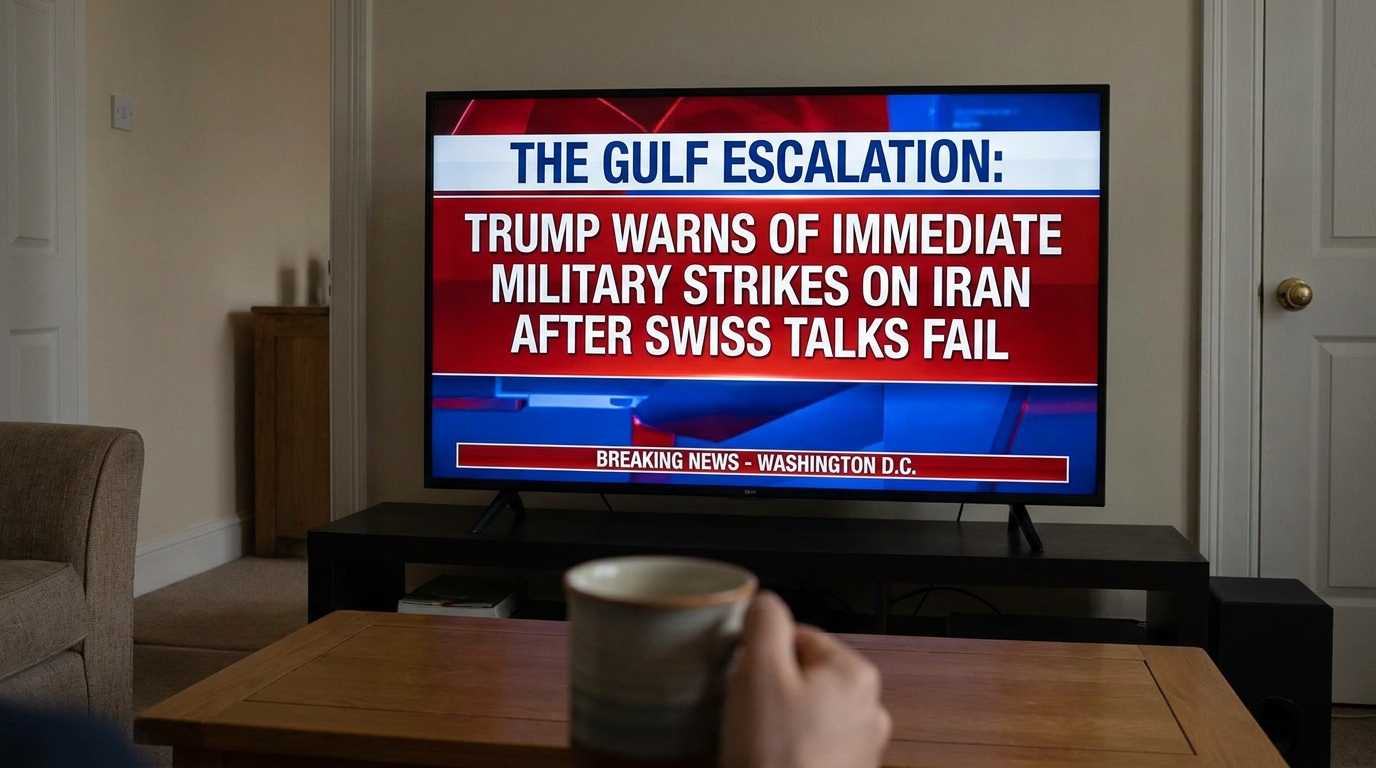
The Gulf Escalation: Trump Warns of Immediate Expansion of Military Strikes on Iran Following Collapse of Swiss Peace Framework
Back to the Brink: Why the US-Iran Peace Deal Collapsed and What’s Next
Just a few weeks ago, the world was breathing a sigh of relief. Diplomats had gathered in the Swiss Alps at the Bürgenstock Resort, smiling for the cameras as they signed the Islamabad Memorandum on June 17. It was supposed to usher in a fragile, 60-day window of stabilization to finally wind down the devastating war in West Asia.
Today, those hopeful Swiss alpine summits are a distant memory.
We are officially back on a hot-war footing. Following a series of highly aggressive clashes in the Persian Gulf, President Donald Trump has officially declared the interim ceasefire "over," reinstating a total U.S. naval blockade on Iran. With consecutive nights of heavy airstrikes pounding Iranian positions, the region is bracing for an even wider military conflict.
1. The Trigger: The Battle for the Strait of Hormuz
To understand how a historic peace treaty dissolved in less than a month, we have to look at the ultimate strategic choke point: the Strait of Hormuz.
Look closely at the satellite image above. You can see just how incredibly narrow this waterway is. Roughly twenty percent of the world’s petroleum passes through this tiny strip of water daily, making it the throat of the global energy economy.
Under the terms of the June 17 peace memorandum, the strait was supposed to reopen fully to neutral, toll-free international shipping. However, Tehran almost immediately began testing the limits of the deal. Arguing that the ceasefire granted them the right to "manage" regional traffic, Iranian forces attempted to implement a highly controversial "pay-to-pass" scheme, demanding routing protocols and fees from commercial vessels.
When shipping companies resisted, the situation turned violent. On July 6 and 7, Iranian forces launched drone and missile strikes on three commercial cargo ships transiting the strait. By Monday, Omani waters saw even heavier violence when two national tankers—the MT Al Bahiyah and MT Mombasa—were struck by Iranian cruise missiles, injuring several crew members.
To Washington, this was a clear, bad-faith violation of the treaty, and the diplomatic off-ramp vanished instantly.
2. The Resumption of the Blockade and Heavy Airstrikes
The American response has been swift, heavy, and highly coordinated. On Monday, July 13, President Trump formally notified Congress that hostilities had officially resumed. By 4:00 PM Eastern Time on Tuesday, July 14, U.S. Central Command (CENTCOM) put a total naval blockade into full effect across all Iranian ports, oil terminals, and coastal zones.
Currently, more than twenty U.S. warships and hundreds of military aircraft are actively enforcing the perimeter. For Iran's economy—already reeling from years of sanctions and the devastation of the earlier phase of this war—the sudden loss of its remaining oil export routes is a catastrophic blow.
But Washington isn't just stopping ships; it is actively degrading Iran’s military capacity:
- The Seven-Hour Wave: On Tuesday night, U.S. fighter jets, armed drones, and naval vessels launched a massive, coordinated precision campaign.
- Tactical Targets: The strikes targeted dozens of active military installations, focus-firing on Iranian missile launch pads, drone assembly depots, and coastal radar stations near the Strait of Hormuz.
- Active Defense Interceptions: Simultaneously, allied bases in Bahrain and Kuwait have been placed on high alert, actively intercepting retaliatory drone and missile counter-strikes launched by the Islamic Revolutionary Guard Corps (IRGC).
3. The New Red Line: Pickaxe Mountain
As military actions intensify, the White House has signaled that the next phase of strikes could target Iran's most heavily protected assets—specifically its nuclear-related infrastructure.

The satellite imagery above shows "Pickaxe Mountain," a heavily fortified ridge adjacent to the Natanz nuclear facility. Buried hundreds of feet beneath the solid rock of this mountain lies a vast network of tunnels designed to shield Iran’s advanced uranium centrifuges and nuclear research assets from conventional airstrikes.
President Trump explicitly warned this week that the U.S. is closely monitoring the Pickaxe Mountain site, hinting that its deep-buried bunkers are no longer off-limits. While military analysts debate whether conventional bunker-busters can fully penetrate the rock, the mere mention of Pickaxe Mountain as a live target shows that the administration is prepared to launch a far more destructive campaign than we saw during the initial spring offensive.
4. The Political Fallout in Washington
While the military maneuvers play out in the Gulf, a parallel battle is raging on Capitol Hill over the legality of the intervention.
By delivering formal notification to Congress on July 7, the Trump administration effectively opened a new 60-day window under the War Powers Act. This law allows the president to initiate military engagements to preserve national security, but requires them to pull back within 60 days unless Congress formally authorizes a declaration of war.
The decision has polarized Washington:
- The Administration’s Stance: Officials argue that immediate, decisive action is required to protect global shipping lanes, defend American allies like the UAE and Qatar, and prevent Iran from securing a functional nuclear weapon.
- The Congressional Pushback: Critics and anti-war advocates have fiercely condemned the quick return to violence. Senator Bernie Sanders vocally warned that the president is dragging the country back into a "reckless war based on lies," arguing that the sudden escalation is a dangerous trap that will cost countless lives and bleed billions of taxpayer dollars.
The Outlook
The Bürgenstock peace process was designed to give both Washington and Tehran a face-saving exit from a grueling conflict. Instead, the structural dispute over who controls the physical lanes of the Strait of Hormuz has pulled both nations right back into the arena.
With the U.S. naval blockade now actively patrolling the coast and the threat of strikes on Pickaxe Mountain looming, the diplomatic off-ramps have completely dissolved. The region has entered an incredibly volatile phase where a single tactical miscalculation on the water could ignite a full-scale, unrestricted regional war.