Category: Global politics || Posted Jul 26, 2026
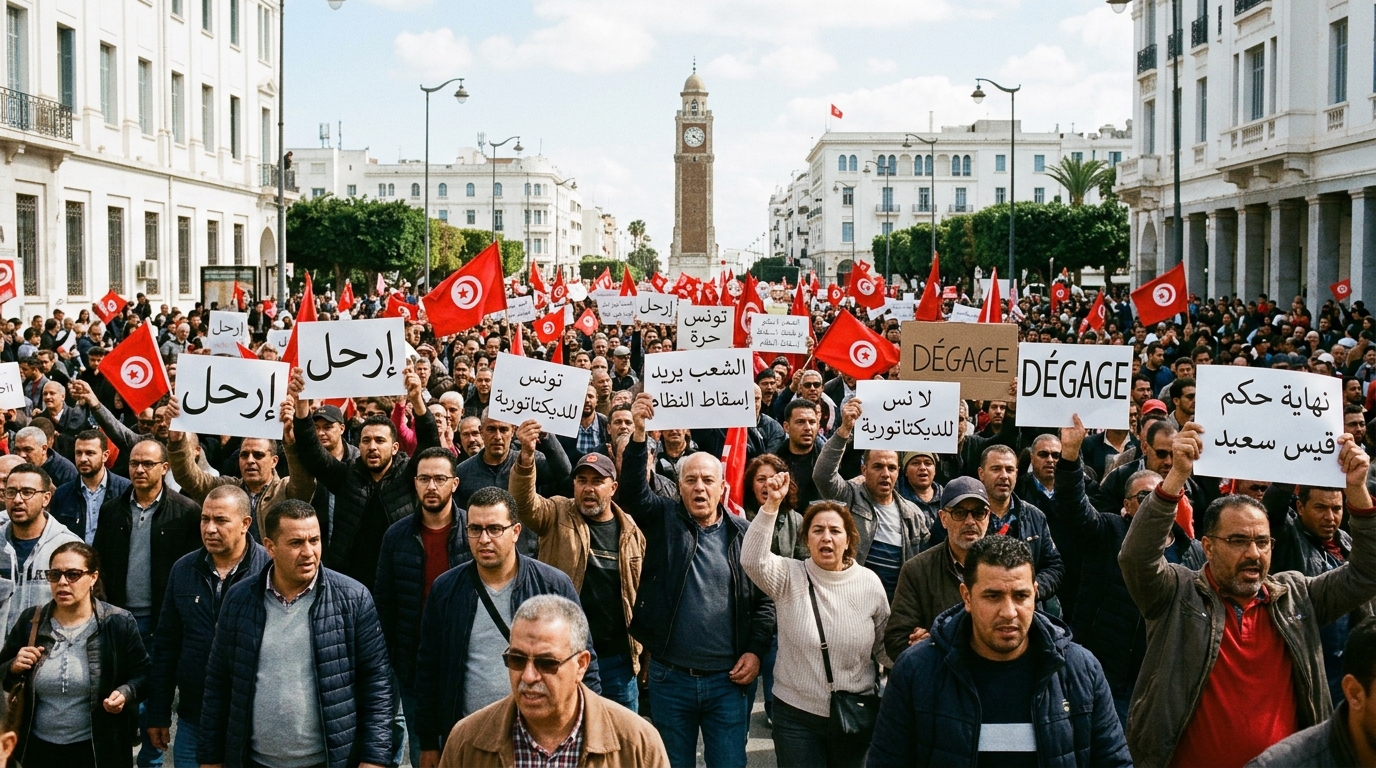
Thousands Rally in Tunisian Capital Calling for End of President's Rule
The streets of the Tunisian capital flooded once again with thousands of vocal demonstrators. Marking exactly five years since President Kais Saied suspended parliament and seized executive powers, citizens from across the political spectrum gathered in Tunis to demand an immediate return to constitutional democracy, the release of political prisoners, and an end to Saied’s autocratic rule.
What was originally proclaimed by Saied in July 2021 as a temporary measure to clean up government corruption has transformed, in the eyes of his critics, into a rigid authoritarian state. Today's massive rallies highlight a populace reaching a breaking point amid political repression and crumbling public infrastructure.
1. Five Years of "Rule by Decree"
On July 25, 2021—Tunisia’s Republic Day—President Saied invoked emergency powers, dismissed the prime minister, suspended parliament, and began ruling by decree. Over the subsequent years, he dismantled key judicial bodies, rewrote the constitution to grant the presidency sweeping powers, and systematically targeted his political rivals.
Today, the country's opposition leadership sits almost entirely behind bars. Prominent figures currently imprisoned under anti-terrorism and state security laws include:
- Rached Ghannouchi: Head of the Islamist Ennahda party and former speaker of parliament.
- Abir Moussi: Leader of the right-wing Free Destourian Party.
- Sonia Dahmani & Mourad Zghidi: High-profile defense attorneys and journalists jailed for publicly criticizing government policy.
During Saturday's march, protesters carried portraits of jailed dissidents alongside a large mock cage representing the state of political freedom in Tunisia. Crowds chanted slogans like "Out with dictator Saied," "Get out," and "No fear, no terror, streets belong to the people".
2. Economic Strain and Service Failures
While political repression sparked the movement, worsening daily living conditions have mobilized everyday citizens who previously remained politically neutral.
Tunisia is grappling with severe inflation, persistent shortages of basic food commodities, and soaring youth unemployment. Compounding the crisis, an intense summer heatwave across North Africa has triggered multiple wildfires and exposed the failure of municipal utilities. Widespread power grid failures and water shutoffs have left millions without essential services during extreme temperatures, sharpening public fury at state mismanagement.
"We were promised reform and dignity," noted academic and sociology researcher Mouldi Gassoumi during the rally. "Instead, citizens have seen the dismantling of the republic's core values, replaced by poverty, systemic failures, and absolute power".
3. A Fractured Nation Re-Unifies
Perhaps the most significant takeaway from the demonstrations in Tunis is the unprecedented alignment among formerly bitter political adversaries. The rally was spearheaded by coalition groups including the National Salvation Front, bringing together leftist activists, secular democrats, and members of the Ennahda party.
Women led many of the primary chanting blocks, calling for an immediate national dialogue, economic stabilization, and a broad amnesty for all political detainees.
Despite heavy police presence, metal barriers, and armored vehicles deployed along central thoroughfares like Avenue Habib Bourguiba, the protest proceeded without major violent clashes. As opposition movements signal plans for continued strikes and marches, the pressure on President Saied’s administration is higher than at any point since his 2021 power grab.