Category: Tutorials & Guides || Posted Aug 02, 2026
How to Secure Your Digital Assets in 2026: A Step-by-Step Hardware Wallet Setup Guide for Beginners
In the digital age, convenience is the ultimate security vulnerability.
Picture this: You wake up, grab your smartphone, and open your favorite portfolio app to check your digital assets. Everything looks green. You feel secure. But while you were sleeping, a silent, invisible exploit swept through a popular browser extension, a centralized third-party protocol suffered a silent database compromise, or a clever phishing campaign tricked an automated signature request. In a matter of seconds, years of accumulated capital vanish into an anonymous, unrecoverable wallet on the blockchain. There is no customer service hotline. There is no bank fraud department to call. The ledger is immutable, and the loss is absolute.
This is the harsh reality of self-custody in 2026. As decentralized finance, tokenized commodities, and digital assets become increasingly integrated into global portfolios, cybercriminals have evolved far beyond simple phishing emails. Today’s threat landscape features AI-generated deepfake social engineering, sophisticated clipboard-hijacking malware, and zero-day exploits targeting browser-based software wallets.
Yet, millions of users still keep substantial fortunes sitting behind the fragile walls of hot wallets connected permanently to the internet. The antidote to this vulnerability is as old as cryptography itself: offline isolation.
Securing your digital assets is no longer an advanced option for hardcore cypherpunks; it is the absolute baseline requirement for anyone holding value in a web3 environment. Here is the definitive, step-by-step masterclass on how to completely sever your attack surface using modern hardware wallet architecture.
To understand why a hardware wallet is non-negotiable, we must examine the fundamental mechanics of how digital assets are stored. A common misconception among beginners is that crypto is "stored" inside a physical hardware device or a software app. In reality, your coins and tokens never leave the public blockchain. What you actually own is a private key—a cryptographically generated string of numbers that grants you absolute authorization to move the funds associated with your public address.
If your private keys touch a device connected to the internet—such as a desktop computer, a smartphone, or a browser extension—they are inherently exposed to keyloggers, remote access trojans (RATs), and malicious smart contract approvals.
The Hardware Wallet Architecture
A hardware wallet (often called a cold storage wallet) is a specialized, air-gapped electronic device designed with one single, unbreakable mandate: generate private keys, sign transactions internally, and never, under any circumstances, expose those private keys to an internet-connected device.
Even if your computer is heavily infected with malware, a genuine hardware wallet isolates the signing process inside a secure element (SE) microchip. When you initiate a transaction, the data is sent to the hardware device, you physically review and approve the transaction details on the device's onboard screen, and the device signs the transaction offline, transmitting only the cryptographic proof back to the internet.
The 2026 Step-by-Step Security Blueprint
Setting up a hardware wallet incorrectly is just as dangerous as not having one at all. To achieve true self-custody security, beginners must execute a rigorous, sequential onboarding protocol.
1.Procure Directly and Verify Supply Chain Integrity:Phase 1.Never purchase a hardware wallet (such as a Ledger, Trezor, or Keystone) from third-party marketplaces like eBay, Amazon, or peer-to-peer sellers. Always order directly from the official manufacturer. Upon arrival, inspect the packaging for physical tampering. When initializing the device via its official companion app, ensure the software verifies the device's cryptographic authenticity to confirm the chip has not been intercepted or modified in transit.
2.Generate and Record Your Offline Recovery Seed:Phase 2.During initialization, the device's secure element will generate a BIP-39 recovery seed phrase—typically a randomized sequence of 12 to 24 words. This is the master key to your entire digital identity. Write these words down physically using a pen on the provided recovery sheets. Never take a photograph of your seed phrase, never type it into a notes app, and never upload it to cloud storage. Anyone who views your seed phrase instantly owns all your assets.
3.Secure the Physical Backup:Phase 3.Paper is susceptible to fires, floods, and natural degradation. For robust security, transfer your recovery seed phrase onto a heavy-duty, marine-grade stainless steel backup plate (such as a Cryptosteel or Billfodl). Store your primary backup in a secure, fireproof location, and consider separating your backup from your hardware device if utilizing dual-location risk mitigation.
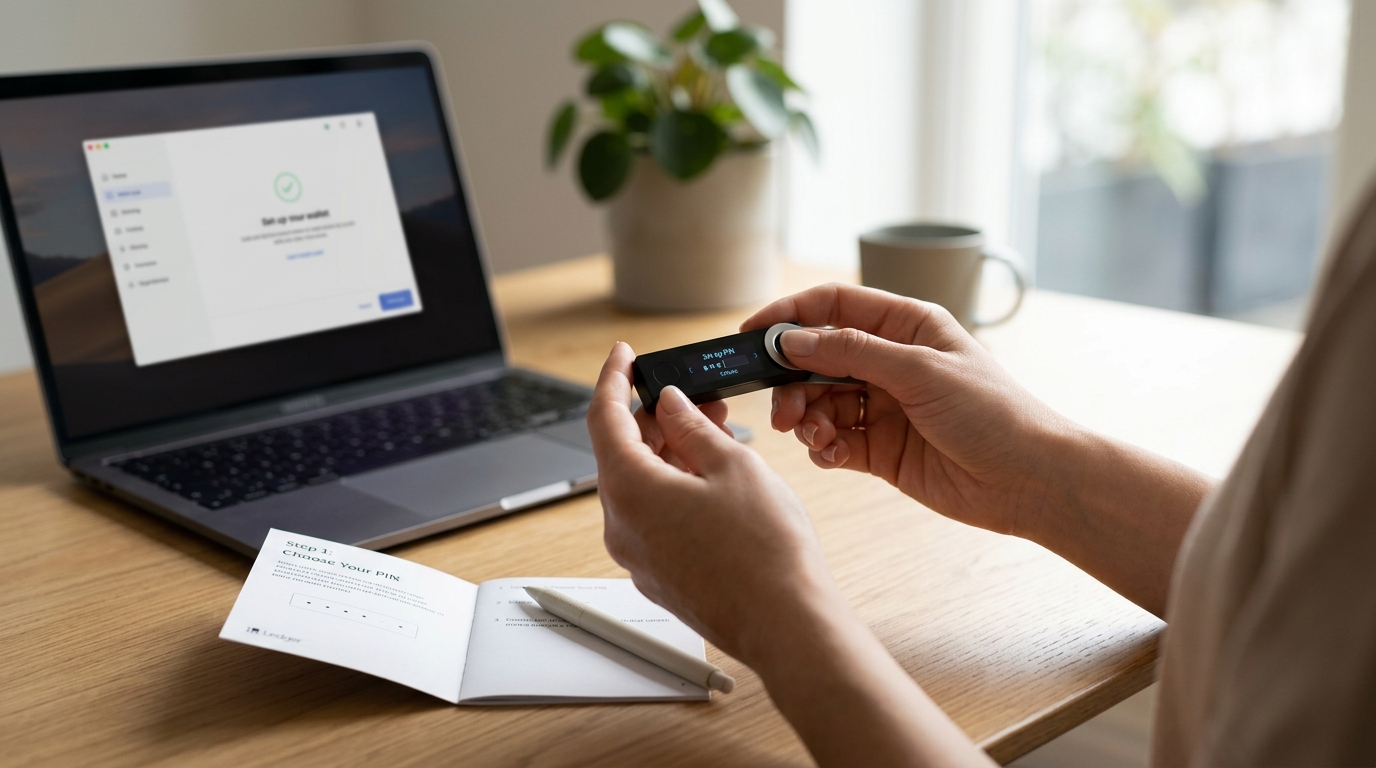
4.Establish PIN Protection and Passphrases:Phase 4.Set a strong, unique PIN code on the device itself. For advanced protection, configure an optional BIP-39 Passphrase (often called a 25th word). This acts as a custom password that, when combined with your seed phrase, generates an entirely hidden, secondary wallet. This provides plausible deniability and an extra layer of defense even if your physical seed phrase is compromised.
5.Perform a Controlled Test Recovery:Phase 5.Before transferring your entire portfolio to the new hardware wallet, execute a sanity check. Send a negligible amount of digital assets to the device, wipe the hardware wallet entirely, and practice restoring it using your physical recovery sheet. Once you confirm the funds reappear successfully, you can safely deploy your full capital allocation.
The Hardware Ecosystem Landscape
The hardware wallet market has matured significantly, offering specialized form factors tailored to different user preferences:
- The Secure Bluetooth Standard: Devices like the Ledger Nano X or Ledger Stax offer Bluetooth connectivity, allowing users to interact seamlessly with mobile web3 applications while keeping keys strictly isolated in the secure element.
- The Air-Gapped Minimalist: Devices like the Keystone or Trezor Safe 3 focus on open-source transparency and air-gapped data transfer (using QR codes instead of USB cables or Bluetooth), eliminating all physical and wireless interface vectors.
As blockchain technology permeates institutional and retail finance, security infrastructure is undergoing a radical paradigm shift. The next few years promise technological evolutions that will redefine how we protect digital wealth. Here is an analysis of potential future developments, emerging risks, and market probabilities currently being evaluated by cybersecurity experts.
Quantum Computing and Post-Quantum Cryptography
The most prominent long-term horizon discussion in digital asset security centers around quantum computing. While current quantum computers lack the qubit count and error-correction capabilities to break modern ECDSA (Elliptic Curve Digital Signature Algorithm) cryptography used by Bitcoin and Ethereum, computer scientists project that cryptanalytically relevant quantum computers could emerge within the next decade.
Industry analysts are watching to see how major layer-1 blockchains implement post-quantum cryptography (PQC) upgrades. For hardware wallet manufacturers, this means future devices will likely require hardware architecture upgrades capable of supporting quantum-resistant signature schemes (such as lattice-based cryptography) to ensure legacy private keys cannot be reverse-engineered from public addresses by quantum algorithms.
The Rise of Multi-Party Computation (MPC) and Passkeys
While hardware wallets remain the gold standard for individual self-custody, institutional and high-net-worth security is rapidly pivoting toward Multi-Party Computation (MPC) and cryptographic passkeys.
One potential scenario is the widespread consumer adoption of threshold signatures, where a private key is never generated as a single whole entity. Instead, it is split into multiple distinct cryptographic shares distributed across separate devices or biometric signers. If this trend trickles down from institutional custodians to retail software, the traditional seed phrase could eventually be phased out in favor of frictionless, multi-factor social recovery models backed by hardware-level secure enclaves.
The Threat of AI-Driven Social Engineering
While physical device hacking remains difficult due to secure elements, the human attack surface is expanding. Cybersecurity researchers warn that the most dangerous vector in the coming years will not be compromised code, but hyper-targeted AI deepfakes.
Market sentiment suggests that bad actors will increasingly deploy real-time synthetic voice and video simulations of trusted protocol founders, exchange support staff, or developer team members to trick users into approving malicious smart contract transactions. The ultimate defense against this trend will not just be hardware isolation, but mandatory hardware-level transaction display parsing—ensuring the hardware screen displays human-readable transaction intent before any signature is released.
Securing digital assets is not a one-time event; it is an ongoing operational mindset. In an ecosystem where financial sovereignty is entirely in your own hands, the margin for error is razor-thin.
As we look toward an increasingly tokenized future influenced by quantum advancements and advanced AI threats, the foundational rules remain immutable: Never trust, always verify, and keep your private keys strictly offline.
The key variables to watch on the horizon include the rollout of post-quantum blockchain upgrades, the evolution of air-gapped cryptographic hardware standards, and shifts in regulatory self-custody frameworks. By anchoring your portfolio in disciplined cold storage hygiene today, you ensure that your digital assets remain entirely under your control, no matter how chaotic the external landscape becomes.
Disclaimer: The following article is strictly for informational and educational purposes. It does not constitute financial, legal, or security advice. Digital asset security involves inherent risks, and readers are solely responsible for safeguarding their private keys, credentials, and physical recovery seed phrases.