Category: Security & Regulation || Posted Aug 02, 2026
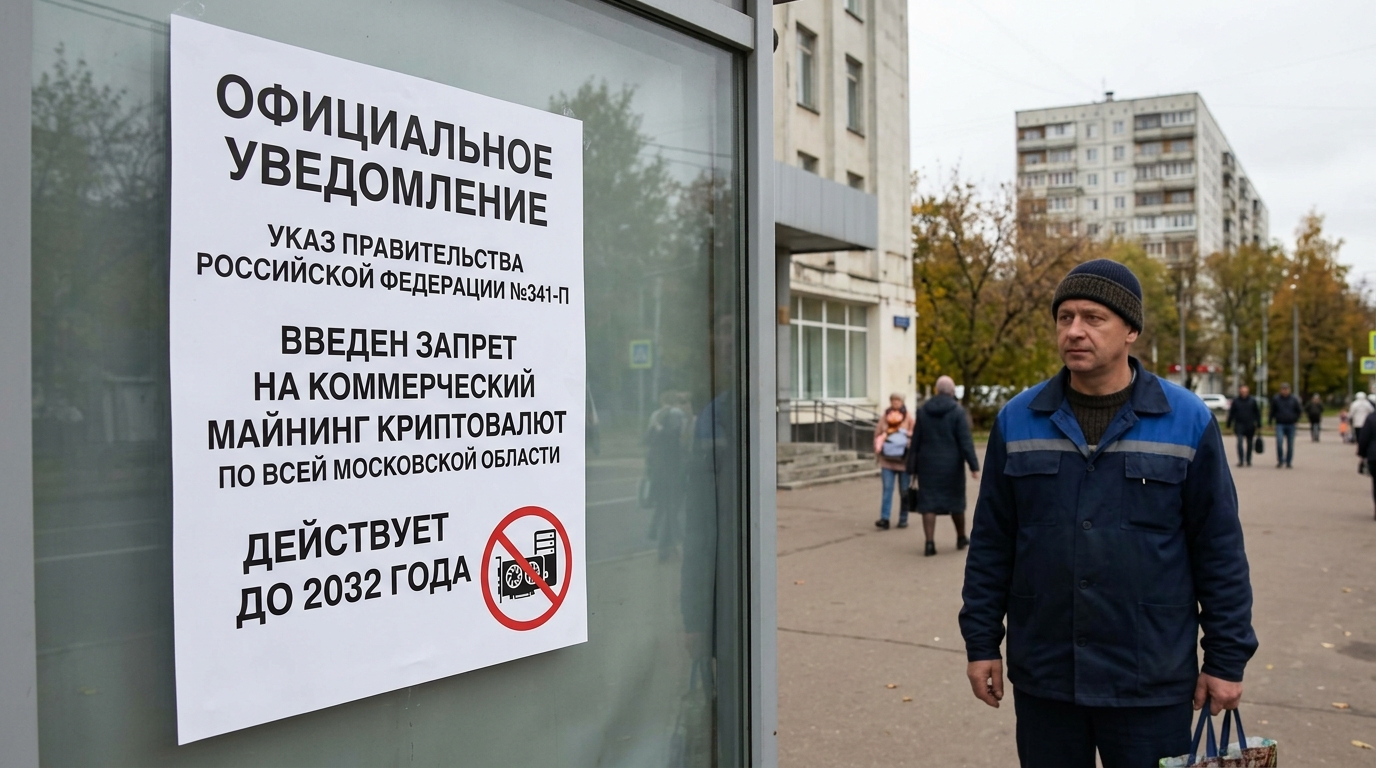
Russian Decree Officially Bans Commercial Crypto Mining Across the Entire Moscow Region Through 2032
The humming racks of industrial ASICs are going dark across Russia’s beating economic heart.
For years, the Russian Federation walked a fascinating regulatory tightrope with digital assets. While Western economic sanctions drove Moscow to embrace cryptocurrency as a vital conduit for cross-border trade and international settlements, domestic reality collided with an unyielding physical constraint: the power grid. When energy-hungry mining facilities began pushing regional electrical infrastructure to its absolute breaking point, the government drew a hard line.
In a sweeping legislative decree published on the Russian government’s official information portal, authorities officially enacted a comprehensive, long-term prohibition on commercial cryptocurrency mining across Moscow, the Moscow Region, and specific parts of the Kursk Region. Set to take effect on August 15, 2026, and stretching all the way through December 31, 2032, this six-year ban marks one of the most aggressive state-level interventions against decentralized infrastructure in modern economic history.
As industrial miners scramble to relocate equipment and regional power authorities race to stabilize capacity, the decree signals a definitive shift: national energy security now trumps the unfettered expansion of proof-of-work mining in Russia’s core economic zones.
To understand the mechanics behind this historic decree, one must examine the official rationale published by federal agencies and the Ministry of Energy.
The primary catalyst for the ban is not monetary policy or a rejection of cryptocurrency as a financial tool, but rather an acute electrical capacity shortfall. According to official assessments from the Russian Ministry of Energy, connecting high-intensity cryptographic mining hardware to the power grids of Moscow and surrounding territories poses an immediate, unsustainable threat to regional energy stability.
1. The Scope of the Ban
Published on the official government portal, the newly enacted resolution introduces rigid geographic and temporal constraints:
- Target Territories: The prohibition applies directly to Moscow, the broader Moscow Region, and designated settlements within the Kursk Region near the border.
- Effective Window: The restrictions officially commence on August 15, 2026, and remain legally binding through December 31, 2032.
- Operational Impact: Industrial-scale and commercial mining operations in these zones face complete shutdowns, aligning with prior regional bans previously implemented across parts of Siberia, the North Caucasus, and select southern territories.
2. The Dual-Track Reality of Russian Crypto Policy
The Moscow mining ban highlights the complex, dual-track approach Russia has taken toward digital assets since international sanctions isolated its banking sector in 2022:
- Embracing Crypto for Trade: The Central Bank of Russia and federal lawmakers have actively promoted digital assets for international trade, establishing legal frameworks for cross-border settlements, creating national mining equipment registries, and implementing tax structures for miners.
- Restricting Domestic Power Consumption: Conversely, domestic proof-of-work mining—which consumes massive quantities of baseload electricity—has faced increasingly strict localized limitations as regional grids struggle under combined industrial and residential demand.
Energy officials and regional governors have argued that block-reward mining delivers minimal economic diversification or civic welfare to dense urban centers like Moscow compared to traditional manufacturing or IT infrastructure, making power grid preservation the government's top priority.
As mining operators in the capital region prepare to dismantle server racks and decommission facilities ahead of the August 15 deadline, industry analysts, energy economists, and digital asset strategists are examining how this long-term prohibition could reshape the broader mining landscape over the next decade.
Scenario A: Domestic Migration to Energy-Surplus Regions (Trend-Driven Probability)
Industry analysts suggest that displaced industrial miners will not simply abandon operations, but instead relocate their hardware to domestic regions boasting structural energy surpluses and explicit state backing.
In this potential trajectory:
- Siberian Inflow: Large-scale mining operations could migrate eastward to parts of Siberia or the Far East, where hydroelectric generation provides abundant, low-cost power that does not threaten urban grid stability.
- Consolidation Under State Control: As the federal government rolls out national equipment registries and tax monitoring frameworks, remaining miners will likely operate within heavily regulated, tax-compliant data centers rather than decentralized warehouses.
Scenario B: Accelerated Capital Flight to International Hubs (Speculative Market Sentiment)
Market observers speculate that stringent, long-term bans extending through 2032 could prompt major Russian mining syndicates to look beyond national borders.
In this hypothetical outcome:
- Cross-Border Relocation: Operators with sufficient capital may ship ASIC hardware to jurisdictions in Central Asia, the Middle East, or Latin America offering stable power purchase agreements and welcoming regulatory climates.
- Decentralization of Hash Rate: While Russia has historically represented a major share of global Bitcoin hash rate, sustained domestic restrictions could permanently dilute its standing in the global mining ecosystem.
Scenario C: Grid Modernization and Technological Adaptation (Long-Term Outlook)
Energy policy experts note a third possibility focused on grid infrastructure development:
- Smart-Grid Integration: Over the multi-year span of the ban leading up to 2032, regional authorities could upgrade Moscow's substation and transmission capabilities.
- Conditional Resumption: If energy capacity expands sufficiently through nuclear, natural gas, or grid enhancements, future administrations could theoretically revise the decree before the 2032 expiration date—though such an outcome remains purely speculative.
The Russian government's decree banning commercial mining in Moscow through 2032 represents a pragmatic collision between national digital asset adoption and physical infrastructure limits. While Moscow remains open to utilizing cryptocurrencies as a macroeconomic tool for international trade, it has made it unequivocally clear that local power grids will not be sacrificed to fuel proof-of-work extraction in its capital region.
For market participants and industry watchers, several key variables will dictate the next phase of this transition:
- Enforcement and Compliance: Monitoring how effectively federal tax and energy agencies enforce the August 15 cutoff across the capital region.
- Hash Rate Migration: Tracking whether displaced industrial miners successfully pivot to energy-surplus domestic zones or migrate internationally.
- Grid Infrastructure Metrics: Observing official energy reports to see if regional power deficits begin to stabilize under the new restrictions.
- Federal Policy Evolution: Evaluating how future legislative adjustments balance the Kremlin's desire for sanctioned trade tools with domestic power constraints.
As the August 15 enforcement date approaches, the capital region's era of industrial crypto mining officially comes to a close, setting the stage for a more centralized, tightly regulated future for Russian blockchain infrastructure.
Editorial Disclaimer: This article is strictly for informational, educational, and analytical purposes. It does not constitute financial, legal, tax, or investment advice. Market predictions, geopolitical scenarios, and hypothetical outcomes represent qualitative policy analysis, not guaranteed future results. Readers should conduct independent research and consult qualified legal and technical professionals before making operational decisions.