Category: Global politics || Posted Aug 02, 2026
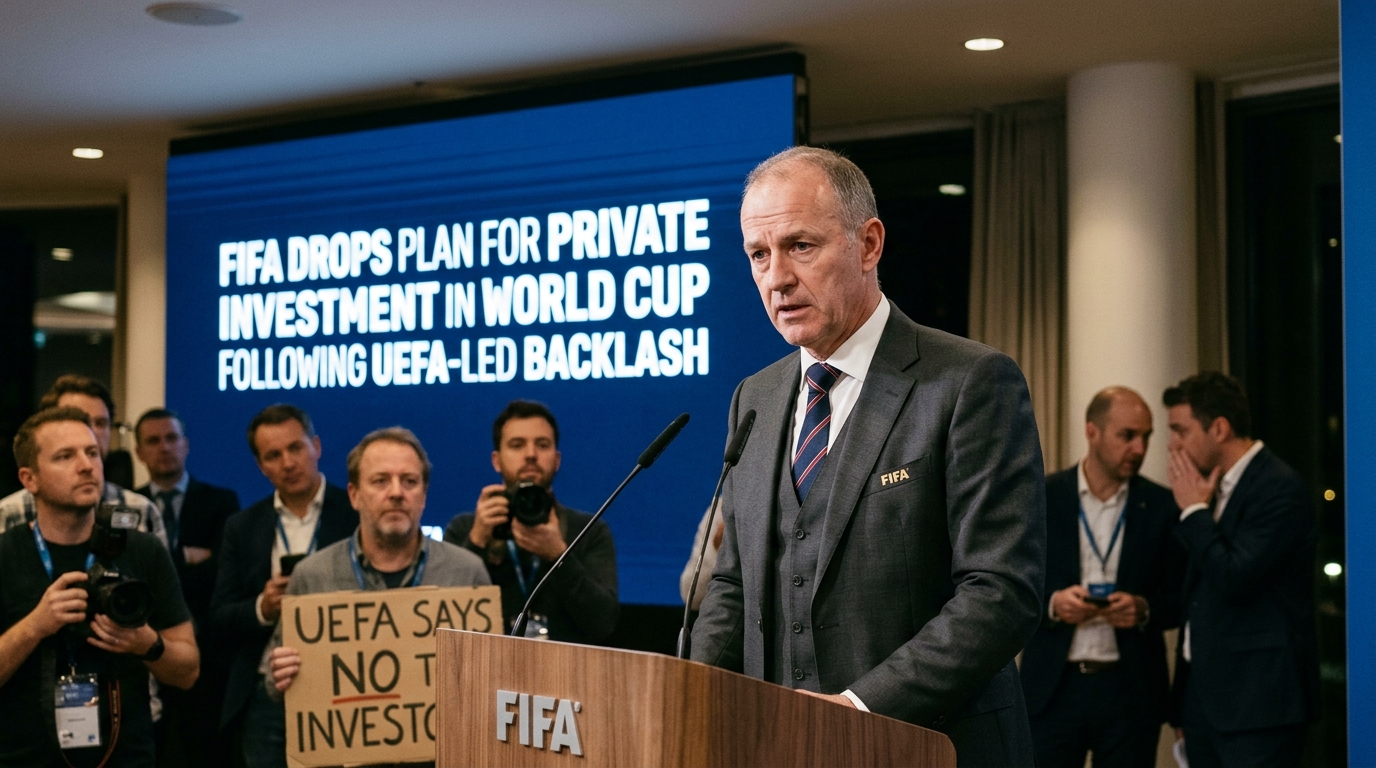
FIFA President Drops Plan to Open World Cup to Private Investors Following Massive UEFA-Led Backlash
For a brief, earth-shaking week in the summer of 2026, global football stood at the absolute precipice of a seismic paradigm shift. Fresh off the heels of a record-breaking World Cup hosted across the United States, Canada, and Mexico—one that hauled in an unprecedented financial windfall exceeding $15 billion—FIFA President Gianni Infantino attempted to execute the most audacious financial restructuring in the history of sports governance.
The Soul of the Game Is Not for Sale: Inside the Spectacular Collapse of FIFA’s $20 Billion World Cup Privatization Bid
The vision? To carve out the crown jewels of international soccer into a standalone, for-profit corporate entity valued at a staggering $20 billion, selling a lucrative 20-percent minority stake to elite private equity.
What followed was an explosive, high-stakes institutional war. It triggered immediate fury across European capitals, a unanimous boycott threat from all 55 member associations of UEFA, high-profile resignations from within FIFA’s inner circle, and a rare, open revolt by political and sporting leaders who declared unequivocally that the world’s most beloved game was not a commodity to be traded on Wall Street.
Just days later, facing an existential crisis that threatened to fracture global sport permanently, Infantino executed a breathtaking political U-turn, officially scrapping the proposal. But as the smoke clears, the fallout leaves a battered governing body, a deeply fractured international community, and a burning question for the future of world football: How did a secretive financial scheme push the beautiful game to the brink of a civil war, and what comes next?
To understand the magnitude of the storm, one must examine the mechanics of the plan that nearly reshaped global soccer. Known internally and publicly as FIFA Forward Enterprise (FFE), the initiative was designed to act as a commercial subsidiary that would take control of revenue-generating global tournaments—most notably the men’s and women’s World Cups, alongside the expanded Club World Cup.
The Financial Blueprint and Wall Street Ties
FIFA had reportedly partnered with financial giant J.P. Morgan to orchestrate the venture. The plan aimed to raise up to $4.2 billion in fresh capital by selling non-controlling equity stakes to carefully selected long-term private investors. Chief among the prospective backers was Thrive Capital, a venture capital firm founded by Joshua Kushner, whose brother, Jared Kushner, is the son-in-law of U.S. President Donald Trump.
To win over the votes required for a scheduled September 19 approval vote, FIFA dangled a transformative financial incentive before its 211 national member associations:
- The Upfront Bonus: Each member association was offered an immediate, one-off payment of $20 million in early 2027 to sign on to the commercial framework.
- Permanently Scaled Funding: Annual distributions under the FIFA Forward development program were slated to leap from the current budgeted $8 million per cycle to a staggering $20 million, with promises of further increases in subsequent cycles.
For smaller and developing football federations across Africa, Asia, Oceania, and parts of the Americas, the offer represented an unprecedented financial injection. For FIFA leadership, it was billed as an engine to supercharge global soccer development. But to critics, critics-in-exile, and major continental confederations, it looked entirely different: an attempt to lock in a permanent system of financial patronage designed to secure Infantino's political hegemony while commercializing the sport’s ultimate public trust.
The Immediate Backlash and Institutional Revolt
The reaction from European football’s governing body was swift and uncompromising. UEFA released a scathing statement describing the proposal as a “shabby, back room, opaque deal” that crossed a line institutional sports bodies should never violate.
"The soul and governance of football are not assets to trade — especially with zero transparency as to who gains financially," UEFA declared. "None of us are the owners of football. It is not FIFA’s to sell."
The resistance quickly escalated from rhetorical condemnation to hard operational threats. Under the leadership of its member associations, UEFA moved to orchestrate a blanket boycott, warning that none of its national teams would participate in any FIFA-administered competition should the privatization plan remain alive. Concurrently, the Asian Football Confederation (AFC), CONCACAF, and the European Club Association (ECA)—representing over 850 elite clubs—voiced deep alarm over being entirely sidelined from a process hatched behind closed doors.
The internal pressure cooker inside FIFA boiled over rapidly:
- High-Level Resignations: Carlos Cordeiro, a senior advisor to Infantino, resigned abruptly in sharp protest, stating publicly that he could not stand by while FIFA considered monetizing a stake in the World Cup.
- Scathing Insider Rebuke: FIFA Chief Operating Officer Kevin Lamour reportedly delivered a sharp critique of the process, reflecting a widespread sentiment among administrators that the project was driven with a "serious lack of respect" for proper governance channels.
- Political Condemnation: High-ranking government figures, including British Prime Minister Andy Burnham, openly criticized the move, reinforcing the public consensus that the World Cup belongs to the global public, not private equity portfolios.
The Climbdown
Recognizing that the friction threatened to permanently fracture international soccer and trigger a catastrophic institutional schism, Gianni Infantino capitulated. In an official statement released on August 1, 2026, the FIFA president announced the immediate termination of the FFE proposal:
"Having listened carefully to all the views, it has become clear that the project has created divisions of a nature that, regardless of the level of support, are no longer in the interest of the objective set out in the first place... Our purpose has always been — and will always be — to unite and improve. As a result, this proposal will not proceed."
While the immediate privatization threat has been neutralized, the political shockwaves are still reverberating through the corridors of Zurich and beyond.
As the dust settles on the aborted $20 billion commercialization plan, sports economists, governance experts, and industry insiders are looking ahead to what this turbulent episode means for the future. While the immediate threat to the World Cup's ownership structure has passed, the underlying commercial and political pressures that birthed the FFE project remain very much alive.
Several potential trajectories and future scenarios are currently being debated across the global sports landscape:
1. The Leadership Crisis & The 2027 Election Outlook
- The Scenario: While Infantino successfully defused the immediate revolt by dropping the plan, institutional trust has been severely compromised. Major federations—particularly within Europe and parts of the Americas—are openly questioning whether the current administration can deliver on transparency promises made a decade ago.
- The Probability: Industry analysts view Infantino's political standing as significantly weakened ahead of his scheduled re-election bid next year. However, given the deep loyalty commanded among numerous smaller member associations who rely heavily on FIFA development grants, a coordinated ousting will require unprecedented cross-continental unity. Observers note that while an immediate resignation is unlikely, the era of unhindered executive maneuvering at FIFA may be drawing to a close.
2. Alternative Commercialization Pathways
- The Scenario: FIFA sits on massive revenue ambitions, especially as tournament expansions (such as the 48-team World Cup and expanding club formats) drive up operational costs while search for matching revenues becomes more complex. Without private equity equity stakes, FIFA may pivot toward more traditional, aggressive commercial channels—such as multi-billion dollar debt financing, bespoke broadcasting packages, or expanded corporate sponsorship tiers—to keep funding distributions high.
- The Probability: Highly likely. The financial expectations of member associations have been whetted by talks of increased funding cycles. FIFA will inevitably need to find creative, less controversial ways to generate liquidity without alienating continental confederations.
3. Structural Governance Reform and Oversight
- The Scenario: The crisis has galvanized calls from national associations and independent bodies for legally binding guardrails that prevent future executive-led attempts to monetize core tournament assets. Proposals are circulating to amend FIFA statutes, ensuring that any future commercial restructuring of international competitions requires a supermajority across all continental confederations rather than a simple majority of member votes.
- The Probability: Moderate to high. UEFA, the AFC, and major European clubs are expected to push hard for institutional checks and balances in upcoming congress meetings, fundamentally altering how major financial decisions are vetted within global soccer.
The dramatic rise and sudden fall of the FIFA Forward Enterprise proposal will be studied for years as a defining moment in modern sports administration. It proved that while global football is a multi-billion-dollar commercial behemoth driven by hyper-lucrative broadcast rights and global sponsorships, its core assets remain anchored by a deep sense of cultural heritage and public stewardship.
For readers, sports enthusiasts, and industry observers, several key variables will dictate the shape of international football over the coming months:
- The Post-Climbdown Dialogue: Watch how FIFA handles its upcoming consultative sessions with continental confederations. Whether genuine reconciliation occurs or underlying resentments fester will define the unity of the sport.
- Financial Adjustments for MAs: Monitor how FIFA plans to bridge the expectation gap for smaller national associations that were anticipating enhanced funding cycles from the aborted commercial venture.
- Internal Opposition Movements: Pay close attention to how European and Asian federations organize institutional oversight to safeguard the traditional governance model against future top-down financial initiatives.
The World Cup remains safe from Wall Street equity portfolios for now, but the battle for the financial and moral soul of international football is far from over.