Category: Security & Regulation || Posted Aug 04, 2026
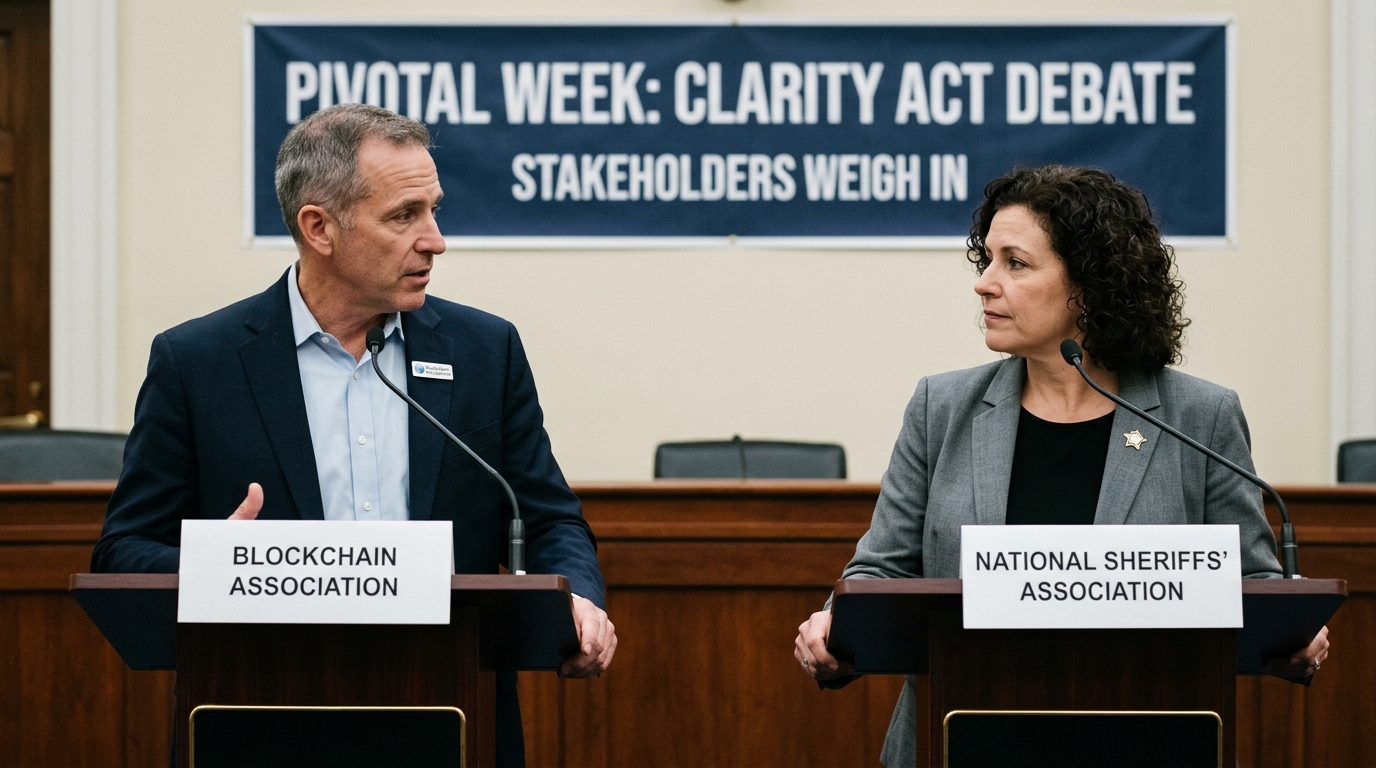
Blockchain Association counters National Sheriffs' group claims as pivotal week for Clarity Act unfolds
The countdown clock in Washington is deafening. With the United States Senate barrelling toward its August recess, lawmakers find themselves trapped in a high-stakes legislative pressure cooker. At the center of the storm is the Clarity Act, the most comprehensive—and intensely contested—federal framework for cryptocurrency regulation in American history. But just days before the Capitol doors are set to lock, a vicious turf war has erupted, pitting the digital asset industry's most formidable lobbying powerhouse against one of the nation's most influential law enforcement coalitions.
On one side stands the National Sheriffs' Association (NSA), warning that the current iteration of the bill could blow a gaping hole in America's financial defenses. On the other is the Blockchain Association (BA), fiercely defending the legislation and aggressively attempting to dismantle the NSA's narrative before a critical procedural vote can be called.
The battleground is the soul of decentralized finance (DeFi). The core conflict revolves around a fundamental question that has haunted the crypto industry for years: How do you regulate neutral, open-source code without suffocating the very innovation that makes it valuable? As the clock ticks down to Friday’s recess, the outcome of this clash could permanently dictate the trajectory of the multi-trillion-dollar digital asset market, determining whether the United States solidifies its position as a global web3 leader or abdicates its throne entirely.
To understand the sheer magnitude of this legislative showdown, we must step away from the political theater and examine the verified factual record. The events of the past week represent a rapid escalation of a long-simmering dispute over how federal anti-money laundering (AML), sanctions, and know-your-customer (KYC) laws should apply to the blockchain ecosystem.
The Sheriffs' Opening Salvo
In late July 2026, the National Sheriffs' Association—an organization representing over 3,000 sheriffs and 10,000 public safety officials—fired a warning shot squarely at Senate leadership. In a formal letter addressed to Senate Majority Leader John Thune and Senate Minority Leader Chuck Schumer, the NSA articulated deep concerns regarding the Clarity Act's regulatory scope.
The crux of the NSA's argument was that the legislation features overly broad carve-outs that would effectively exempt DeFi protocols, blockchain bridges, mixers, and software developers from existing AML and sanctions requirements. The sheriffs warned lawmakers that the bill would leave law enforcement with fewer tools to combat financial crimes, insisting that all entities in the crypto sector must be regulated and that no participant should receive a "blanket exemption".
The Blockchain Association's Counter-Offensive
Recognizing the existential threat these claims posed to the bill's survival in a tight legislative window, the Blockchain Association rapidly mobilized. On Monday, August 3, 2026, the BA delivered a comprehensive eight-page rebuttal to Senators Thune and Schumer, directly contesting the NSA's interpretation of the legislation.
Lindsay Fraser, the BA's chief policy officer, emphasized the urgency of the moment in an interview with The Block, stating, "I think because a vote on the Senate floor is in the near future, it's really important to correct the record on any kind of existing misconceptions about the bill".
According to the factual breakdown provided in the BA's letter, the Clarity Act does not grant blanket immunity to bad actors. Instead, the BA argues the legislation imposes "rigorous obligations" on true intermediaries while carefully parsing the technological realities of blockchain networks.
The Section 10604 Flashpoint
At the heart of this technical dispute is a highly controversial provision known as Section 10604, or the Blockchain Regulatory Certainty Act. This section aims to create a legislative safe harbor for non-custodial developers, clarifying that they are not inherently classified as money transmitters under federal law.
The BA's letter painstakingly reasoned that the law draws a vital legal distinction: it separates entities that exercise "actual control" over customer assets (who must strictly adhere to compliance laws) from the software developers who merely write and publish "neutral software". The BA explicitly stated that individuals who maintain control over supposedly decentralized protocols cannot use the label of "DeFi" to evade regulatory rules under this framework.
A Fractured Law Enforcement Consensus
Perhaps the most striking factual revelation in the BA's counter-argument is the exposure of a deep fracture within the law enforcement community itself. While the NSA vehemently opposes the current draft, the BA documented that the sheriffs' stance does not reflect a unified consensus.
The Blockchain Association highlighted that several heavy-hitting public safety organizations—including the Fraternal Order of Police, the Major Cities Chiefs Association, and the National Organization of Black Law Enforcement Executives (NOBLE)—have actually expressed support for advancing the legislation. Furthermore, the BA pointed to a July letter signed by 160 former law enforcement and national intelligence officials urging Senate leadership to pass the Clarity Act.
The Ticking Clock
The legislative mechanics are moving at a breakneck pace. Lawmakers are scheduled to leave Washington on Friday for the August recess, after which their focus will shift entirely to the November 2026 elections, leaving an incredibly narrow window for passage. Senator Thune has stated he expects to hold a procedural vote ahead of the recess, but as of early August, a final vote date has not been officially scheduled. Complicating matters further, an unresolved bipartisan negotiation regarding ethics language involving the White House remains a final hurdle blocking the bill's path to the floor.
With the facts established, we turn to the horizon. The digital asset market is famously forward-looking, and industry analysts, institutional investors, and compliance experts are aggressively stress-testing potential outcomes. As the Clarity Act enters its most pivotal week, three distinct scenarios are emerging.
Scenario A: The Pre-Recess Breakthrough and Market Euphoria (Best-Case Probability)
Industry analysts are watching to see if the Blockchain Association's counter-letter successfully neutralizes the NSA's concerns among centrist lawmakers, providing Senator Thune with the political cover needed to push a procedural vote through this week.
If a last-minute ethics deal is struck and the bill clears the Senate before Friday, the market reaction could be historic. One potential scenario is a massive influx of sidelined institutional capital pouring into the American digital asset sector. By legally enshrining the distinction between custodial intermediaries and non-custodial software developers, the U.S. would instantly become the most attractive jurisdiction for web3 innovation. Market sentiment suggests this clarity could spark a renaissance in domestic DeFi development, as venture capital firms deploy funds without the lingering fear of retroactive regulatory enforcement against code creators.
Scenario B: The November Limbo (Trend-Driven Probability)
While unproven, many political strategists speculate that the complexity of the DeFi provisions, combined with the lingering ethics debate, may simply require more time than the Friday deadline allows.
If the Clarity Act fails to reach the floor before the August recess, it will be thrust into the unpredictable chaos of the November election cycle. In this scenario, the crypto industry faces a grueling period of uncertainty. Market observers theorize that the legislation could be relegated to a post-election "lame-duck" session. This delay would likely introduce significant volatility to digital asset markets through the fall, as investors price in the risk of the bill being severely diluted, indefinitely shelved, or forced to start over entirely under a new Congress in 2027.
Scenario C: Global Regulatory Arbitrage (Worst-Case Outlook for U.S. Dominance)
If the law enforcement pushback spearheaded by the NSA successfully demonizes the DeFi safe-harbor provisions, some analysts foresee a scenario where the Clarity Act is stripped of Section 10604 entirely.
Should the legislation be altered to classify neutral software developers as money transmitters, the consequences could be severe. Industry experts hypothesize that such an outcome would trigger an immediate and aggressive brain drain. Developers, node operators, and protocol architects would likely accelerate their migration out of the United States, seeking refuge in jurisdictions with firmly established, innovation-friendly frameworks, such as the European Union under its MiCA regulations or emerging hubs in the Middle East and Asia.
The clash between the National Sheriffs' Association and the Blockchain Association is far more than a routine lobbying dispute; it is a proxy war for the future of digital sovereignty, financial privacy, and technological innovation. The Clarity Act represents the federal government’s first genuine attempt to comprehensively regulate an industry that was explicitly designed to operate outside traditional perimeters.
As this pivotal week unfolds, readers and market participants should closely monitor a few critical variables. First, watch the status of the unresolved ethics language negotiations with the White House—a breakthrough here is the prerequisite for any floor action. Second, monitor Senator Thune’s scheduling decisions; if a procedural vote is officially calendared before Friday, it signals that leadership believes they have the votes to overcome the law enforcement objections. Finally, observe whether any additional law enforcement agencies break ranks to publicly support or oppose the NSA's position, as this internal consensus will heavily sway undecided lawmakers.
The era of regulatory ambiguity is ending. Whether the Clarity Act passes on Friday, stalls until winter, or fractures under the weight of its own ambition, the foundational rules of the global digital economy are being written right now.
Editorial Disclaimer: This article is strictly for informational, educational, and analytical purposes. It does not constitute financial, legal, tax, or investment advice. Market predictions, geopolitical scenarios, and hypothetical outcomes represent qualitative policy analysis, not guaranteed future results. Readers should conduct independent research and consult qualified legal and technical professionals before making operational decisions regarding cryptocurrency or digital assets.
Understanding Law Enforcement Support for the Clarity Act
This video breaks down the recent endorsement of the Clarity Act by major law enforcement organizations like NOBLE, providing crucial context on the divided consensus discussed in the dueling letters.