Category: Security & Regulation || Posted Aug 07, 2026
The $942 Million Wake-Up Call: Meta’s Court Loss and the Dawn of Hardcoded Child Safety
The era of unregulated, algorithmic engagement at the expense of youth mental health may have just slammed into a $942 million brick wall.
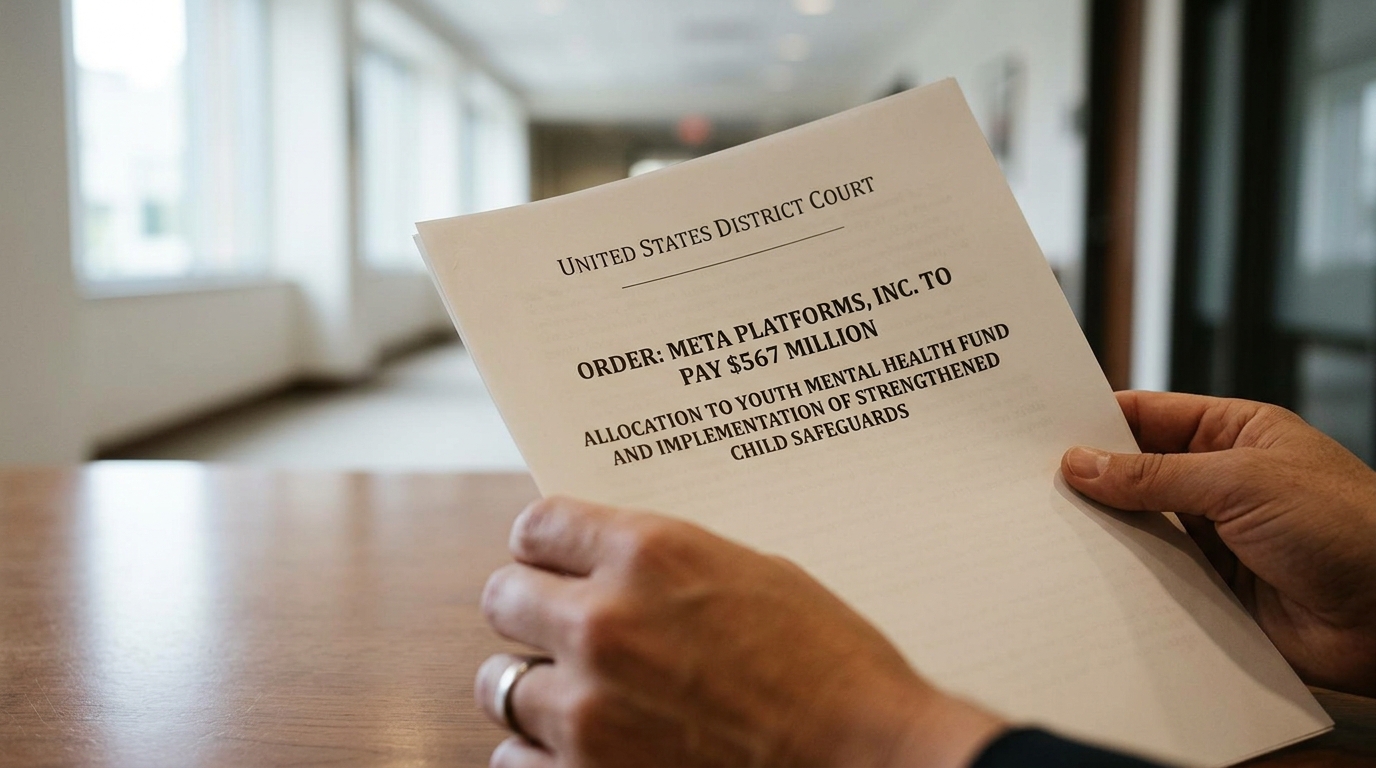
For over a decade, social media giants have operated under a foundational Silicon Valley ethos: design for maximum attention, keep users scrolling, and deal with the societal fallout later. But the bill for that prolonged "attention economy" experiment has finally come due, and it is carrying an unprecedented price tag. In a sweeping, landmark ruling from a New Mexico state court on Thursday, Meta—the parent company of Facebook and Instagram—was ordered to pay an eye-watering $567 million into a youth mental health fund and fundamentally overhaul how its platforms interact with minors.
Coupled with a $375 million jury penalty levied against the tech behemoth earlier this year, the total financial blow now approaches $1 billion. But the financial sting is arguably the least of Meta's problems. Judge Bryan Biedscheid did not just hit the company's wallet; he targeted the very architecture of its platforms. By declaring that Meta created a "public nuisance" akin to noxious industrial pollution, the court has set a perilous new legal precedent.
As a wave of similar lawsuits from states, school districts, and grieving families prepares to crash down on the tech industry, the New Mexico ruling serves as a massive flare in the night sky. The rules of engagement have changed. The courts are no longer accepting "terms of service" updates as a substitute for real protection. We are witnessing the first forceful mandate to hardcode child safety directly into the digital infrastructure of the internet.
To grasp the full impact of this seismic legal shift, we must separate the emotional rhetoric from the verified facts established in the New Mexico courtroom. The ruling is the culmination of a two-phase legal battle spearheaded by New Mexico Attorney General Raúl Torrez, and it introduces some of the most aggressive, court-mandated product changes in the history of social media.
The Financial Redress and the "Public Nuisance"
The financial structure of the ruling is highly specific. The $567 million order is not a generic government fine; it is specifically earmarked for remediation. According to the court's mandate, $420 million will be aggressively deployed over the next five years to fund direct clinical and behavioral treatment services for young people in New Mexico whose mental health has been affected. The remaining funds will support sweeping awareness campaigns, prevention initiatives, and screening services.
The legal mechanism used to justify this payout is deeply significant. During this second phase of the trial, Judge Biedscheid ruled that Meta’s platforms constituted a "public nuisance". The judge drew a direct, chilling parallel between physical environmental damage and digital harm, stating that the negative effects of Meta's platforms "migrate to the internet as a whole and, perhaps most concerning, to the real world and create a common, societal burden" on children, families, schools, hospitals, and law enforcement.
This follows the devastating first phase of the trial in March 2026, where a jury slapped Meta with a $375 million penalty after concluding the company violated consumer protection laws by knowingly harming children's mental health and concealing its knowledge regarding child sexual exploitation on its platforms.
The Mandatory Architectural Shifts
The most disruptive element of the court order lies in the mandatory product changes Meta must implement for users in New Mexico over the next five years. The court has effectively rewritten Meta's product roadmap for the state.
- Notification and Usage Limits: Meta is now ordered to enforce a digital curfew. Push notifications for users under 18 must be disabled from 8 a.m. to 3 p.m. on weekdays during the school year, and from 10 p.m. to 7 a.m. otherwise.
- Default Privacy and Account Purges: Teen accounts in the state must be set to private by default. Furthermore, the company must actively delete the accounts of users known to be under 13, along with all personal information collected from them.
- AI Safeguards and Adult Contact Controls: The court mandated tighter controls restricting adult contact with minors, enhanced safeguards for AI chatbots, and a more rigorous review process for reports of child sexual abuse.
- The COPPA Paradox and AI Age Prediction: In a fascinating twist of legal irony, the court acknowledged that federal children's privacy laws—specifically the Children’s Online Privacy Protection Act (COPPA)—actually prevented the judge from ordering mandatory, hard age-verification systems (like requiring ID uploads) for children under 13, as it would require the platform to illegally collect more personal data. Instead, the court ordered Meta to rely on artificial intelligence. Meta has two years to develop a dedicated “under-13-years-of-age prediction model” that uses behavioral signals (like friend networks and content consumption) to identify and boot underage users. The company must also establish a reporting portal in partnership with schools to allow educators to flag underage accounts.
Meta, for its part, has strongly disagreed with the ruling and vowed to appeal. A company spokesperson asserted that Meta works diligently to keep users safe, has been transparent about the challenges of moderating bad actors, and will continue to defend itself against claims it believes misrepresent the facts.
As the dust settles on the New Mexico courthouse, the digital landscape is bracing for the aftershocks. The digital asset and tech communities are intensely forward-looking, and industry analysts are currently mapping out exactly how this $942 million precedent will ripple outward. What happens next will define the internet for the next generation.
Scenario A: The Domino Effect and National Product Redesign (Trend-Driven Probability)
Industry analysts are watching to see if the New Mexico ruling acts as a catalyst for a massive, nationwide structural change at Meta and other tech firms. Meta is already staring down the barrel of a multi-district federal lawsuit in Oakland, California, where it faces claims from dozens of states regarding youth mental health.
One potential scenario is that creating a hyper-regulated, isolated product ecosystem strictly for New Mexico residents becomes a logistical nightmare for Meta's engineering teams. Rather than maintaining a fragmented platform where teenagers in Albuquerque have drastically different app experiences than teenagers in Phoenix, market sentiment suggests Meta might eventually capitulate and roll out these stringent safety features—such as nighttime notification blocks, default private accounts, and aggressive AI age-prediction models—as a universal standard across the entire United States. If this occurs, the New Mexico AG will have effectively successfully legislated product design for the entire country through the court system.
Scenario B: The Age of Verification and the End of Anonymity (The Technological Outlook)
Market observers speculate that this ruling will accelerate the deployment of sophisticated, AI-driven behavioral tracking. Because the court noted that COPPA prevents platforms from demanding hard ID for age verification, the tech industry must rely on "age assurance" algorithms. wfmynews2.com
While unproven, some privacy advocates theorize that forcing platforms to build advanced prediction models to guess a user's age based on their interactions, friend groups, and content consumption will result in an even deeper level of surveillance. In a bid to protect children, we may inadvertently mandate that tech companies monitor user behavior with unprecedented, granular intensity. Analysts hypothesize that this will spur a massive boom in the "RegTech" (Regulatory Technology) sector, as third-party companies rush to develop and license AI age-verification tools that comply with these new, complex legal mandates without violating federal privacy laws.
Scenario C: The Appellate Gauntlet and the Legal Quagmire (Worst-Case for Advocates)
Some legal experts foresee a scenario where the impact of the New Mexico ruling is severely delayed or ultimately diluted. Meta’s legal war chest is vast, and the company has explicitly stated its intention to appeal. Anadolu Ajansı
In this scenario, Meta will likely argue that holding a platform liable as a "public nuisance" for the mental health of its users violates Section 230 of the Communications Decency Act and sets a dangerous standard for free expression. If appellate courts agree that Judge Biedscheid overstepped by effectively dictating software design, the mandated changes could be stayed (paused) for years while the case grinds its way to the Supreme Court. Strategists suggest that a prolonged appeals process would maintain the status quo, leaving states and school districts to fight agonizing, expensive, state-by-state battles while the underlying architecture of social media remains largely unchanged.
The $942 million judgment against Meta in New Mexico is a watershed moment in the history of consumer technology. It officially marks the transition from an era where social media harms were treated as unfortunate side effects to an era where they are litigated as direct, actionable damages—akin to environmental pollution. The Guardian+ 1
For market participants, parents, and technology professionals navigating this rapidly shifting landscape, the key variables to watch are clear.
First, closely monitor the appellate courts. The speed and success of Meta's appeal will dictate whether other states view the "public nuisance" strategy as a viable blueprint. Second, watch the upcoming federal trial in Oakland, California, where the sheer volume of plaintiffs (dozens of states) could force a national settlement that fundamentally alters the digital economy. Finally, track the development of Meta’s mandated "under-13 prediction model"; the success or failure of this AI tool will likely establish the new industry standard for how the internet handles the messy, complex reality of age verification. Indiatimes
The wild west of algorithmic engagement is facing its most serious reckoning yet. Whether the courts ultimately force a total rebuild of our digital public squares or simply extract massive financial tolls along the way, one thing is certain: the true cost of the attention economy has finally been quantified, and the bill is staggering.
Editorial Disclaimer: This article is strictly for informational, educational, and analytical purposes. It does not constitute financial, legal, psychological, or investment advice. Market predictions, legal scenarios, and hypothetical outcomes represent qualitative policy analysis, not guaranteed future results. Readers should conduct independent research and consult qualified legal and technical professionals before making operational or investment decisions regarding the technology sector.