Category: Security & Regulation || Posted Aug 10, 2026
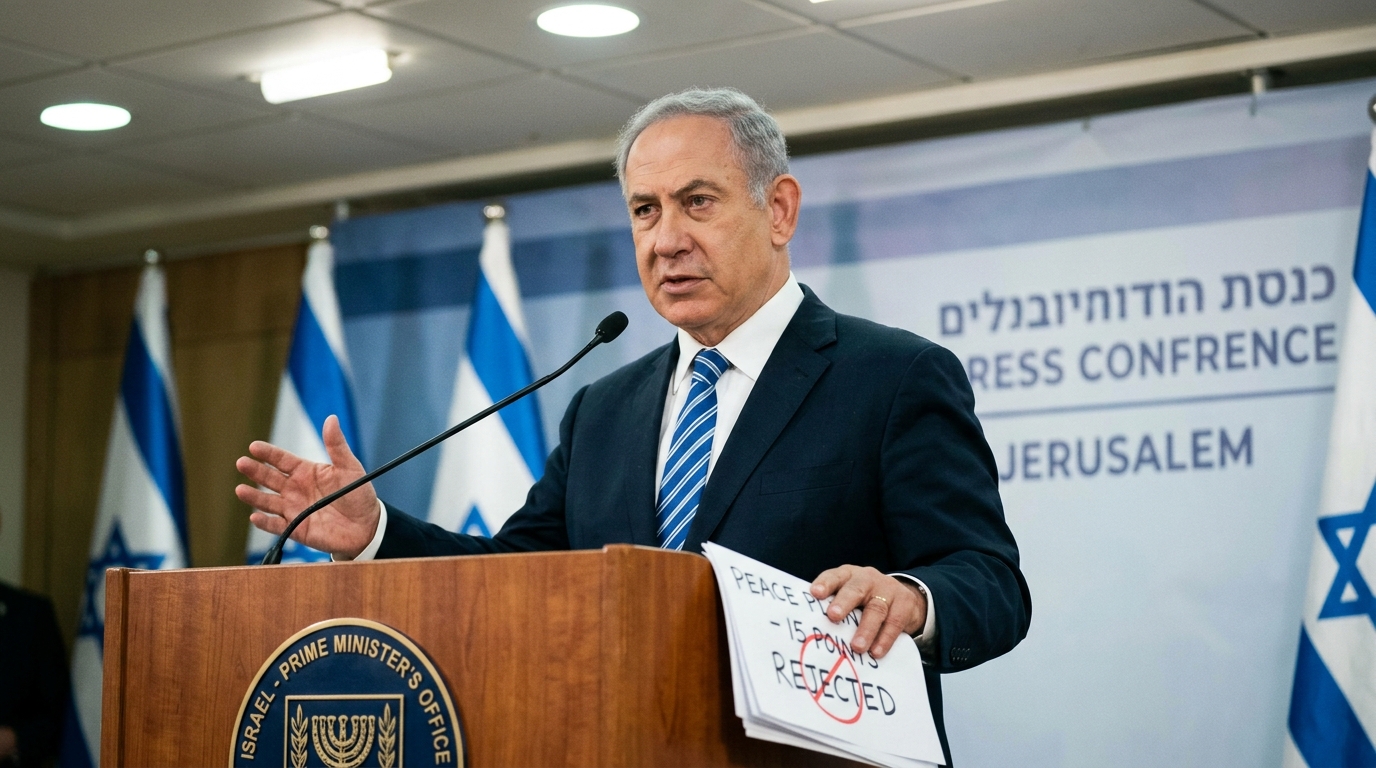
Israeli Prime Minister Netanyahu Rejects Board of Peace's 15-Point Plan, Insisting on Complete Hamas Disarmament
The Ultimate Collision: Netanyahu, Trump’s Board of Peace, and the Battle Over Gaza’s Future
The illusion of an easy diplomatic finish line has just shattered against the rocks of political reality.
For weeks, international headlines celebrated what was billed as a historic breakthrough: a US-backed, 15-point roadmap engineered by the newly established "Board of Peace" to finally draw down the grueling conflict in Gaza. Promoted as a masterstroke of international diplomacy, the framework promised a phased Israeli military withdrawal met by the disarmament of Hamas and a transition of power to a new Palestinian technocratic administration.
Yet, any premature sighs of relief from Washington were cut brutally short. Standing before his weekly cabinet meeting, Israeli Prime Minister Benjamin Netanyahu delivered a blunt, unvarnished rejection of the plan, issuing a direct challenge to the U.S. administration and drawing a hard, unyielding line in the sand.
With this public break, Netanyahu has upended months of delicate behind-the-scenes maneuvering. By insisting that the Israel Defense Forces (IDF) will not yield an inch of territory or execute a single withdrawal until Hamas is completely and genuinely stripped of every heavy and light weapon, the Israeli leader has plunged regional geopolitics back into high-stakes volatility. As domestic political pressures mount and Washington weighs its next move, the collision between the Board of Peace's phased ideals and Israel’s maximalist security demands has set the stage for a geopolitical showdown of historic proportions.
To understand the immense friction shaking the diplomatic corridors of Washington, Jerusalem, and Cairo, we must separate the high-level political posturing from the hard, verifiable facts on the ground.
The Anatomy of the 15-Point Plan
The conflict centers on a 15-point roadmap drafted earlier this year by Nickolay Mladenov, the High Representative for Gaza under the international "Board of Peace," and formally championed by U.S. President Donald Trump. The framework was designed to untangle the post-war governance of the Gaza Strip through a sequence of synchronized milestones:
- Phased Disarmament: The gradual surrender of Hamas’s military infrastructure.
- Mirrored Pullback: A phased military withdrawal of the IDF from population centers and strategic corridors in the Gaza Strip.
- Technocratic Transition: The eventual handover of civil administrative duties to an independent Palestinian National Committee or technocratic body.
While U.S. officials previously claimed that both sides had signaled alignment with the framework, structural disagreements over the sequence of events proved fatal.
Netanyahu’s Absolute Line in the Sand
Speaking directly to his cabinet ministers, Netanyahu made it unmistakably clear that Israel rejects the timeline and structure of the 15-point document.
"Israel rejects the 15-point Gaza document proposed by the Board of Peace," Netanyahu declared. "The IDF will not carry out any withdrawal until Hamas is genuinely disarmed. And when I say the disarming of Hamas, it means heavy weaponry, lighter weaponry, all weaponry. And we are talking about genuine disarmament, not fictitious disarmament."
Netanyahu emphasized that Israeli forces—which security estimates place in control of roughly 70 percent of the Gaza Strip—will continue active military operations to thwart threats, completely bypassing the parallel concessions envisioned by international mediators. Furthermore, the Prime Minister doubled down on his long-standing ideological stance, explicitly ruling out the creation of a Palestinian state in Gaza or the West Bank under his watch.
The Counter-Positions: Hamas and Washington
The Israeli rejection creates an acute diplomatic crisis for the U.S. administration, which had publicly hailed the framework as a major milestone.
Meanwhile, Hamas officials have maintained their own strict conditions. Representatives for the militant group have insisted that any discussion of surrendering weaponry is strictly contingent upon Israel first fulfilling prior obligations—including a permanent cessation of hostilities, a full IDF withdrawal, and the unrestricted influx of humanitarian aid and reconstruction materials into the devastated enclave.
Caught in the middle, international mediators are watching a fragile, post-ceasefire landscape threaten to unravel entirely as all primary actors retreat into maximalist corners.
With the diplomatic tracks officially derailed, the international community is bracing for the fallout. Analysts and regional experts are actively mapping out how this high-stakes standoff could evolve over the coming months.
Scenario A: The Standoff Deepens and Diplomatic Paralysis Takes Hold (Trend-Driven Probability)
Industry analysts are watching to see if the public rupture between Netanyahu and the U.S.-led Board of Peace results in a protracted diplomatic freeze.
One potential scenario is that Washington, facing domestic political cycles and competing foreign policy crises, scales back its active mediation efforts, leaving the parties trapped in a status quo of low-intensity conflict and military occupation. In this environment, market and political sentiment suggests that Israel will maintain its operational freedom in Gaza indefinitely, while domestic hardliners within Netanyahu’s coalition solidify their influence, shelving any comprehensive international reconstruction frameworks for the foreseeable future.
Scenario B: Backchannel Compromise and Phased Security Guarantees (Best-Case Probability)
While unproven, some diplomatic insiders speculate that Netanyahu’s public rejection is primarily a domestic political maneuver—designed to appease right-wing coalition partners ahead of upcoming electoral pressures—while leaving room for quiet, behind-the-scenes renegotiation.
Market observers theorize that U.S. and regional intermediaries (such as Egypt and Qatar) could work to restructure the 15-point plan, front-loading verifiable verification mechanisms for disarmament. If a formula can be found that satisfies Israel’s demand for absolute security without requiring a simultaneous, unconditional IDF retreat, a modified version of the transition roadmap could be resurrected in late 2026.
Scenario C: Regional Escalation and Multi-Front Fracture (Worst-Case Outlook)
If the breakdown of the Board of Peace framework completely destroys trust between Washington and Jerusalem, some geopolitical experts foresee a scenario where the diplomatic vacuum is filled by renewed military escalation.
Without a political horizon or an agreed-upon governance structure for post-war Gaza, the risk of structural collapse expands outward. Analysts hypothesize that a total failure of the peace framework could trigger fresh waves of regional instability, intensifying flare-ups across northern borders and deeply complicating ongoing international efforts to contain wider Middle Eastern conflicts.
Benjamin Netanyahu’s outright rejection of the Board of Peace’s 15-point plan marks a watershed moment in the post-2023 geopolitical landscape. By explicitly stating that no withdrawal will occur until every weapon is cleared from Hamas's hands, and by slamming the door on a future Palestinian state, the Israeli leadership has drawn a bright, uncompromised red line that directly challenges international mediation efforts.
For international observers, policy analysts, and citizens tracking the region, the coming weeks will hinge on a few critical variables:
- Washington’s Response: How the U.S. administration chooses to handle this rare, public defiance from its closest Middle Eastern ally.
- Internal Israeli Coalition Dynamics: Whether Netanyahu’s hardline stance successfully insulates him from political threats on his right flank, or if it accelerates internal government instability.
- The Ground Reality: Whether the ongoing military operations in Gaza permanently foreclose any future possibility of a technocratic administrative transition.
The blueprint for peace in Gaza has hit a brick wall. What happens next will dictate not only the fate of the enclave, but the future architecture of international diplomacy in the Middle East.