Category: Opinion & Analysis || Posted Aug 07, 2026
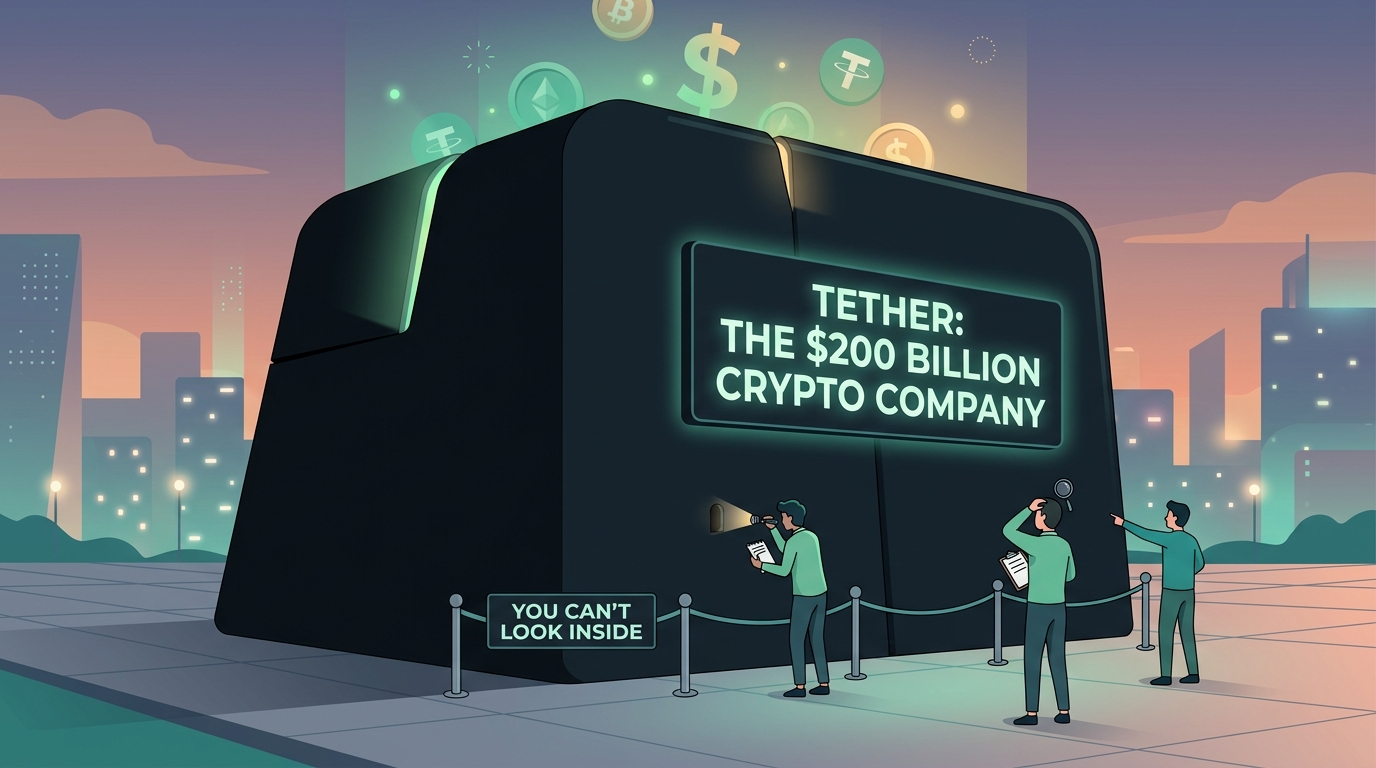
Tether: The $200 Billion Crypto Company You Can't Look Inside
Imagine a corporate entity that generates more annual net profit than BlackRock or Goldman Sachs, maintains a workforce smaller than a typical regional high school, and holds a portfolio of U.S. Treasury debt larger than that of entire sovereign nations like Germany, Australia, or the UAE.
Now imagine that this same entity operates largely outside the traditional Western banking apparatus, sits incorporated across offshore jurisdictions, and issues a private digital currency that serves as the undisputed monetary lifeblood for millions of citizens across inflation-ravaged developing economies.
Welcome to the paradoxical world of Tether (USDT).
Approaching a colossal $185 billion to $200 billion market capitalization, Tether has evolved from a controversial crypto-exchange lubricant into a systemic geopolitical force. It functions as a de facto shadow central bank for the digital asset ecosystem and global emerging markets. Yet, despite its planetary footprint, Tether remains one of the most secretive, tightly held, and endlessly debated companies in modern economic history.
How did a firm with fewer than 100 employees build a global financial engine of this magnitude? What actually backs the digital dollars underpinning global crypto trade? And what happens to the world economy if this offshore juggernaut encounters an unprecedented liquidity shock?
To understand Tether, one must set aside the online tribalism surrounding cryptocurrency and analyze the company strictly through the lens of institutional finance, market structure, and balance sheet mechanics.
1. The Ultimate Arbitrage: How $185+ Billion Generates Billions in Profit
At its core, Tether’s fundamental business model is deceptively simple—and astonishingly lucrative.
When a trader in Istanbul, a importer in Buenos Aires, or an institutional desk in Singapore wants digital dollars, they deposit fiat U.S. dollars (or cash equivalents) with Tether. In return, Tether mints and issues an equivalent amount of USDT—a digital token pegged 1:1 to the U.S. dollar on public blockchains like Tron and Ethereum.
Tether pays zero interest to the holders of USDT. However, Tether takes the billions of real fiat U.S. dollars deposited by customers and invests them into high-yielding, short-term income assets—primarily U.S. Treasury Bills.
When interest rates sit elevated, holding nearly $115 billion in U.S. Treasuries generates a massive, automated cash harvest. In 2025, Tether reported full-year net profits exceeding $10 billion. For context, that puts Tether’s profit-per-employee metrics off any chart known to traditional corporate finance.
2. Dissecting the Balance Sheet: Gold, Bitcoin, and the Volatile Buffer
For years, critics insisted Tether was printing tokens out of thin air without reserves. In response, Tether engaged BDO Italia to issue quarterly independent attestation reports. While these attestations are not full traditional financial audits, they provide a documented window into Tether’s holdings.
According to Tether's Q2 2026 attestation data:
- Total Consolidated Assets: ~$187.75 billion
- Total Liabilities (Circulating USDT): ~$183.64 billion
- Net Excess Reserve Cushion: ~$4.11 billion
While the firm's vast Treasury bill position provides deep short-term liquidity, the internal composition of Tether’s reserves has evolved significantly. Tether has systematically deployed profits to purchase non-fiat, hard reserve assets:
- Physical Gold: Over 146 metric tons of gold valued at approximately $18.84 billion.
- Bitcoin: Approximately 98,933 BTC valued at roughly $5.80 billion.
The Cushion Dynamics: Mark-to-Market Realities
This diversification introduces a unique financial dynamic. Between early 2026 and mid-2026, Tether’s excess reserve buffer declined from $8.23 billion to $4.11 billion. This shift occurred not because Tether lost cash, but because market values for gold and Bitcoin fluctuated downward during that window.
Because Tether’s non-fiat reserve assets are marked to market, drops in gold or crypto prices directly shrink the excess capital buffer protecting USDT holders from redemptions.
Interactive Reserve Buffer Simulator
The simulator below models how mark-to-market fluctuations in gold and Bitcoin prices affect Tether's net excess reserve cushion.
3. Wall Street Alliances and the Audit Dilemma
For years, mainstream observers asked a fundamental question: Where are the U.S. Treasuries actually kept?
That mystery was largely resolved through Tether’s institutional relationship with Cantor Fitzgerald, the prestigious Wall Street brokerage firm. Cantor Fitzgerald serves as a key custodian holding the vast majority of Tether's U.S. Treasury portfolio. This partnership provided Tether with a crucial link to U.S. capital markets.
Simultaneously, pressure from global rating agencies and institutional investors forced Tether to pursue deeper accounting transparency. In late 2025, S&P Global lowered USDT's stability rating to '5 (weak)' due to its exposure to higher-risk non-cash assets. In response to growing institutional demands, Tether initiated a transition toward a full third-party audit with KPMG.
4. Regulatory Balkanization: MiCA, the GENIUS Act, and the El Salvador Pivot
As Tether grew, world governments split into distinct camps regarding how to handle a $185+ billion unregulated private currency.
- The European Union (MiCA Compliance): Under the EU’s Markets in Crypto-Assets (MiCA) regulation, stablecoin issuers are required to hold at least 60% of their reserves in accredited European bank deposits. Tether CEO Paolo Ardoino publicly rejected this requirement, warning that forcing vast cash holdings into fractional-reserve European banks introduces systemic bank-run risks. As a consequence, major European crypto exchanges delisted USDT for EU residents, opening room for fully compliant competitors like Circle's USDC to capture European regulated trading volume.
- The United States (GENIUS Act Framework): The passage of federal legislation—including the landmark GENIUS Act—established the first unified federal regulatory architecture for payment stablecoin issuers in the U.S. While creating paths for domestic issuers, U.S. regulators have tightened oversight on foreign-domiciled reserve models.
- The Offshore Pivot (El Salvador): Rather than bending to Western financial constraints, Tether doubled down on jurisdiction-shifting. Obtaining a Digital Asset Service Provider license in El Salvador, Tether relocated key operational structures and corporate leadership to the Latin American nation, aligning itself directly with sovereign nation-state crypto initiatives. Wikipedia
5. Sovereign Empire-Building: Reinvesting Profits Beyond Crypto
Tether is no longer just a stablecoin company; it is transforming into a multi-sector technology conglomerate. Operating under the principle that excess profits should fund sovereign technology resilience, Tether has deployed billions into strategic sectors:
| Sector | Primary Investment / Project | Strategic Objective |
| Artificial Intelligence | Northern Data ($1B+ investment) | Acquiring high-density GPU cluster infrastructure for decentralized AI training. |
| Neurotech | Blackrock Neurotech ($200M majority stake) | Developing brain-computer interfaces (BCI) competing with Neuralink. |
| Green Energy & Mining | Volcano Energy (El Salvador) / Uruguay Sustainable Infrastructure | Harnessing geothermal and renewable energy sources for sovereign Bitcoin mining. |
| P2P Communications | Holepunch Protocol | Building fully encrypted, peer-to-peer, serverless communication tools. |
Looking forward, Tether stands at an unprecedented crossroad. How will this private monetary empire fare in an era defined by central bank digital currencies (CBDCs), aggressive Western regulation, and geopolitical realignments?
The following scenarios highlight potential future trajectories for Tether and the broader stablecoin landscape.
Scenario A: The Sovereign Digital Standard (Bull Trajectory)
- Analytical Context: Industry observers note that despite regulatory friction in Europe, global demand for physical and digital U.S. dollars in developing nations continues to grow rapidly.
- Potential Outcome: In this scenario, Tether solidifies its position as the default, parallel monetary system for emerging economies across Latin America, Africa, Southeast Asia, and Eastern Europe. As local fiat currencies face inflationary pressure, millions of unbanked citizens bypass local banking systems entirely, conducting daily commerce in USDT.
Simultaneously, U.S. fiscal authorities may recognize that Tether’s massive T-bill appetite acts as a crucial structural buyer for expanding national debt. Tether becomes an indispensable, offshore engine of U.S. dollar hegemony—effectively acting as a private monetary ambassador for the U.S. dollar without requiring U.S. taxpayer backing.
Scenario B: Regulatory Balkanization (Base Trajectory)
- Analytical Context: Market data reveals a widening divide between G7-regulated onshore exchanges and offshore, peer-to-peer liquidity networks.
- Potential Outcome: Rather than a single global stablecoin market, the world economy splits permanently into a two-tier system:
- The Regulated G7 Sphere: Fully licensed, bank-backed tokens like Circle’s USDC and bank-issued euro stablecoins dominate institutional settlement, Wall Street trading, and European commerce.
- The Offshore Emerging Sphere: Tether retains dominant market share across peer-to-peer networks, trade finance in developing nations, and non-G7 crypto venues where strict bank-reserve mandates do not apply.
This balkanization allows Tether to thrive as an offshore financial utility while sacrificing formal market access to regulated Western banking channels.
Scenario C: The Mark-to-Market Stress Test (Bear Trajectory)
- Analytical Context: Risk management analysts point out that holding non-fiat assets like Bitcoin and physical gold creates price sensitivity on the balance sheet.
- Potential Outcome: If macro-economic shocks cause a simultaneous steep drop in gold and Bitcoin prices, Tether’s net excess reserve buffer could face severe compression. If that mark-to-market decline occurs alongside a sudden, high-volume redemption demand from institutional token holders, Tether could experience a liquidity mismatch.
While its core U.S. Treasury holdings provide short-term liquidity, managing large-scale redemptions during asset price drops would test the operational strength of its risk management architecture.
Tether is no longer just a story about cryptocurrency; it is a story about the changing nature of money, sovereignty, and international finance in the 21st century.
It represents a historic financial anomaly: a private company operating from small jurisdictions that commands sovereign-scale capital, influences U.S. debt markets, and provides monetary plumbing for global trade. Pluang
Key Variables for Market Observers to Watch Next:
- 1. Completion of the KPMG Full Audit: Tracking whether the ongoing full financial audit provides definitive verification of asset custody and legal ownership standards.
- 2. Excess Reserve Cushion Trajectory: Monitoring quarterly BDO attestations to observe whether Tether’s excess buffer recovers back toward historical highs or narrows under mark-to-market shifts.
- 3. Market Share Shifts Post-MiCA: Watching whether regulated alternatives continue gaining ground in European and G7 trading venues or if Tether's dominance in emerging markets offsets Western exchange delistings.
- 4. Strategic Reinvestment Pacing: Following how Tether's multi-billion-dollar profit allocations into AI infrastructure, energy grids, and neurotechnology reshape its identity from a pure stablecoin issuer into a global technology holding company.
Disclaimer: This article is strictly for informational, educational, and editorial purposes and does not constitute financial, legal, tax, or investment advice. All financial figures, balance sheet metrics, and regulatory references reflect verified public attestations and reporting as of mid-2026.