Category: Global politics || Posted Aug 07, 2026
Houthi Rebels Kill Dozens of Saudi-Backed Yemeni Government Forces in Missile and Drone Attacks
The Middle East is defined by its volatile fault lines, and none are as consequential to global stability as the jagged mountains and strategic coastlines of Yemen.
For four years, the international community held its breath, observing a fragile, UN-brokered truce that kept one of the globe's most devastating civil wars on a precarious pause. But in the unpredictable theater of Middle Eastern geopolitics, peace is often just the quiet period used to reload and recalibrate. That quiet has officially ended in a barrage of fire and steel. In a sudden, devastating escalation that threatens to redraw the regional map and severely disrupt global trade, Iran-aligned Houthi rebels have launched a highly coordinated, deadly assault on Saudi-backed Yemeni government forces.
The stakes could not be higher. This is not a localized skirmish; it is a violent resumption of a proxy war that acts as the geopolitical fulcrum between the United States, Saudi Arabia, Iran, and Israel. As global powers grapple with intersecting crises, the abrupt reignition of the Yemeni civil war introduces a volatile new variable that threatens to set the entire Arabian Peninsula ablaze. The illusion of stability has evaporated, leaving behind a stark, blood-soaked reality that demands immediate global attention.
The Reality: Anatomy of a Coordinated Strike
The factual record of the recent escalation paints a grim picture of military precision and devastating human cost. On Thursday, August 6, 2026, Houthi forces launched a series of surprise drone and ballistic missile strikes targeting military installations in Yemen’s Marib and Hadramawt provinces. Saudi Gazette
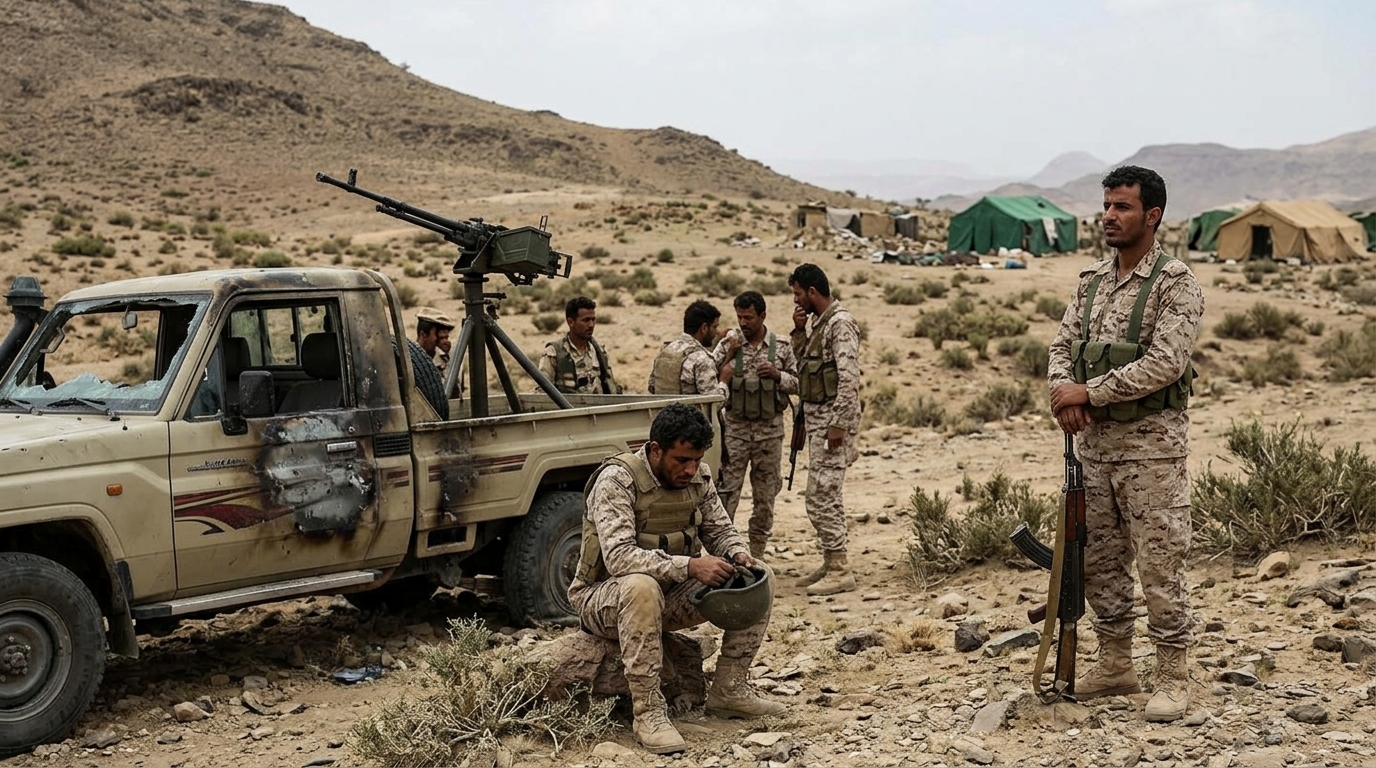
The attacks were ruthlessly timed. One of the ballistic missiles struck government troops during their highly vulnerable morning formation. The primary targets were camps belonging to the 1st and 3rd Yemeni Emergency Force divisions—units that fight under the banner of the internationally recognized Presidential Leadership Council (PLC) and are heavily financially backed by Saudi Arabia.
Ground Zero: Marib and Hadramawt
The geography of the strikes is highly significant. According to multiple military and medical sources on the ground, the coordinated assault hit the al-Ruwaik area in central Marib, as well as the Al-Abr and Al-Wadiah areas in Hadramawt, which sit strategically close to the Saudi border. Marib has long been the last major northern stronghold for the internationally recognized government, serving as an energy-rich prize that the Houthis have coveted for years. Hadramawt, a massive eastern expanse, is critical for logistics and territorial continuity.
According to verified reports, the strikes killed at least 45 to 58 Yemeni government troops, while leaving approximately 80 others wounded. This staggering casualty count makes it unequivocally the deadliest strike against the internationally recognized Yemeni government since the UN-brokered truce was established in 2022.
The Cross-Border Spillover
The escalation was not contained within Yemen's borders. In a separate, simultaneous incident, Saudi officials reported that Houthi forces indiscriminately shelled the southern Najran region in Saudi Arabia. Major General Turki al-Maliki, spokesperson for the Saudi-led military coalition, confirmed that this cross-border attack injured 11 civilians—including seven Saudi nationals, one Yemeni, two Egyptians, and one Pakistani expatriate. Tragically, the victims included a four-year-old child who sustained second-degree burns.
The official rhetoric immediately following the bloodshed has been uncompromising. Houthi military spokesman Yahya Saree publicly claimed responsibility for the strikes, framing the deadly barrage as a preemptive measure. Saree alleged that the Houthis had observed “large Saudi military build-ups in their final stages” and issued a stark warning for remaining troops in PLC camps to defect and flee before further attacks. India Today
Conversely, the Yemeni Defense Ministry condemned the assault as a "treacherous attack," vowing in a formal statement that its armed forces will respond to the Houthi aggression "at the appropriate place and time".
Key Insight: The targeting of the Yemeni Emergency Force (YEF) carries distinct propaganda value. While fighting for the internationally recognized government, the YEF is directly paid by Saudi Arabia, allowing the Houthis to frame their domestic adversaries explicitly as foreign proxies.
The Reality: Geopolitical Shockwaves
To understand the full gravity of these attacks, one must look beyond the immediate casualties and examine the broader, highly interconnected regional war. The Yemeni civil war, which officially began when the Houthis seized the capital city of Sanaa in 2014, has long been viewed as a primary proxy battleground. However, the timing of this renewed violence is intrinsically tied to a rapidly deteriorating global context.
The strikes occurred as the Middle East is already reeling from the broader US-Israeli conflict with Iran. Over the past year, the Houthis have increasingly integrated their military objectives with broader Iranian regional strategies, stepping up high-profile attacks against international shipping in the Red Sea. Now, they are violently turning their attention back to domestic and Saudi adversaries.
Furthermore, this explosion of violence coincides with delicate, high-stakes diplomatic maneuvering. At the very moment Houthi missiles were raining down on Marib, Iran announced it was in the "final stage" of drafting a massive agreement with Oman concerning the Strait of Hormuz—the vital global shipping artery that historically processes roughly one-fifth of the world’s traded oil and natural gas. Iranian Foreign Ministry spokesperson Esmail Baghaei linked the agreement's success to the United States lifting restrictions on Iranian ports. This dynamic underscores how interconnected the Red Sea blockades, the Strait of Hormuz negotiations, and the Yemeni battlefields truly are.
The resumption of hostilities inside Yemen serves as a profound strategic headache for Washington. Prior to August 2026, the relative quiet on the Yemeni ground front allowed the United States to focus its naval and air assets almost entirely on protecting Red Sea shipping lanes and addressing the broader Iranian threat. By reigniting the civil war, the Houthis effectively force the Saudi-backed coalition and its Western allies to divide their attention, stretching military and diplomatic resources incredibly thin.
The Horizon: What Comes Next?
While the factual events of August 6 and 7 establish the bloody reality on the ground, the strategic community is now aggressively gaming out what might happen next. It is crucial to remember that the following future projections represent current market sentiment, military analysis, and potential hypothetical scenarios—not guaranteed outcomes.
Scenario 1: A Massive Saudi-Led Retaliation
Industry analysts and geopolitical experts are closely watching to see if Saudi Arabia will pivot from its recent defensive posturing to a massive, full-scale military retaliation. There is intense speculation, fueled by regional reporting, that Riyadh may be preparing a major land and sea offensive against the Houthis in central Yemen.
If this scenario unfolds, the goal would likely be to forcefully break the Houthi’s chokehold on the southern Red Sea and permanently secure Saudi oil export routes. However, such a move carries severe, potentially existential risks. It could pull Saudi Arabia back into a grueling, multi-year military quagmire just as the Kingdom has been desperately trying to pivot its focus and capital toward its "Vision 2030" domestic economic transformation. A full-scale Saudi retaliation remains a potent possibility that could dramatically widen the conflict's footprint.
Scenario 2: The Evolution of Asymmetric Drone Warfare
The devastating attacks in Marib and Hadramawt demonstrated a chilling reality: the Houthi arsenal of drones and ballistic missiles has grown terrifyingly sophisticated. Market observers and defense analysts are hypothesizing about the future trajectory of this asymmetric warfare model.
One potential scenario involves the Houthis leveraging further advanced technology to completely overwhelm traditional air defense systems. The economics of this warfare heavily favor the insurgents; deploying a swarm of low-cost suicide drones forces adversaries to expend multi-million-dollar interceptor missiles in response. If Houthi forces can consistently breach air defenses to hit military formations and civilian centers with pinpoint accuracy, the psychological and tactical balance of power in the Arabian Peninsula could shift dramatically. The global defense industry is watching this space closely to evaluate the efficacy of current anti-drone countermeasures.
Scenario 3: The Complete Weaponization of Global Chokepoints
Perhaps the most economically terrifying scenario being discussed by global supply chain analysts is the synchronized weaponization of dual maritime chokepoints. While currently unproven and purely speculative, market sentiment fears a coordinated effort where Houthi forces escalate their naval blockade in the Bab el-Mandeb Strait while allied forces simultaneously exert pressure in the Strait of Hormuz.
If these two vital maritime arteries face simultaneous, sustained military threats, the shock to global energy markets could be catastrophic. Analysts warn that under this worst-case scenario, freight rates would skyrocket, insurance premiums for commercial vessels would reach untenable levels, and a significant spike in global crude oil prices could trigger a secondary wave of worldwide inflation, heavily impacting consumer goods globally.
Scenario 4: The Diplomatic Collapse and Proxy Escalation
A final potential outcome involves a total collapse of all back-channel diplomatic efforts. If the internationally recognized Yemeni government feels its survival is existentially threatened by these renewed attacks, it may demand heavier, direct kinetic intervention from the United States and the Saudi coalition. This scenario could lead to a rapid, highly visible buildup of Western naval and air assets in the Gulf of Aden, potentially triggering direct confrontations between US forces and regional militias on multiple fronts. The overarching fear is a cascading proxy escalation—where a local strike in Yemen triggers retaliatory bombings across other Middle Eastern flashpoints, linking all regional conflicts into a single, uncontainable theater of war.
The Takeaway: A Region on a Knife's Edge
The deadly strikes of August 2026 have definitively closed the chapter on Yemen’s uneasy truce. The deaths of dozens of Saudi-backed troops and the cross-border strikes into Najran are not isolated, random incidents; they are the highly calculated opening salvos of a renewed, incredibly complex phase of a decade-long war.
For the international community, the variables to watch are now sharply defined:
- Saudi Military Mobilization: Will Riyadh launch a massive counter-offensive, or will it prioritize domestic stability and seek to contain the fallout diplomatically?
- Houthi Sustainability: Can the insurgent forces sustain this high level of domestic military aggression while simultaneously managing their aggressive blockade in the Red Sea?
- The Broader Chess Match: How will this renewed conflict impact the delicate, multi-front tensions playing out between the United States, Israel, and Iran?
The answers to these questions remain deeply shrouded in the fog of war. What is absolutely certain, however, is that the Yemeni people, the regional powers, and the fragile global economy are once again standing on a knife’s edge. The coming weeks will determine whether the Middle East can step back from the brink or if it will plunge headlong into an unprecedented era of multi-front warfare.