Category: Security & Regulation || Posted Aug 13, 2026
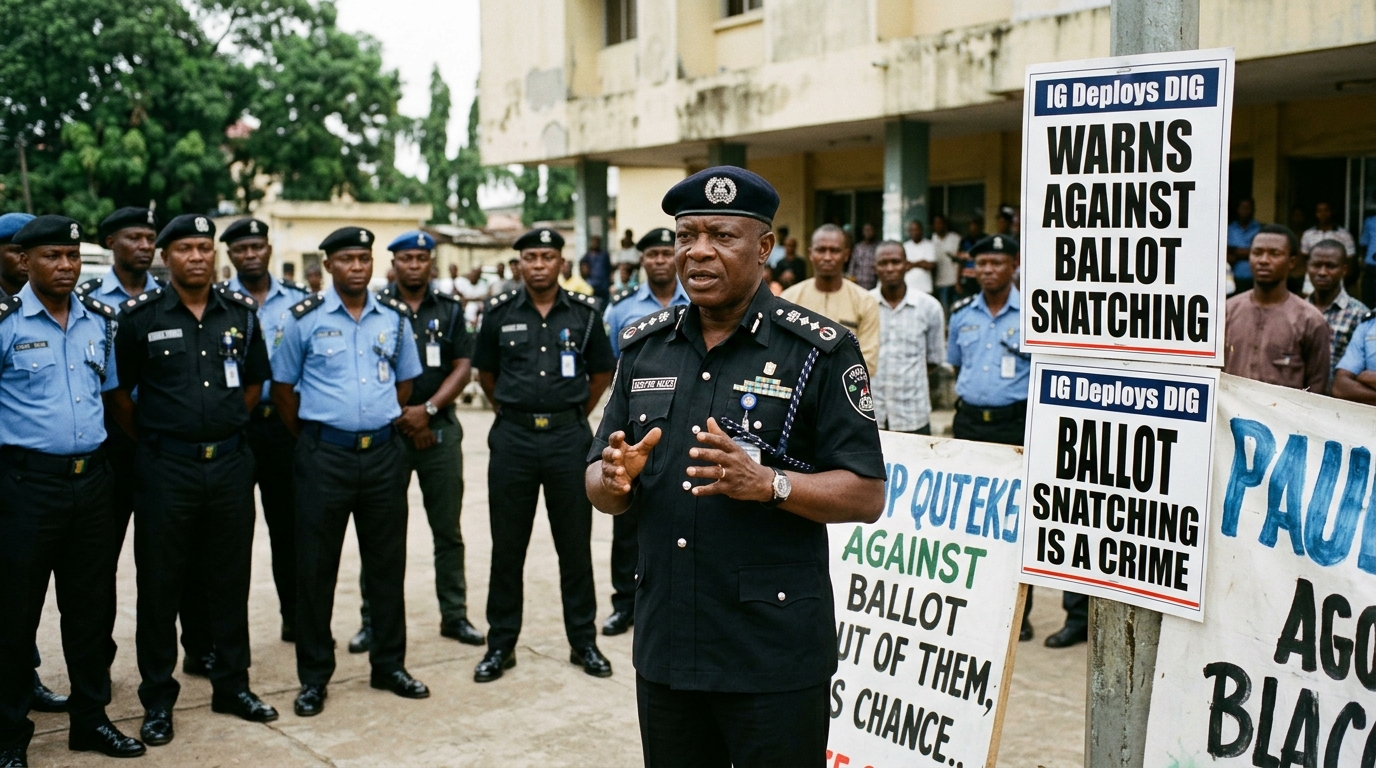
IG Deploys DIG, Warns Against Ballot Snatching
The Iron Ring: How Nigeria’s Police Force is Building a Security Fortress for the Osun Election
As Saturday, August 15, 2026, approaches, the political temperature in Nigeria's Osun State has reached a fever pitch.
In a nation where the specter of electoral violence and political thuggery has historically cast long shadows over democratic processes, the stakes for the upcoming Osun governorship election could not be higher. But this time, the Inspector-General of Police (IGP), Olatunji Rilwan Disu, is refusing to leave anything to chance. In a sweeping, high-profile operational maneuver, the IGP has unleashed a massive security architecture, deploying one of the nation's top police commanders—Deputy Inspector-General of Police (DIG) Ishyaku Mohammed—to personally take the helm of election security in Osun State.
The message broadcasting from the Force Headquarters in Abuja is unmistakable: the era of impunity is over.
With strict, unequivocal warnings issued to political actors and their foot soldiers, the IGP has drawn a hard line against ballot snatching, voter intimidation, and electoral violence. Anyone attempting to subvert the will of the people will face swift and severe consequences. As a multi-layered security grid locks into place across the state’s three senatorial districts, the Osun election is shaping up to be not just a contest of political ideas, but a critical stress test of Nigeria's modern electoral security apparatus. Will this massive deployment of federal might guarantee a peaceful transition of power, or are we witnessing the hyper-militarization of a democratic exercise? NPF | Home+ 1
To grasp the magnitude of the IGP’s strategy, we must examine the verified operational details of the deployment and the historical context that has necessitated such an overwhelming show of force.
The Deployment Architecture
The deployment of DIG Ishyaku Mohammed is not merely a symbolic gesture; it is a strategic repositioning of federal police power. According to official statements from the Nigeria Police Force, DIG Mohammed has been tasked with coordinating the entire police component of the election-security arrangement. He will act as the central command node, working in direct synergy with other security agencies under the Inter-Agency Consultative Committee on Election Security (ICCES).
But Mohammed will not be operating alone. He is backed by a formidable command structure, supported by strategically deployed Assistant Inspectors-General of Police (AIGs) and Commissioners of Police (CPs). These senior officers have been distributed across Osun State's three senatorial districts, ensuring that high-level operational supervision and intelligence-led policing extend deep into local communities.
This robust deployment mirrors the aggressive strategies utilized in past volatile elections. For instance, during the supplementary elections in 2019, the Force deployed 5 DIGs, 3 AIGs, and 15 additional CPs to ensure a secure environment, ultimately resulting in the arrest of nearly 800 suspects for electoral offenses.
The Ban on VIP Escorts and Private Security
In a bid to maintain absolute neutrality and prevent the weaponization of private security details, IGP Disu has laid down stringent operational directives. The IGP has reiterated a total ban on armed escorts, security aides, and unauthorized persons accompanying political figures or VIPs to polling units or collation centers on election day.
Furthermore, state-established security outfits, quasi-security groups, and private security organizations have been completely barred from participating in any election-security duties. This directive is crucial, as political elites have historically utilized informal security structures and political patronage networks to execute violence and intimidate voters.
The Threat of Ballot Snatching
At the core of the IGP's warning is a direct assault on the traditional mechanics of electoral fraud in Nigeria. The Inspector-General has explicitly warned political actors, their supporters, and all "intending troublemakers" that offenses such as ballot snatching, voter intimidation, and political thuggery will attract "prompt arrest and prosecution".
Historically, ballot snatching has been a deeply entrenched problem in Nigerian elections, often executed by armed thugs backed by political elites, leading to the cancellation of results or the imposition of illegitimate victors. The Force has stated it has put in place adequate security arrangements to protect voters, Independent National Electoral Commission (INEC) personnel, election materials, and media practitioners before, during, and after the election.
As the security net tightens over Osun State, political analysts and civil society organizations are intensely monitoring the deployment. The digital and physical landscapes are rife with speculation regarding how this heavy security presence will impact the democratic process.
Scenario A: The Deterrent Effect and a Peaceful Poll (Best-Case Probability)
Election observers are watching to see if the massive deployment of senior officers like DIG Mohammed successfully paralyzes the operational networks of political thugs.
One potential scenario is that the overwhelming presence of federal police, coupled with the strict ban on VIP escorts, creates a genuinely secure environment that deters violence. If the police can maintain strict neutrality and swiftly apprehend any individuals attempting to disrupt the polls, market sentiment suggests that voter confidence will surge. A peaceful, transparent election in Osun would serve as a powerful blueprint for future state and national elections, proving that the Nigerian state possesses the capacity to secure its democratic institutions against violent subversion.
Scenario B: Voter Apathy and Intimidation by Presence (Trend-Driven Probability)
While unproven, a highly debated outcome based on historical trends is the psychological impact of hyper-policing on the electorate.
Academic studies on election security in Nigeria have frequently pointed out a paradox: deploying excessive security forces can sometimes instill fear among the electorate, leading to low voter turnout. Some civil society groups theorize that an overwhelming presence of armed police and military personnel at polling units might inadvertently intimidate ordinary citizens, particularly in rural areas, causing them to stay home rather than risk being caught in potential clashes between security forces and political thugs. In this scenario, the election may be peaceful, but it will suffer from a crisis of low democratic participation. International Journal of Intellectual Discourse
Scenario C: Security Compromise and Elite Capture (Worst-Case Outlook)
The most severe threat to the integrity of the election lies in the potential compromise of the security apparatus itself.
Despite the IGP's directives demanding professionalism and neutrality, analysts hypothesize that localized elite capture remains a significant risk. In past elections, allegations have surfaced regarding security personnel being overwhelmed by political thugs or, worse, being actively complicit in electoral malpractice. Some political observers foresee a scenario where well-funded political actors manage to bypass or compromise lower-ranking officers deployed to remote polling units. If widespread ballot snatching or violence occurs despite the heavy deployment, it would severely damage the credibility of the Nigeria Police Force and trigger intense post-election litigation and civil unrest.
The deployment of DIG Ishyaku Mohammed and the sweeping security architecture implemented for the Osun governorship election represents a massive flex of federal muscle by the Nigeria Police Force. By explicitly targeting the mechanics of electoral fraud—from ballot snatching to the use of VIP escorts—IGP Olatunji Rilwan Disu is attempting to engineer an environment where the will of the voter is sacrosanct.
For citizens, political stakeholders, and international observers tracking the Osun election, the critical variables to watch are clearly defined. First, monitor voter turnout figures; a significant drop may indicate that the heavy security presence successfully deterred voters alongside thugs. Second, watch for real-time reports from independent election monitors regarding the neutrality and responsiveness of the police at local polling units. Finally, track the enforcement of the VIP escort ban—any high-profile violations of this rule will instantly signal cracks in the IGP's security fortress.
The stage is set in Osun State. The police have drawn their line in the sand, and the nation is watching to see if the fortress holds.
Editorial Disclaimer: This article is strictly for informational, educational, and analytical purposes. It does not constitute political, legal, or security advice. Market predictions, geopolitical scenarios, and hypothetical outcomes represent qualitative policy analysis, not guaranteed future results. Readers should rely on official announcements from the Independent National Electoral Commission (INEC) and verified news sources for real-time updates regarding the electoral process.
IGP Warns Ballot Box Snatchers Ahead of Governorship Polls
To understand the historical context and the recurring nature of these security warnings, watch this video from a previous election cycle where the IGP issued a stern warning against ballot snatching.