Category: Security & Regulation || Posted Aug 12, 2026
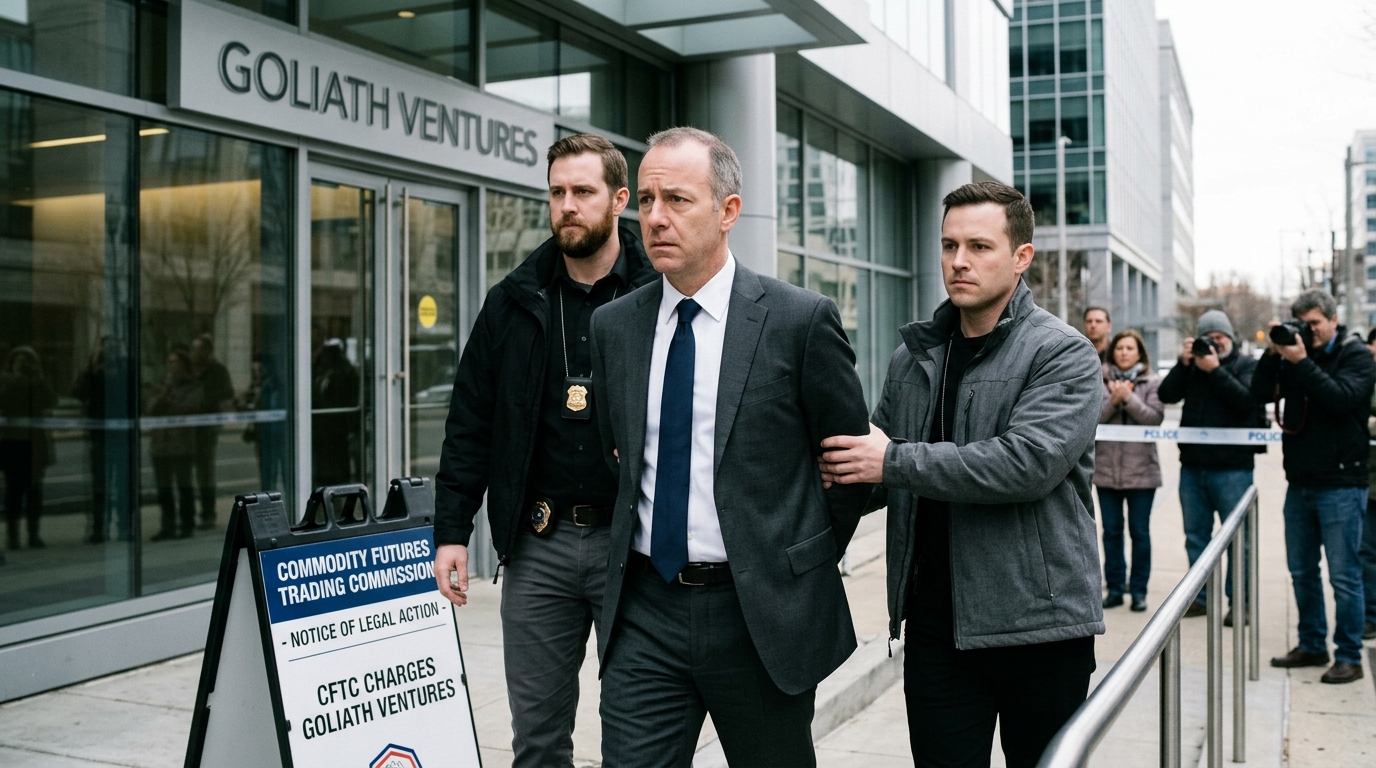
CFTC Charges Goliath Ventures and CEO with $400 Million Crypto Fraud Scheme
The gravitational pull of "guaranteed" crypto wealth has long been a siren song for retail investors, but the catastrophic implosion of Goliath Ventures has just redefined the anatomy of a modern financial illusion.
Picture this: A charismatic, 34-year-old CEO flying private, driving Lamborghinis, and hosting extravagant Christmas parties. He lives in an $8.5 million mansion in Windermere, Florida’s exclusive Isleworth community, rubs shoulders with political elites, and freely donates hundreds of thousands of dollars to high school marching bands and drug-abuse prevention charities. To the outside world, Christopher Alexander Delgado was the ultimate American success story—a self-made pioneer who had cracked the code of decentralized finance (DeFi) and crypto liquidity pools, allegedly transforming digital code into guaranteed monthly returns of up to 8 percent.
But behind the velvet ropes, luxury events, and philanthropic photo-ops, federal investigators say a massive, hollow shell was waiting to collapse.
The illusion finally shattered. Following Delgado's explosive guilty plea to federal criminal charges in June 2026, the U.S. Commodity Futures Trading Commission (CFTC) has just dropped a devastating regulatory hammer. On August 11, 2026, the CFTC formally charged Goliath Ventures and Delgado with orchestrating a $400 million crypto fraud scheme, accusing the firm of misappropriating almost every single dollar handed to them by roughly 1,600 desperate investors. The fallout from this colossal Ponzi scheme is tearing through the Central Florida investment community, exposing catastrophic blind spots in traditional banking oversight and leaving a quarter of a billion dollars in pure investor losses in its wake. This is not just another crypto scandal; it is a masterclass in the weaponization of trust, and the shockwaves are only just beginning.
To understand how a scheme of this magnitude operated under the noses of investors and financial institutions alike, we must strip away the high-level marketing and examine the hard, verified facts established by federal prosecutors, court documents, and regulatory filings.
The Illusion of "Liquidity Pools"
Between January 2023 and January 2026, Christopher Delgado operated Goliath Ventures, a firm previously known as Gen-Z Venture Firm. The pitch to prospective clients was incredibly sophisticated yet deceptively simple. Investors were told that their capital would be deployed into cryptocurrency "liquidity pools"—a legitimate mechanism in decentralized finance where users lock their assets in a smart contract to facilitate trading on decentralized exchanges, earning fees in return.
By leveraging the complex, often misunderstood mechanics of DeFi, Goliath promised monthly returns of 3% to 8%. However, the Department of Justice (DOJ) and the CFTC have laid bare a shockingly different reality. Of the estimated $328 million to $400 million raised by the firm, federal prosecutors allege that only about $1 million was ever actually placed into a cryptocurrency liquidity pool.
The remaining hundreds of millions of dollars were reportedly used for two primary purposes: sustaining the Ponzi structure by paying fictitious "returns" to earlier investors, and funding Delgado’s ultra-luxurious lifestyle. Department of Justice
Philanthropic Washing and Manufactured Trust
Delgado, a man whose LinkedIn profile indicated he previously worked at an In-N-Out Burger for nearly eight years, rapidly reinvented himself as a formidable political and philanthropic heavyweight. In Central Florida, he became known as a highly visible benefactor. He made a $250,000 donation to a drug-abuse initiative and provided over $50,000 to send the Apopka High School band and cheerleading squad to London’s New Year’s Day parade.
He aggressively cultivated political connections to manufacture an aura of untouchable legitimacy. Public records show Delgado donated tens of thousands of dollars to political campaigns, including the Republican Party of Florida and Donald Trump’s fundraising operations. He even attended a bill signing at the White House and shared photographs of himself with top political figures. For prospective investors, these luxury events, charitable sponsorships, and high-level political connections functioned as the ultimate proof of Goliath’s bona fides.
The Whistleblower and The Collapse
The facade began to crack in September 2025, largely due to the efforts of Danny de Hek, a New Zealand-based investigative journalist. De Hek began publishing reports linking Goliath Ventures to the architects of a previously collapsed crypto scheme known as My Liquidity Partner (MLP). Despite Goliath filing a defamation lawsuit against de Hek to silence him, the journalist had already begun forwarding his findings to Homeland Security Investigations.
The regulatory dragnet quickly tightened. On February 24, 2026, federal authorities arrested Delgado on charges of wire fraud and money laundering. Four months later, on June 30, 2026, Delgado entered a federal guilty plea, explicitly admitting to conspiracy to commit wire fraud, wire fraud, and money laundering. In his plea, he confessed to utilizing investor capital to acquire multi-million dollar properties in Windermere, Winter Park, Sanford, and Kissimmee, alongside Lamborghinis, Rolls-Royces, Rolex watches, and custom Tiffany jewelry.
The Institutional Enablers
The fallout has transcended Delgado himself, creeping into the traditional banking sector. In March 2026, a class-action lawsuit was filed against JPMorgan Chase. The plaintiffs allege that the banking titan provided the essential financial infrastructure that allowed the Ponzi scheme to flourish, arguing that the rapid cycling of funds, round-number wire transfers, and complete absence of cryptocurrency trading revenue were blazing red flags that the bank’s compliance systems negligently ignored. Wikipedia+ 1
On August 11, 2026, the CFTC formally filed its own massive civil enforcement action against Goliath Ventures and Delgado, vowing to "aggressively police fraud" in crypto asset markets.
With Delgado awaiting his October 8, 2026 sentencing and the CFTC joining the fray, the digital asset ecosystem is standing at a critical juncture. What happens next could permanently alter the landscape of crypto compliance and investor recovery.
Scenario A: The Banking Sector Compliance Shockwave (Trend-Driven Probability)
Industry analysts are watching to see if the class-action lawsuit against JPMorgan Chase sets a terrifying new precedent for traditional financial institutions. One potential scenario is that if plaintiffs successfully hold a Tier-1 bank liable for failing to flag the overt transaction patterns of a crypto Ponzi scheme, the broader banking sector may forcefully de-risk. Market sentiment suggests that regional and national banks could proactively sever ties with unverified digital asset funds, imposing draconian compliance audits on any firm claiming to operate "DeFi liquidity pools." This trend could effectively choke off the fiat off-ramps that fraudulent actors rely on, but it could simultaneously stifle legitimate blockchain startups seeking basic banking services.
Scenario B: The Regulatory Power Grab (Best-Case for Market Oversight)
While unproven, some regulatory insiders speculate that the CFTC will use the Goliath Ventures case as high-profile ammunition in Washington D.C. to demand broader jurisdictional authority over crypto spot markets. The CFTC’s explicit targeting of Goliath's alleged Bitcoin and Ether operations indicates a muscular approach to enforcement. Market observers theorize that this spectacular $400 million failure could serve as the catalyst for comprehensive bipartisan crypto legislation. If lawmakers view this as a systemic failure of consumer protection, we may witness the expedited rollout of strict, mandatory registration and reserve-auditing requirements for any entity soliciting retail funds for crypto yields.
Scenario C: The Asset Recovery Mirage (Worst-Case for Investors)
For the estimated 1,600 victims who collectively lost around $250 million, the future remains undeniably grim. Some legal experts foresee a scenario where the recovery process devolves into a multi-year bankruptcy and civil forfeiture quagmire. Because Delgado reportedly diverted massive sums into highly illiquid or rapidly depreciating assets—like private travel, Christmas parties, and luxury vehicles—analysts hypothesize that the court-appointed receivers will struggle to claw back anything close to the original principal. One potential outcome is that victims may only receive pennies on the dollar, a devastating financial reality that underscores the permanent destruction of wealth inherent to large-scale Ponzi structures.
The rise and catastrophic fall of Goliath Ventures serves as a brutal reminder that the fundamental laws of financial gravity still apply in the digital age. Behind the complex jargon of "liquidity pools" and decentralized finance was one of the oldest financial crimes in the book, dressed up in modern technological clothing and wrapped in a veneer of philanthropic respectability.
As we move forward, market participants and the public should keep a close eye on a few critical variables. First, Delgado’s scheduled sentencing on October 8, 2026, will set a benchmark for how severely the DOJ is willing to punish high-profile crypto fraudsters. Second, the trajectory of the class-action lawsuit against JPMorgan Chase will test the legal boundaries of institutional complicity in the digital asset era. Finally, the CFTC’s sweeping enforcement action signals that federal regulators are aggressively pivoting from warning retail investors to actively hunting down the architects of decentralized fraud.
The Goliath Ventures saga is a stark warning. The promise of outsized, risk-free yield is often just a high-priced ticket to a devastating financial collapse, and the bill has officially come due.
Former CEO arrested in alleged $328M Ponzi scheme
To understand the initial local impact and legal maneuvers surrounding these federal charges, watch this news report detailing the founder's initial arrest.