Category: Opinion & Analysis || Posted Aug 14, 2026
The Global South's Digital Future Must Not Belong to Bezos and Musk – Analysis
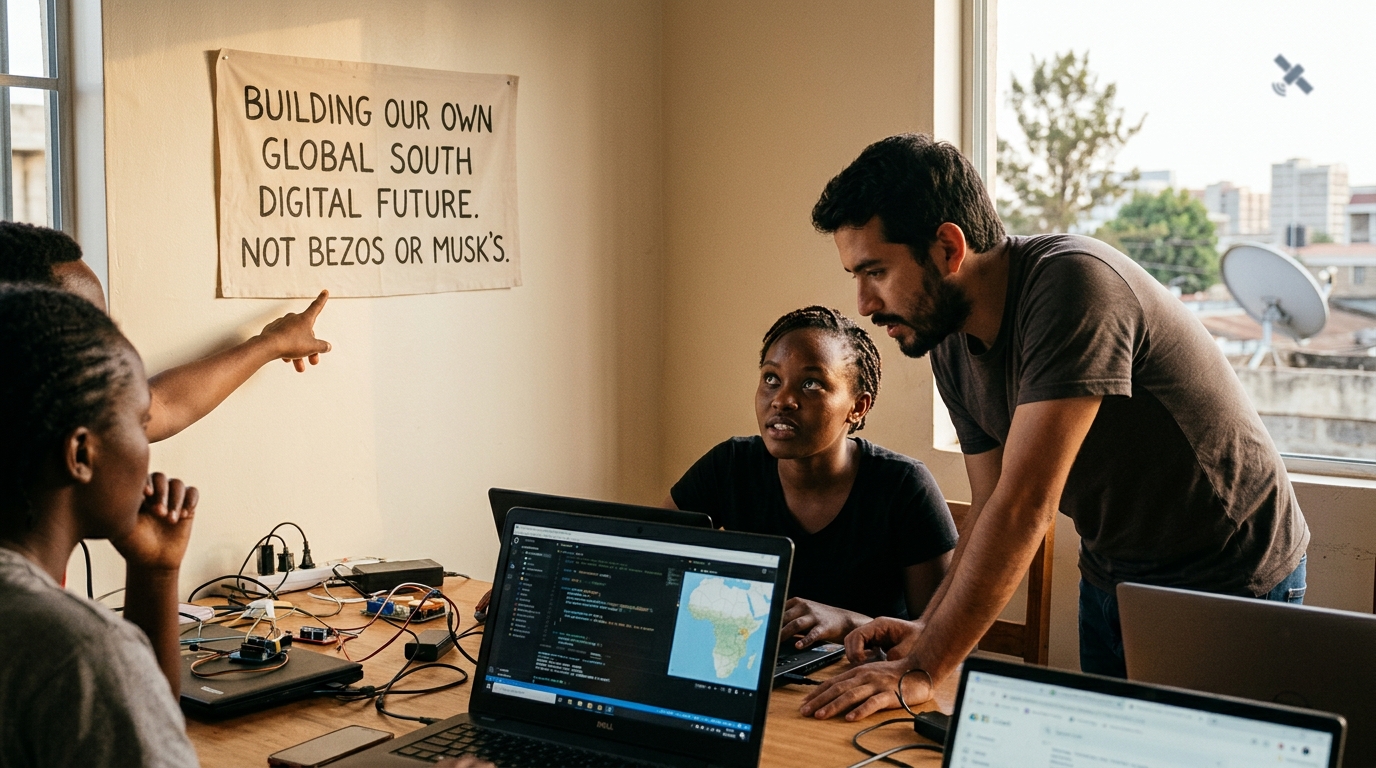
The New Digital Dependency: Why the Global South’s Future Cannot Belong to Silicon Valley’s Titans
For decades, the standard narrative of globalization promised an egalitarian future: a weightless, borderless digital frontier where a programmer in Lagos, São Paulo, or Jakarta possessed the exact same leverage as a venture capitalist in Menlo Park. The cloud was marketed as an ethereal, neutral public square, floating effortlessly above geopolitics.
Today, that illusion has evaporated.
The physical reality of the digital age is ruthlessly anchored in server farms, submarine fiber-optic cables, semiconductor fabs, and proprietary artificial intelligence models overwhelmingly owned, operated, and regulated by a handful of U.S. corporate titans. From software stacks to data localization, citizens and governments across the Global South generate the raw fuel of the modern economy—data—while foreign monopolies extract, process, and monetize it. Tricontinental: Institute for Social Research
Tricontinental: Institute for Social Research
When critical public infrastructure, national identification databases, and sovereign communication channels rely on the infrastructure of Western tech behemoths, independence becomes an empty slogan. The foundational question defining our geopolitical era is sharp and unavoidable: Will the digital future of the Global South remain an extension of Silicon Valley’s balance sheet, or can developing nations forge a path toward true technological sovereignty?
The Anatomy of Modern Technological Dispossession
To understand the scope of the challenge, we must move past the abstract language of "the cloud" and examine the physical and structural mechanisms keeping the Global South in a state of digital subordination.
1. The Physical Illusion of the Cloud
A data "cloud" sounds immaterial, but it is actually an extraordinarily heavy, highly centralized concentration of physical assets. The hardware powering global computing—hyperscale server farms, advanced Graphic Processing Units (GPUs) essential for artificial intelligence, and routing architectures—is geographically and financially concentrated.
Tricontinental: Institute for Social Research+ 1
Data compiled by international institutes indicates that the United States and China dominate the global AI infrastructure stack, hosting the vast majority of advanced compute power. Meanwhile, vast regions of the Global South remain "compute deserts." Even when data centers are physically constructed on developing soil, they are frequently owned by foreign hyperscalers, meaning local resources—water for cooling and megawatts of electricity—are consumed to process data whose economic value is exported abroad.
2. The Triple Trap: External Dependence, Governance, and De-skilling
Recent economic and geopolitical frameworks—such as research published by organizations like Tricontinental: Institute for Social Research—highlight a structural trap composed of three reinforcing challenges facing developing nations:
Tricontinental: Institute for Social Research
- Severe External Dependence on the Tech Stack: From operating systems to cloud computing contracts dominated by foreign web services, domestic software industries in many emerging markets struggle to capture significant market share. For instance, despite multi-billion-dollar domestic IT sectors in countries like Brazil and India, a staggering percentage of core enterprise software and cloud infrastructure remains foreign-owned.
- Tricontinental: Institute for Social Research+ 1
- Governance Without Sovereignty: Many Global South governments have enacted comprehensive data protection laws (such as Brazil’s LGPD or India’s digital privacy frameworks). However, regulatory frameworks often lack teeth when the underlying infrastructure sits outside national jurisdiction or is controlled by entities too powerful to discipline effectively.
- The Erosion of Local Capabilities: When an economy relies entirely on imported ready-made technological solutions, the domestic pipeline for hardware manufacturing, foundational research, and native software engineering withers away, locking the nation into a permanent consumer role rather than a producer role.
What’s Next? Probable Scenarios for the Global Digital Order
As developing nations grapple with these stark imbalances, policymakers, regional coalitions, and civil society movements are mapping out potential trajectories for the next decade. Industry analysts and geoeconomic forecasters generally point toward three distinct scenarios.
Scenario 1: The Sovereign Firewall and Regional Fragmentation (The Trend-Driven Path)
- Market Sentiment & Premise: Governments across Latin America, Africa, and Southeast Asia increasingly view foreign digital dominance as a national security vulnerability.
- The Potential Outcome: In this scenario, more nations follow the path of building "National Sovereign Clouds" and enacting strict data localization mandates. Regional blocs pool resources to develop shared open-source software, localized large language models trained in native languages, and independent payment rails. While this approach slows down immediate access to cutting-edge Western commercial tools, it gradually fosters domestic tech ecosystems, shielding local economies from extraterritorial sanctions or sudden corporate policy shifts.
Scenario 2: The Neo-Colonial Digital Bidding War (The High-Risk Trap)
- Market Sentiment & Premise: Pressed for capital, energy investments, and rapid infrastructure buildouts, emerging markets compete fiercely to attract foreign tech giants.
- The Potential Outcome: To win multi-billion-dollar data center investments, cash-strapped nations engage in a "race to the bottom"—offering extreme tax exemptions, lenient environmental regulations, and concessions on water and power grids. Foreign hyperscalers build state-of-the-art facilities, but the profits, intellectual property, and strategic value flow directly back to shareholders in the Global North. The Global South is left bearing the environmental and resource costs while remaining structurally subordinate.
- Tony Blair Institute
Scenario 3: Open-Source Multiplexing (The Disruptive Wildcard)
- Market Sentiment & Premise: The rapid democratization of open-source artificial intelligence models and decentralized hardware standards lowers the barrier to entry for developing nations.
- The Potential Outcome: Leveraging open-weight models and affordable local compute clusters, independent developers in the Global South bypass traditional corporate gatekeepers entirely. By tailoring technology directly to hyper-local agricultural, linguistic, and municipal needs, a decentralized network of sovereign tech hubs emerges, successfully challenging the monopoly power of centralized U.S. and foreign tech conglomerates.
The trajectory of the twenty-first-century global economy will not be decided solely in factories or oilfields; it will be forged in server racks, data governance councils, and code repositories. If the Global South remains a passive consumer of digital infrastructure owned by Silicon Valley, the promise of national independence will ring hollow.
For observers tracking the evolution of international digital policy, several core variables will dictate whether true sovereignty is achieved:
- The Localization of Compute: Monitor whether emerging economies can successfully finance and build independent, energy-sustainable domestic data infrastructure rather than outsourcing physical data custody to foreign firms.
- Open-Source Adoption vs. Proprietary Lock-in: Watch how aggressively regional institutions invest in open-source software and native AI models to break free from proprietary licensing traps.
- The Energy-AI Equation: Track how developing nations balance the intense water and power demands of data centers against local community needs, avoiding exploitative concessions to foreign tech capital.
A truly global digital future requires infrastructure that serves public welfare rather than private monopoly extraction. The window to secure that future is narrowing by the day.