Category: Global politics || Posted Aug 14, 2026
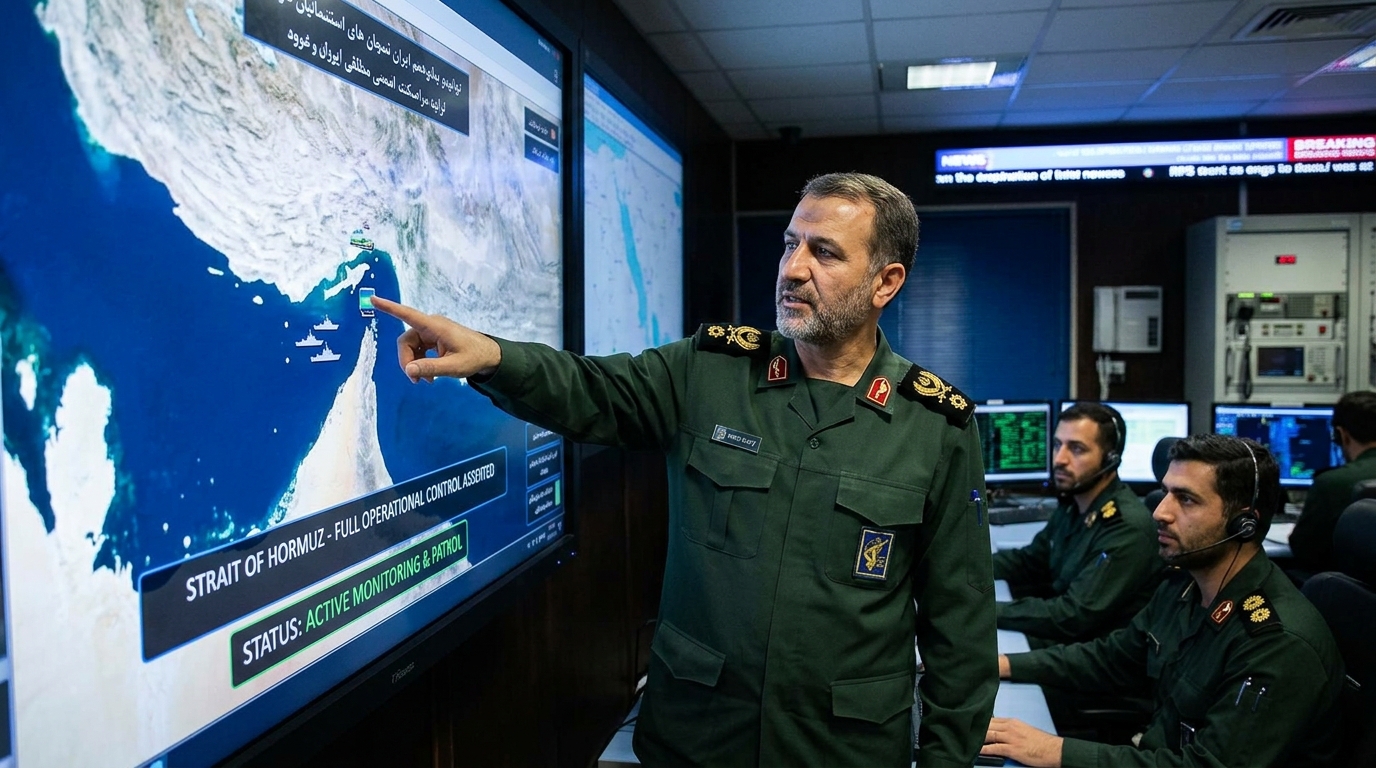
Iran Asserts Full Control Over Strait of Hormuz, Challenging US Claims of Dominance
The Phantom Chokepoint: Inside the High-Stakes Propaganda War Over the Strait of Hormuz
Two superpowers are looking at the exact same strip of shimmering blue water—and seeing two completely different realities.
From the flight deck of the USS George H.W. Bush, patrolling aircraft roar into the Arabian sky to enforce what Washington hails as an impenetrable "Wall of Steel". U.S. President Donald Trump took to social media to declare with characteristic bravado that the United States holds "total control" over the Strait of Hormuz, asserting, "I think we will keep it!"
But 1,200 miles away in Tehran, that declaration met with flat-out scorn. Describing the White House claims as "baseless lies and fabrications," Iranian military command fired back with a stark reality check: no commercial tanker moves through the vital global energy artery without the explicit permission, oversight, and supervision of the Islamic Republic.
Welcome to the ultimate psychological and tactical chess match of 2026. While Washington claims dominance through naval blockades and fighter jets, Tehran insists it holds the keys to the kingdom. Who is actually controlling the world’s most crucial maritime chokepoint? Let’s investigate the facts, the rhetoric, and the fragile future of global trade.
Two Competing Narratives on the Water
To cut through the political theater, we must ground ourselves strictly in the verified record of what is happening inside and around the Strait of Hormuz.
The U.S. "Wall of Steel"
The White House and U.S. Central Command (CENTCOM) are backing up their claims of dominance with heavy kinetic posture. Following months of regional conflict that began earlier this year, U.S. naval forces have established a rigorous enforcement perimeter.
- The Blockade Metrics: CENTCOM reports have confirmed that American forces have actively redirected dozens of commercial vessels, boarded multiple ships, and disabled targeted craft to enforce compliance with secondary sanctions and security protocols.
- Air Superiority: Fixed-wing aircraft operating from carrier strike groups maintain round-the-clock dominance overhead, aiming to deter hostile drone operations and protect open shipping lanes.
The Iranian Counter-Claim and the Omani Track
Conversely, Iran's Khatam al-Anbiya Central Headquarters, alongside senior Islamic Revolutionary Guard Corps (IRGC) and Basij leadership, maintains that Washington's assertions are fundamentally detached from ground-level operations. Channels TV
- The Permit and Fee Apparatus: Tehran asserts that its forces retain operational control over the waterway's traffic management. Under frameworks coordinated partly through regional backchannels with Oman, any potential resumption of transit is structured around designated routing coordinates (northbound traffic near the Iranian coast, southbound via Omani-backed corridors).
- The Explicit Ban: Iranian officials, including members of the National Security Commission, have reiterated an absolute prohibition: no U.S.- or Israeli-linked vessels will be permitted passage under any circumstances, whether in war or peacetime.
The International Maritime Organization (IMO) and global shipping syndicates have looked on with growing alarm, noting that this dual-control standoff leaves international shipping caught in an untenable crossfire.
Speculative Scenarios and Probabilities
As the rhetorical battle between Washington and Tehran intensifies, commodity traders, defense analysts, and geopolitical forecasters are attempting to model how this phantom chokepoint crisis resolves.
Note: The following forward-looking projections reflect current market sentiment and strategic analysis rather than guaranteed outcomes.
Scenario A: The Managed Corridor Compromise (Estimated Probability: ~45%)
- The Hypothesis: The ongoing talks mediated by Oman successfully operationalize a time-limited, 60- to 120-day traffic scheme. Washington tacitly looks away as non-U.S. commercial tankers navigate structured northern and southern lanes under localized monitoring, bypassing a formal political settlement. Seatrade Maritime News
- Market Sentiment Impact: Global crude oil risk premiums deflate moderately. While shipping insurance remains high, physical barrels begin flowing more consistently, providing relief to energy-importing economies.
Scenario B: The Forever Standoff (Estimated Probability: ~35%)
- The Hypothesis: Neither Washington nor Tehran backs down from its control claims. The U.S. "Wall of Steel" blocks sanctioned vessels, while Iran maintains a de facto permit and restriction regime over local waters. A true normalisation of trade remains frozen indefinitely.
- Market Sentiment Impact: Global shipping lines permanently price in alternative routing and long-haul bypasses. Energy markets settle into a persistently elevated pricing band, anchoring structural inflation worldwide.
Scenario C: The Kinetic Flashpoint (Estimated Probability: ~20%)
- The Hypothesis: A miscalculation between patrolling U.S. fighter jets and Iranian naval assets results in a direct tactical engagement, shattering the fragile informational war and turning the strait into an active combat zone once more.
- Market Sentiment Impact: Commodity markets experience an immediate, violent spike. Energy futures skyrocket past previous highs as physical transit grinds to a complete, enforced halt.
The war of words over who controls the Strait of Hormuz highlights a sobering geopolitical reality: in modern conflict, perception and narrative control are just as vital as naval tonnage. While President Trump points to aircraft carriers and blockade metrics, Tehran leverages regional geography and political defiance to assert its ongoing authority. Fox News
For observers, investors, and policymakers, three key indicators will determine the true state of the waterway in the coming weeks:
- Tanker Tonnage Metrics: Tracking actual daily throughput volumes rather than political declarations from either capital.
- The Omani Agreement Finalization: Monitoring whether the technical traffic scheme between Oman and Iran is formally enacted.
- Insurance and Underwriting Shifts: Observing whether Lloyd's market syndicates alter their war-risk classifications for vessels transiting the Persian Gulf.
The battle for the Strait of Hormuz is far from over. Until a unified, legally binding framework replaces the current standoff, the world’s most important energy corridor remains caught in the balance between competing claims of absolute power.