Category: Market News & Trends || Posted Aug 23, 2026
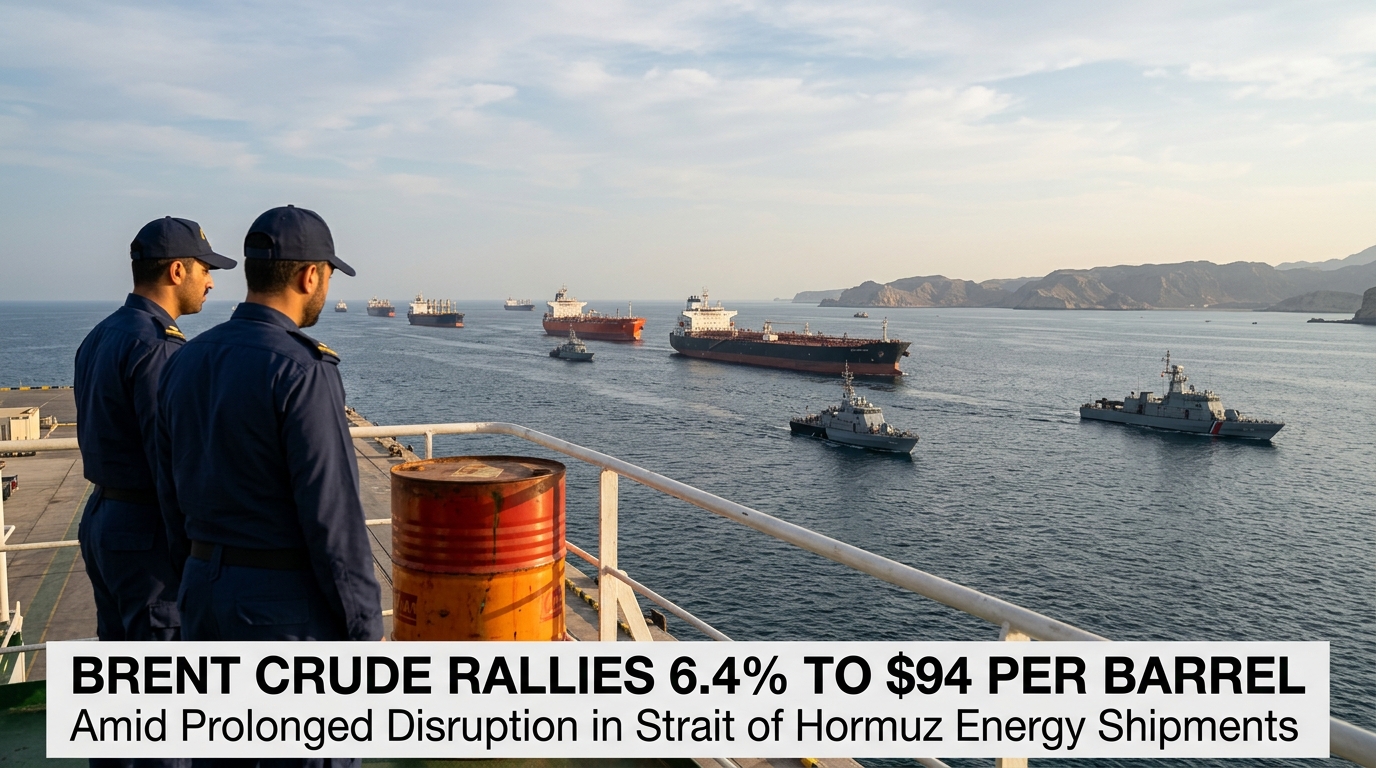
Brent Crude Rallies 6.4% to $94 Per Barrel Amid Prolonged Disruption in Strait of Hormuz Energy Shipments
The Chokepoint Holding the Global Economy Hostage
The lifeblood of the global economy is stalling in the narrow, volatile waters of the Persian Gulf, and energy markets are flashing red warnings.
In a powerful, multi-day surge, benchmark Brent crude rallied 6.4% over the week to settle at $94.16 per barrel, while West Texas Intermediate (WTI) climbed to $87.08. The spark igniting this high-stakes rally isn't speculative noise—it is a sustained, grinding crisis along the world's most critical maritime choke point: the Strait of Hormuz.
For months, regional conflicts and naval standoffs have throttled energy transit through the strait, which normally handles roughly 20 million barrels of crude and petroleum products per day—representing roughly one-fifth of global supply. As shipping traffic drops to a fraction of normal daily averages, central bankers, supply-chain strategists, and corporate treasurers around the world are forced to confront a troubling question: How long can the global economy withstand $90+ crude before inflation reignites and fractures the delicate economic balance?
Supply Bottlenecks, Inventory Dips, and the $94 Barrel
To understand why crude oil prices breached $94 per barrel this week, we must look strictly at the hard data driving real-time physical trade and inventory balances.
The Strait of Hormuz Bottleneck
The Strait of Hormuz is a narrow waterway connecting the Persian Gulf to the Gulf of Oman and the Arabian Sea. In standard operating conditions, it serves as the primary export highway for crude leaving Saudi Arabia, the United Arab Emirates, Iraq, Kuwait, and Qatar.
Recent maritime tracking data reveals a significant drop in vessel transits. Shipowners and energy majors are rerouting supertankers or holding vessels in port due to soaring war-risk insurance premiums and security warnings along the channel. According to maritime intelligence reports, daily tanker traffic through the strait recently dropped to single-digit counts per day, compared to historical averages of dozens of major commercial vessels.
Strategic Reserve Depletion and Commercial Stocks
Compounding the maritime crisis is the state of national energy buffers. During previous energy spikes, consumer nations relied heavily on releases from emergency reserves to cushion price surges.
- U.S. Strategic Petroleum Reserve (SPR): U.S. strategic inventories sit near their lowest levels since 1982. Following significant drawdowns over the past several years, the buffer available to counteract sudden international supply shortfalls is constrained.
- Commercial Inventories: While commercial crude inventories saw minor localized upticks in U.S. data, global commercial stockpiles remain below historical 5-year averages, leaving refiners minimal margin for error if Middle Eastern crude supplies remain blocked.
The Disparity Between Spot and Long-Term Futures
Physical spot crude trade has seen massive premiums as refiners scramble for prompt-delivery barrels that bypass the Persian Gulf—such as North Sea Brent, West African grades, and U.S. Gulf Coast supplies. While immediate spot prices surged past $94, long-dated futures curves show a steep backwardation—a market structure where immediate delivery commands a significant premium over contracts set months in the future, signaling that traders view the disruption as a severe short-term supply bottleneck rather than a permanent loss of reserves.
Scenarios, Probabilities, and Macro Effects
Moving beyond the verified spot market data, market strategists and macro analysts are evaluating several forward-looking scenarios. The path of energy prices over the coming months depends on geopolitical resolution, maritime security, and alternative pipeline capacity.
Note: The scenarios, price targets, and probabilities outlined below represent speculative financial modeling and geopolitical analysis, not guaranteed outcomes.
Scenario 1: The Escalation & Extended Blockade ($110 - $130 / bbl)
If military tensions along the Persian Gulf escalate further and transit through the Strait of Hormuz is halted for an extended period, analysts at several global investment banks speculate that Brent crude could challenge its multi-year highs.
In this scenario:
- Global seaborne crude supplies would face a sustained deficit of several million barrels per day.
- High-energy-importing economies across Europe and Asia (particularly China, Japan, and South Korea, which rely heavily on Hormuz crude) would experience sharp surges in domestic fuel and utility costs.
- Central banks worldwide might be forced to pause planned interest rate cuts or re-evaluate hawkish policies to curb energy-driven headline inflation.
Scenario 2: Pipeline Bypass & Escalated Naval Escorts ($80 - $90 / bbl)
A second scenario modeled by energy consultancies assumes that alternative logistics routes are expanded and commercial navies establish secured shipping corridors.
- Saudi & UAE Pipelines: Saudi Arabia's East-West Pipeline (capable of moving crude across the peninsula to the Red Sea) and the UAE's Habshan-Fujairah pipeline (which bypasses Hormuz entirely to deliver crude directly to the Gulf of Oman) could be run at maximum capacity.
- Production Increases: Other major producing nations could increase production allocations to offset lost Gulf volumes. www.aa.com.tr
- Under this outcome, the geopolitical risk premium would dissipate, allowing Brent crude to retrace toward the $80–$90 range.
Scenario 3: Macroeconomic Demand Destruction ($70 - $80 / bbl)
A third possibility involves demand-side shock. If energy costs remain elevated for several consecutive quarters, the resulting cost pressure on manufacturing, aviation, and freight transport could slow broader economic growth. CryptoRank+ 1
The International Energy Agency (IEA) has highlighted that high energy prices combined with high borrowing costs risk dampening global demand growth. If global industrial output slows down significantly, crude consumption would drop, effectively capping further price gains and forcing market benchmark prices lower regardless of ongoing supply tensions.
Critical Variables for the Coming Weeks
The 6.4% weekly rally in Brent crude to $94 per barrel is a direct reflection of maritime vulnerability at one of the world's primary energy crossroads. As markets navigate this crisis, investors, energy consumers, and policymakers should track three essential variables:
- Daily Tanker Transit Data: Watch seaborne AIS tracking data for the Strait of Hormuz. A sustained increase in daily commercial transits is the single fastest indicator that risk premiums will ease.
- Headline vs. Core Inflation Divergence: Track whether rising pump prices begin spilling over into broader core consumer price indices, which would alter central bank rate expectations. Capital.com
- Bypass Pipeline Operational Reports: Monitor output capacity reports from Red Sea and Gulf of Oman terminals to see how much volume can bypass the choke point.
The energy market stands at a critical juncture. While spot markets reflect immediate supply strain, the ultimate trajectory of global energy prices will depend on maritime logistics, alternative supply lines, and global economic resilience.
Editorial & Legal Disclaimer: This article is published strictly for educational, news, and journalistic purposes. It does not constitute financial, investment, legal, or commodities trading advice. Global energy markets, crude oil futures, and international shipping assets carry significant financial risk and volatility. The forward-looking scenarios and price ranges discussed in "The Horizon" section are theoretical industry models and should not be relied upon for trading decisions.