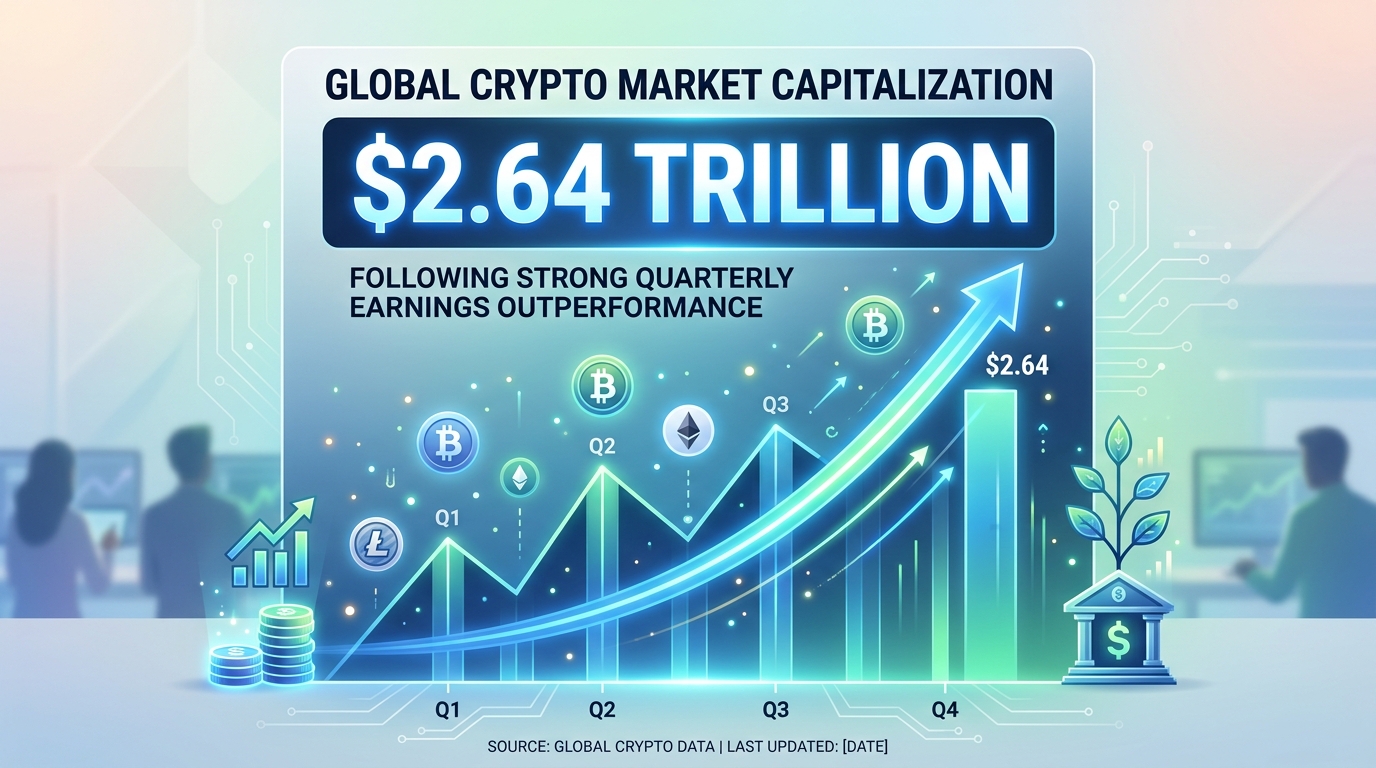
Global Crypto Market Capitalization Touches $2.64 Trillion Following Strong Quarterly Earnings Outperformance
The global digital asset ecosystem has crossed a major psychological milestone as the total cryptocurrency market capitalization reclaims $2.64 trillion. Fueled by institutional earnings beats, surging spot ETF inflows, and macro liquidity shifts, digital assets are reasserting their role at the center of modern finance. Binance
The institutional narrative around digital assets has shifted from speculative curiosity to balance-sheet necessity. As total global cryptocurrency market capitalization touched $2.64 trillion, the surge was driven not by retail frenzy, but by institutional earnings outperformance, corporate treasury allocations, and sustained net inflows into spot digital asset products.
For market observers, this milestone represents more than a numeric rally: it signals a structural realignment between legacy finance and decentralized rails. The question now isn't whether digital assets belong in institutional portfolios, but how deeply they will integrate into global market infrastructure.
The road to $2.64 trillion reflects distinct fundamental drivers that separate current market conditions from previous cycles.
1. Corporate Earnings & Treasury Allocations
Publicly listed digital asset infrastructure providers, bitcoin miners, and web3 enterprise platforms delivered exceptional quarterly earnings, beating Consensus earnings-per-share (EPS) estimates across key operational metrics. Corporate treasury adoption has simultaneously matured, with balance-sheet allocations transitioning from defensive hedges to active yield and capital efficiency strategies.
2. Market Cap & Dominance Structure
Bitcoin (BTC) continues to anchored total capitalization, holding near 58% market dominance, while Ethereum (ETH) holds roughly 10.8%. Meanwhile, high-throughput Layer-1 networks, decentralized finance (DeFi) protocols, and tokenized real-world assets (RWAs) accounted for the remaining market distribution. CoinGabbar
| Asset Class / Metric | Capitalization / Share | Core Driver |
| Total Crypto Market Cap | $2.64 Trillion | Institutional earnings, ETF net inflows, global liquidity |
| Bitcoin (BTC) | ~$1.53 Trillion (58% Dominance) | Treasury reserve status, institutional custody |
| Ethereum (ETH) | ~$285 Billion (10.8% Dominance) | Layer-2 settlement, institutional staking, DeFi |
| Altcoins & DeFi | ~$820 Billion | Tokenized RWAs, cross-chain infrastructure, AI protocols |
3. Macro Liquidity & ETF Inflows
The expansion coincides with broader macroeconomic adjustments, including central bank monetary easing cycles and regulatory updates like the SEC's dedicated securities proposals for digital assets. Spot Bitcoin and Ethereum ETFs continue to act as liquid conduits for institutional capital, absorbing structural supply over-hangs.
[The Horizon]
Looking forward, market participants are evaluating three potential trajectory scenarios over the next 12 to 24 months.
Potential Scenarios & Market Probabilities
- The Best-Case Scenario (Institutional Acceleration): Continued corporate adoption, expanding RWA tokenization (such as sovereign bonds and credit instruments), and clearer global framework enforcement could propel market capitalization toward $3.5T - $4.0T.
- The Base-Case Scenario (Consolidation & Growth): Capital alternates between major assets and high-conviction utility protocols, maintaining market valuation within the $2.4T - $2.8T range as macroeconomic cycles unfold.
- The Downside-Risk Scenario (Macro Headwinds): Unexpected liquidity contractions, geopolitical shocks, or restrictive regulatory enforcement could see market cap retest technical support around $2.0T - $2.2T.
The market's move to $2.64 trillion highlights key structural variables that will shape the next phase of market evolution:
- Institutional Inflow Velocity: Track net daily flows across regulated ETF products and institutional prime brokerage desks.
- Regulatory Framework Implementation: Monitor ongoing rulemaking regarding digital asset custody, market structure, and stablecoin reserves.
- Real-World Asset (RWA) Expansion: Watch the rate at which traditional financial instruments—such as treasury bills and corporate bonds—are tokenized on-chain.
Disclaimer: This analysis is provided strictly for educational and informational purposes and does not constitute financial, legal, or investment advice.