How to Build a High-Throughput Peer-to-Peer Order Matching Engine: A Beginner's Technical Guide
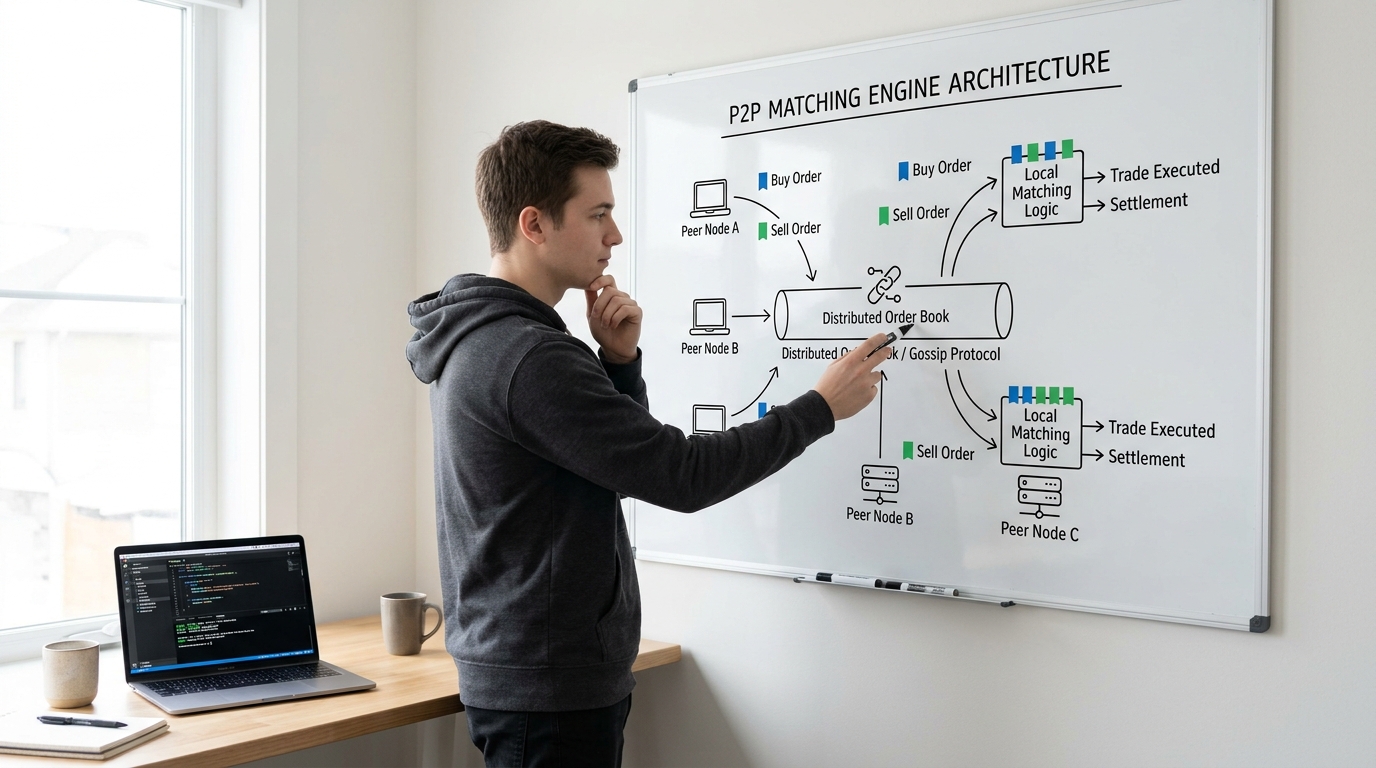
Building a high-throughput peer-to-peer (P2P) order matching engine requires balancing low-latency execution with decentralized order discovery and deterministic state synchronization. To process thousands of orders per second without a centralized server, the architecture must separate order propagation from the execution core.
Core System Architecture
| Component | Architecture Role | Technical Requirement |
| Gossip Transport Layer | P2P network protocol (e.g., Libp2p, GossipSub) for peer discovery and broadcast. | Sub-second message propagation, cryptographic signature verification, rate-limiting. |
| Sequencer Node / Layer | Assigns a deterministic sequence number to incoming buy and sell orders. | Monotonic sequence IDs ensuring all network nodes execute matches in identical order. |
| In-Memory Order Book | Local memory store maintaining active bids (buys) and asks (sells). | Direct memory pointer structures for instant $O(1)$ updates and cancellations. |
| Matching Engine Core | Single-threaded or ring-buffer-driven event loop executing trade fills. | Zero-allocation, lock-free processing following Price-Time priority matching. |
Data Structures for High Throughput
A naive array or database query will cripple performance. A production-grade Central Limit Order Book (CLOB) relies on a composite data structure:
- Red-Black Tree or Skip List (Price Levels): Keeps price levels sorted. Bids are ordered in descending order ($O(\log N)$ lookup for new price levels), while asks are ordered in ascending order.
- Doubly-Linked Lists (Order Queues): Each price level points to a doubly-linked list of resting orders. Inserting a new limit order at an existing price level or appending to a queue takes $O(1)$ time.
- Hash Map (Order Index): Maps
Order_IDdirectly to a node pointer in the doubly-linked list, enabling instant $O(1)$ order modifications and cancellations.
The Core Matching Algorithm
When an incoming "aggressing" order arrives, the engine evaluates it against the opposite side of the order book using Price-Time Priority (FIFO):
- Price Validation: For a buy order, check if $\text{Bid\_Price} \ge \text{Best\_Ask\_Price}$. For a sell order, check if $\text{Ask\_Price} \le \text{Best\_Bid\_Price}$.
- Order Execution: Match the incoming order against the oldest resting order at the best price level.
- Quantity Reduction: Subtract the filled quantity from both the aggressing and resting orders.
- Queue Pruning: If a resting order reaches zero quantity, remove it from the doubly-linked list in $O(1)$ time.
- Resting Residuals: If the aggressing order is only partially filled, insert the remaining quantity as a new resting order into its price queue.
P2P Determinism & Performance Tuning
In a P2P architecture, network jitter causes peers to receive messages at different times. To guarantee all network participants maintain identical state:
- Event Sourcing & Replay: Log every sequenced order event to an append-only write-ahead log (WAL). If a peer drops connection, it replays the event log from its last verified sequence ID.
- Zero Garbage Collection (GC): Pre-allocate fixed-size order object pools in languages like Rust, C++, or Go to completely eliminate GC pauses during high-volatility trading spikes.
- Lock-Free Ring Buffers: Use LMAX Disruptor-style ring buffers to pass incoming network messages into the matching thread without thread contention.