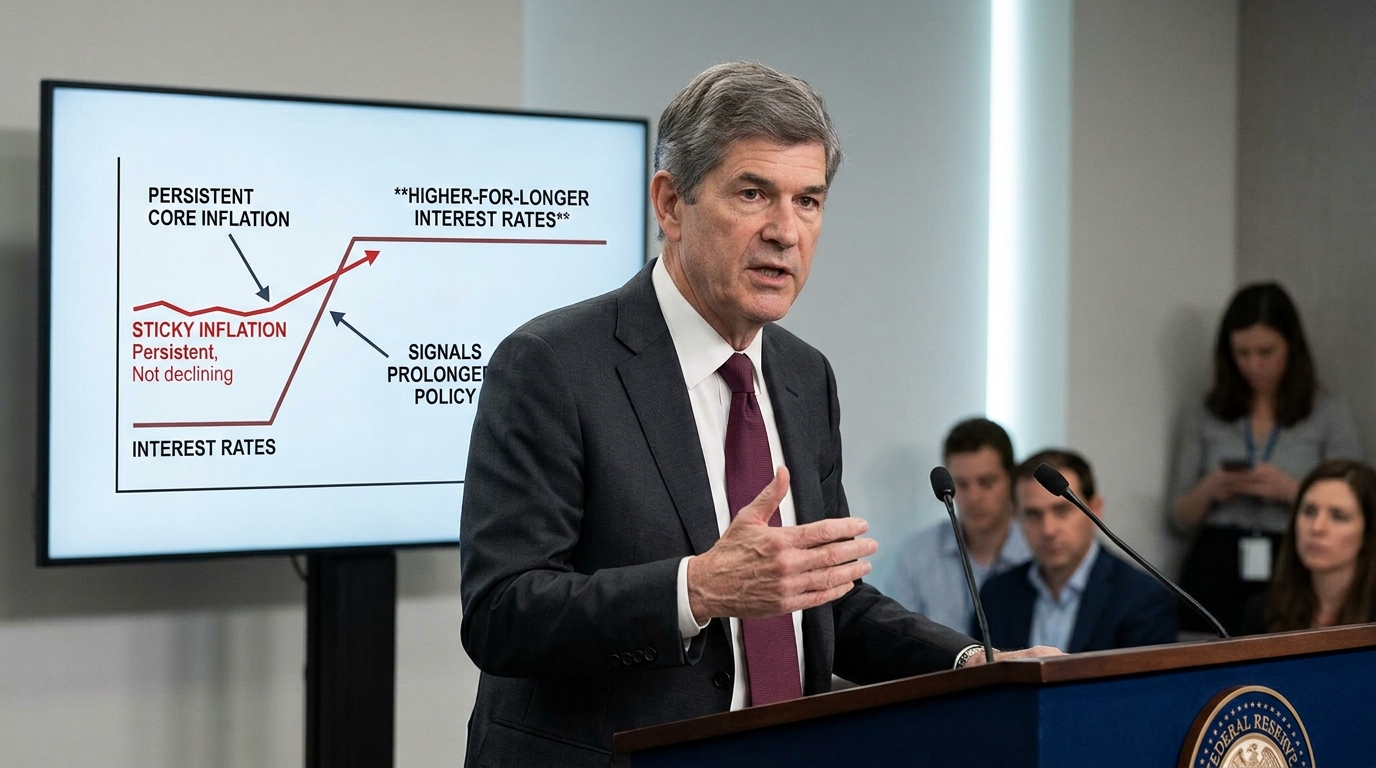
Why Federal Reserve Chair Warsh’s Focus on Sticky Inflation Signals Prolonged Higher-for-Longer Interest Rate Policy
The low-interest rate era is officially dead, and the Federal Reserve’s new chief just delivered its formal eulogy.
When Federal Reserve Chair Kevin Warsh took the stage at the Jackson Hole Economic Policy Symposium, global markets were desperate for a lifeline—a subtle hint of rate cuts or a promise of monetary relief. Instead, they received a stark warning on sticky inflation that reshaped the global economic playbook.
By declaring that current financial conditions are far from restrictive and emphasizing that the central bank has "work to do" if price pressures do not cool at sufficient speed, Warsh signaled a tectonic shift. The message is clear: the central bank is locking in a prolonged "higher-for-longer" interest rate environment.
The Hard Data and Warsh’s Hawkish Pivot
To understand why global markets reacted with such intense volatility, one must separate monetary myth from institutional reality.
The Macroeconomic Backdrop
Since taking office as the 17th Federal Reserve Chair, Kevin Warsh has operated in a challenging economic climate. Despite mid-summer reports showing a slight moderation in headline price spikes, underlying inflation metrics remain stubbornly detached from the Fed's rigid 2% objective.
Institutional Realities & Historical Record
- The Demise of Forward Guidance: Warsh explicitly abandoned the traditional practice of "forward guidance"—the policy of providing detailed advance roadmaps of future rate movements—calling it a crisis-era legacy that has overstayed its welcome.
- Sticky Inflation Dynamics: According to Federal Reserve data, over 54% of goods and services tracked by the U.S. government have sustained annual price increases of 3% or higher—well above the 32% historical average seen over the two decades preceding the pandemic.
- Unyielding Policy Independence: Despite intense external political pressure calling for rapid rate cuts, Warsh reiterated the central bank’s complete operational independence, asserting that restoring price stability is non-negotiable.
What’s Next? Hype, Probabilities, and Future Scenarios
While verified historical data paints a picture of current monetary policy, market participants are focused on what lies ahead. As wall street traders and corporate CFOs recalibrate their models, three distinct potential future scenarios emerge.
Scenario A: The Hawkish Escalation (Best-Case for Inflation Control)
- The Setup: If upcoming Consumer Price Index (CPI) and Personal Consumption Expenditures (PCE) prints show zero meaningful structural cooling, market analysts speculate the Fed could execute active rate hikes.
- Potential Outcome: Yields on 10-year Treasury bonds could surge to multi-year highs. Corporate debt refinancing costs would spike, forcing over-leveraged tech firms and commercial real estate funds into immediate capital restructuring.
- Probability & Sentiment: Fixed-income futures markets rapidly repriced the probability of a rate hike in upcoming policy meetings upward, jumping past 50% immediately following the Jackson Hole address.
Scenario B: The Productivity Miracle via Artificial Intelligence
- The Setup: Warsh has repeatedly referenced the potential for rapid advances in productivity, driven by mass enterprise deployment of artificial intelligence, to expand global supply capabilities and naturally suppress inflation over time.
- Potential Outcome: If AI integration accelerates total factor productivity faster than historical norms, structural supply costs could drop significantly. This would allow the economy to grow robustly without generating demand-driven price spikes—achieving a "soft landing" without aggressive rate cuts.
- Probability & Sentiment: While central bank task forces continue studying these structural shifts, mainstream economists warn that AI-driven productivity gains typically take years to manifest across broad economic indicators.
Scenario C: The Stagflationary Trap (Worst-Case Scenario)
- The Setup: Exogenous geopolitical shocks—such as sustained volatility in global energy markets—could keep headline inflation elevated while high borrowing costs slow baseline economic growth.
- Potential Outcome: Consumers exhaust excess savings while corporations face shrinking profit margins alongside double-digit debt costs. Central banks would be forced to maintain high benchmark rates despite stalling job markets, creating a prolonged period of economic stagflation.
Strategic Variables to Track
Restoring price stability requires enduring higher borrowing costs over a long horizon. As investors, business leaders, and policymakers navigate this structural shift, four key variables will dictate the macro landscape:
- PCE & Core CPI Trajectories: Watch whether core services inflation drops consistently below 3% or remains structurally entrenched.
- Real Yield Spreads: Monitor long-term Treasury yields to gauge whether bond markets are pricing in sustained structural inflation or monetary tightening.
- Corporate Refinancing Walls: Track how mid-market firms handle upcoming debt maturities in a 5%+ benchmark environment.
- Labor Force Productivity Data: Measure whether capital expenditure in automation and technology yields tangible unit-cost reductions.
The era of easy money has closed. The defining economic storyline of the coming years won't be when rates drop, but how effectively the global economy adapts to a world where money has a real, lasting cost.
Clarifying Next Steps & Strategic Context
To better tailor follow-up analysis or custom projections to your exact scenario, sharing a bit more context can help refine the perspective:
Disclaimer: This article is strictly for informational, educational, and editorial purposes and does not constitute financial, investment, legal, or professional advice. All forward-looking projections, speculative scenarios, and market sentiments represent possibilities rather than guaranteed outcomes.