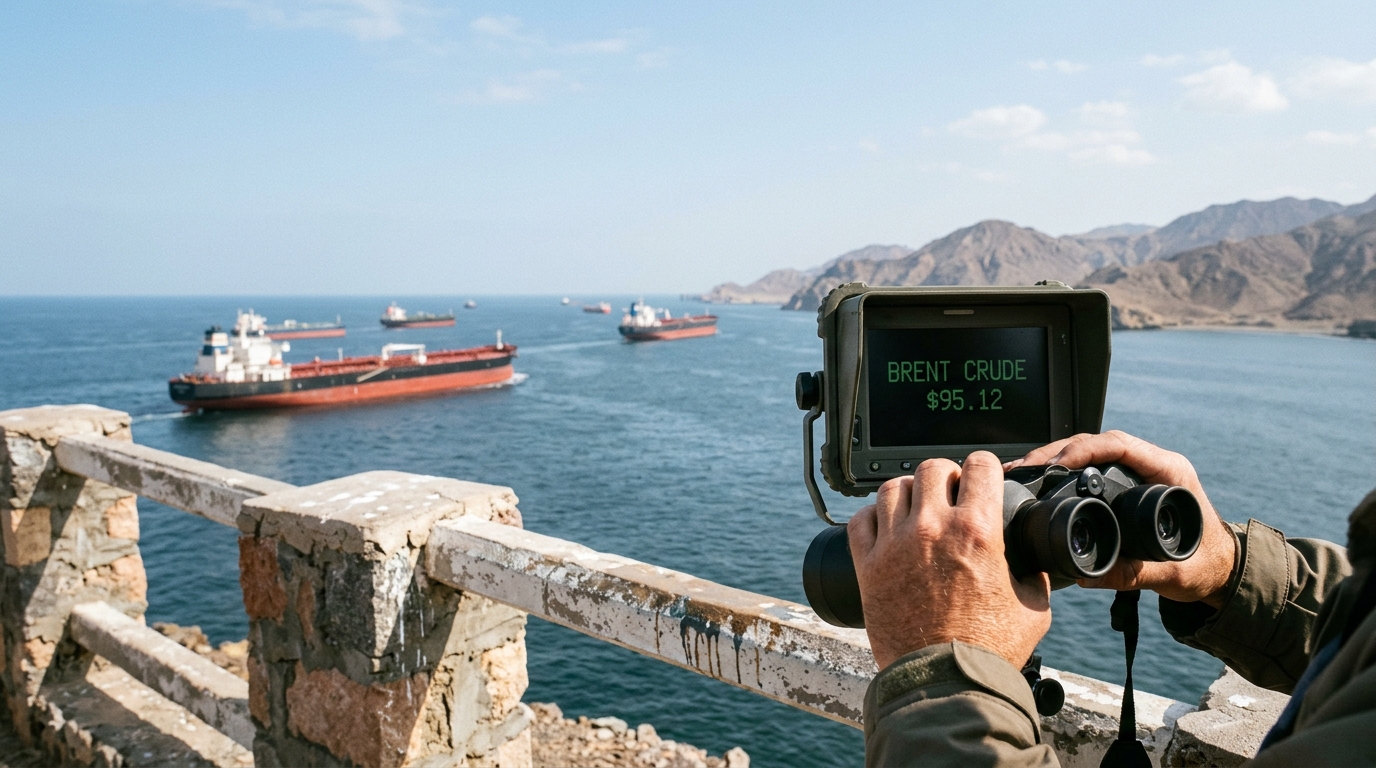
Brent Crude Holds Near $95 Per Barrel as Strait of Hormuz Shipping Disruptions Persist
The Strait of Hormuz has become the ultimate high-stakes bottleneck of the global energy architecture.
Over the past week, Brent Crude pushed past $95 per barrel and swung toward $98. This escalation follows physical exchanges of strikes involving U.S. forces and Iranian vessels, combined with a sharp rise in tanker diversions and soaring war-risk insurance premiums. As commercial shipping through the Persian Gulf plummets to a fraction of its baseline volume, energy markets are confronting a fundamental paradigm shift: $95 is no longer just a temporary spike; it is rapidly consolidating as a structural price floor.
The Reality: Chokepoint Gridlock and Physical Supply Constraints
The Strait of Hormuz typically handles roughly 20% of global petroleum liquids—serving as the primary conduit for crude exports from Saudi Arabia, Iraq, the UAE, Kuwait, and Iran. Current maritime intelligence indicates that physical transit throughput has dropped dramatically, with transit counts falling to a handful of vessels per day as shipowners reroute or hold tankers outside the Gulf.
Structural Drivers of the $95+ Crude Floor
- Skyrocketing War-Risk Premiums: Marine insurers have expanded high-risk areas across the Persian Gulf, forcing vessel operators to weigh prohibitive insurance costs against detour logistics.
- Rerouted Trade Flows: Major Asian refiners—particularly in India and China—are shifting procurement toward Atlantic Basin, West African, and Russian grades, driving up global freight costs and spot differentials.
- Commercial Inventory Draws: U.S. crude inventories recently posted a larger-than-expected draw of 4.5 million barrels, signaling that refiners are drawing on commercial stockpiles to maintain throughput. Nation Thailand
- OPEC+ Production Lags: Although OPEC+ announced gradual production quota adjustments, internal compliance tracking shows actual output lagging announced ceilings by 300,000 to 500,000 barrels per day. The Eastern Herald
The Horizon: Scenarios, Probability Horizons, and Market Dynamics
As energy markets adapt to extended supply chain friction, market analysts, commodity desks, and institutional macro strategists are modeling three potential trajectories.
1. The Extended Friction Scenario (Base Case Probability)
Maritime intelligence firms project that commercial shipping through the Strait could remain constrained into late Q4. Under this scenario, oil prices are expected to range between $85 and $100 per barrel. Alternate pipeline routes—such as Saudi Arabia’s East-West Pipeline (5 million bpd capacity) and Abu Dhabi’s HABSHAN-FUJAIRAH line (1.5 million bpd)—would operate near peak capacity, mitigating a total global deficit but leaving zero margin for operational error.
2. The Full Disruption Escalation (Bullish Tail-Risk)
Major institutional commodity research teams note that if maritime traffic through the chokepoint faces extended, complete disruption, Brent Crude could spike above $120–$130 per barrel. This outcome would trigger global central bank interventions, emergency strategic petroleum reserve (SPR) releases, and demand destruction across major industrial economies.
3. Strategic Rerouting & Diplomatic Resolution (Bearish Case)
If diplomatic channels secure safe-transit corridors or de-escalation agreements take hold, market risk premiums would unwind quickly. Under this scenario, institutional consensus models foresee Brent retracing toward $75–$85 per barrel by year-end, supported by expanded non-OPEC production from the Americas. Markets.com
Key Variables to Watch
The fundamental trajectory of global fuel prices and inflation expectations over the coming months will be determined by four core catalysts:
- OPEC+ Policy Statements: Watch for emergency quota adjustments or direct volume support signals from Riyadh and Abu Dhabi.
- Commercial Shipping Insurance Rates: Changes in war-risk coverage boundaries and hull insurance pricing serve as leading indicators for physical tanker movements.
- SPR Utilization: Whether major import nations execute coordinated strategic stockpile releases to stabilize spot markets.
- Alternative Pipeline Infrastructure: Operational throughput data across non-Hormuz land bypass pipelines in the Arabian Peninsula.