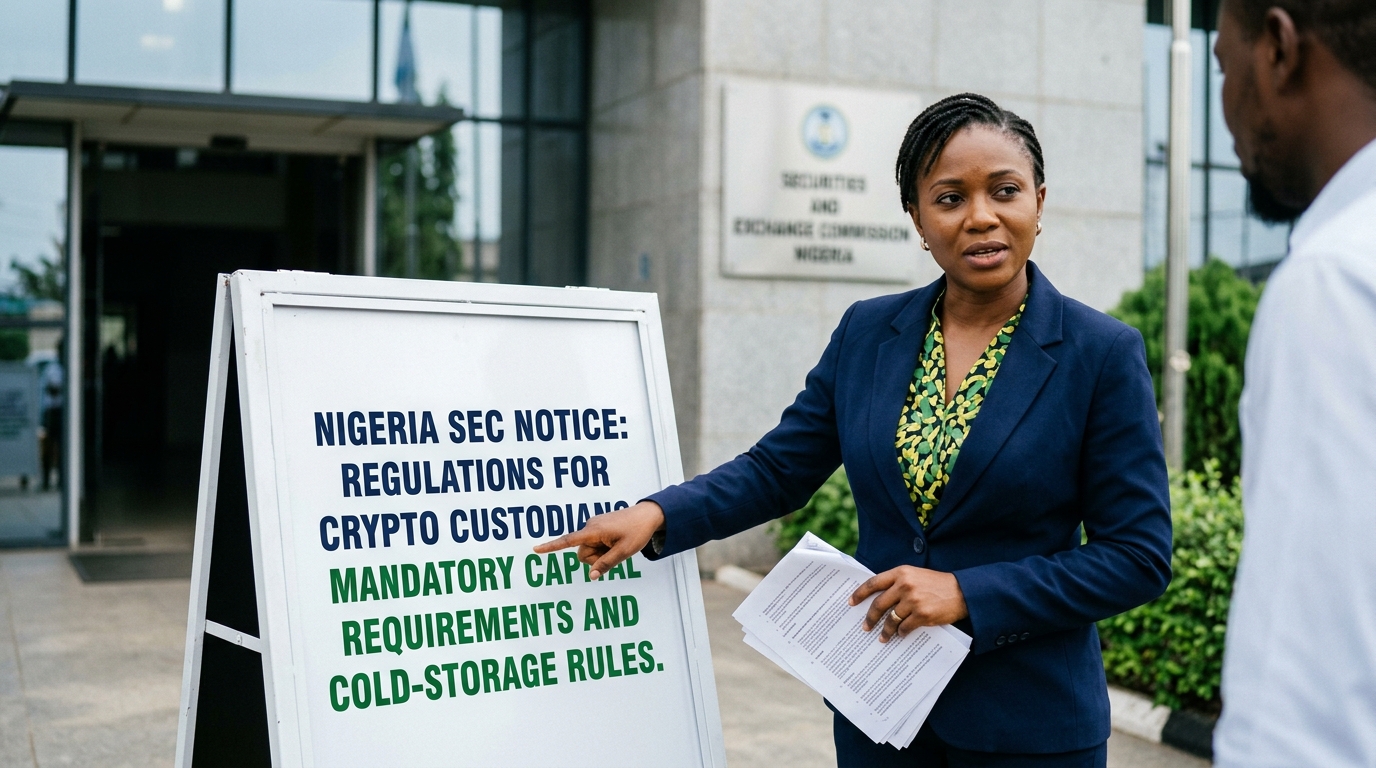
Nigeria SEC Enforces Strict Capital Rules and Mandatory Cold-Storage Mandates for Crypto Custodians
Fortress Africa: Inside Nigeria’s ₦2 Billion Capital Hammer and 80% Cold-Storage Mandate
The era of unregulated, offshore crypto exchanges treating Africa’s largest peer-to-peer digital asset market as a playground has officially come to an end.
On August 20, 2026, Nigeria’s Securities and Exchange Commission (SEC) published a landmark regulatory overhaul titled Proposed Rules on Digital and Virtual Assets Operations, Custody and Markets. The document lays out some of the strict financial and technical requirements for digital asset custodians and virtual asset service providers (VASPs) anywhere on the continent.
Under the proposed framework, Digital Asset Exchanges (DAXs) and Digital Asset Custodians operating in or targeting residents of Nigeria must maintain a minimum paid-up capital of ₦2 billion (upped from the previous ₦500 million floor) alongside a ₦30 million registration fee.
Adding to this balance-sheet test is an uncompromising technical safeguard: a strict mandate requiring custodians to hold at least 80% of all client crypto assets in offline cold storage.
By pairing Wall Street-style capitalization requirements with mandatory cold-storage protocols and local C-suite presence rules, Abuja is sending a message: If you want to touch Nigerian retail liquidity, you must build institutional vaults, prove local solvency, and put down ironclad reserves.
To understand why the Nigerian SEC is deploying such aggressive enforcement measures, financial analysts must look at the structural facts, regulatory history, and operational mechanics outlined in the commission's filings.
The Capital Fortress: ₦2 Billion and the Fidelity Bond
The August 2026 rulebook expands on the SEC's earlier capital circular from January 2026, which quadrupled the paid-up capital requirement for exchanges and custodians from ₦500 million to ₦2 billion.
- Fidelity Insurance Mandate: In addition to the ₦2 billion paid-up capital, Schedule I requires entities to maintain a current fidelity insurance bond covering at least 25% of the stipulated minimum capital.
- Local Incorporation and C-Suite Mandate: Foreign offshore entities can no longer serve Nigerian residents via remote digital channels without establishing a registered local office and appointing a resident Chief Executive Officer or Managing Director.
- Broad Scope of Jurisdiction: The proposed rules explicitly apply to any person or platform offering virtual asset activities targeting Nigerian investors, whether directly, indirectly, or through digital channels. KuCoin
The 80% Cold-Storage Rule Mechanics
To neutralize the risk of catastrophic hot-wallet hacks, systemic insolvency, or misuse of customer funds, the SEC’s proposed custody provisions establish strict operational boundaries:
- 80% Offline Floor: Licensed Digital Asset Custodians must keep at least 80% of customer digital and virtual assets in offline cold storage. Hot and warm wallet infrastructure is strictly capped to the minimal liquidity required for daily operational withdrawals and transaction settlements.
- Key Management & Proof-of-Reserves: The rules mandate advanced cryptographic security standards, including Multi-Party Computation (MPC), multi-signature protocols, hardware security modules (HSMs), and strict segregation of duties for private key access. Custodians are also subject to 24-hour mandatory reporting windows for any security incidents.
- Asset Segregation: Client funds must be completely segregated from the platform’s general corporate treasury, shielding retail assets from corporate creditors or operational losses.
As the SEC’s public comment period concludes, the Nigerian crypto ecosystem stands at a critical crossroads. Industry groups like the Virtual Asset Service Providers Association of Nigeria (VASPA) have pushed back, arguing that a rigid 80% cold-storage rule and uniform ₦2 billion capital floor could stifle smaller local startups and favor deep-pocketed foreign incumbents. Blockwisely
Three key forward-looking scenarios are emerging across West Africa's fintech landscape.
Scenario A: Institutional Consolidation & Institutional Inflow (Trend-Driven Probability)
Industry analysts are watching to see if the ₦2 billion capital threshold acts as a catalyst for widespread market consolidation.
One potential scenario is that smaller domestic crypto brokers will be forced to merge, acquire local banking partners, or pivot to secondary sub-broker licensing categories. Market sentiment suggests that once regulated platforms achieve compliance, major African commercial banks and traditional asset managers could enter the market, offering institutional-grade crypto custody and tokenized real-world asset (RWA) products directly to corporate treasuries.
Scenario B: P2P Liquidity Fragmentation and Regulatory Arbitrage (Worst-Case Outlook)
While unproven, some risk intelligence strategists speculate that excessively high entry barriers could backfire by driving retail users back into unmonitored peer-to-peer (P2P) shadow markets.
Fintech observers hypothesize that if global platforms elect to exit the Nigerian market rather than pay the ₦2 billion capital requirement and open local offices, everyday traders could migrate to decentralized communications channels and non-custodial OTC networks. In this scenario, analysts predict that tracking national remittance flows could become far more difficult for regulators, undermining the SEC's market oversight goals.
Scenario C: The Rise of Pan-African Multi-Sig Custody Vaults (Best-Case Probability)
A scenario widely discussed among blockchain security architects is that the SEC’s custody rules will spur technological innovation in institutional key management.
Market commentators theorize that rather than relying on legacy hardware wallets, custodians will deploy advanced Multi-Party Computation (MPC) systems that meet the SEC’s 80% cold-storage mandate while enabling automated, sub-second settlement speeds. Under this best-case framework, Nigeria could become Africa's premier hub for institutional digital asset custody, setting a benchmark for other African nations building out regulatory frameworks.
The Nigerian SEC’s draft rules represent a decisive step toward professionalizing one of the world's most dynamic crypto markets. By replacing regulatory ambiguity with explicit capital floors, fidelity insurance mandates, and strict cold-storage requirements, regulators are signaling that retail protection is paramount.
As implementation timelines draw closer, compliance leads, exchange operators, and institutional investors should monitor four critical variables:
- Final Rulebook Amendments: Track whether the SEC adjusts the ₦2 billion capital floor or 80% cold-storage rule in response to industry feedback from groups like VASPA.
- ARIP Approval Velocity: Watch how quickly applicants move through the Accelerated Regulatory Incubation Program (ARIP) portal toward full licensing.
- Offshore Exchange Compliance: Monitor whether major international exchanges establish local Nigerian corporate entities and appoint resident C-suite officers to retain local access.
- Stablecoin Reserve Audits: Assess how foreign and domestic stablecoin issuers comply with the tiered 100%–150%+ reserve collateral mandates.
The digital asset sector in Africa is growing up. As capital and custody rules take final shape, the platforms that survive will be those built on rock-solid financial foundations and uncompromised cryptographic security.
Editorial & Risk Disclaimer: This article is written strictly for educational, informational, and analytical purposes. It does not constitute legal, regulatory, compliance, tax, or financial investment advice. Regulatory provisions, capital requirements, and speculative scenarios reflect editorial research of public SEC Nigeria filings and draft rulebooks, not guaranteed regulatory outcomes. Readers should consult qualified legal counsel and financial compliance professionals before making operational or investment decisions.