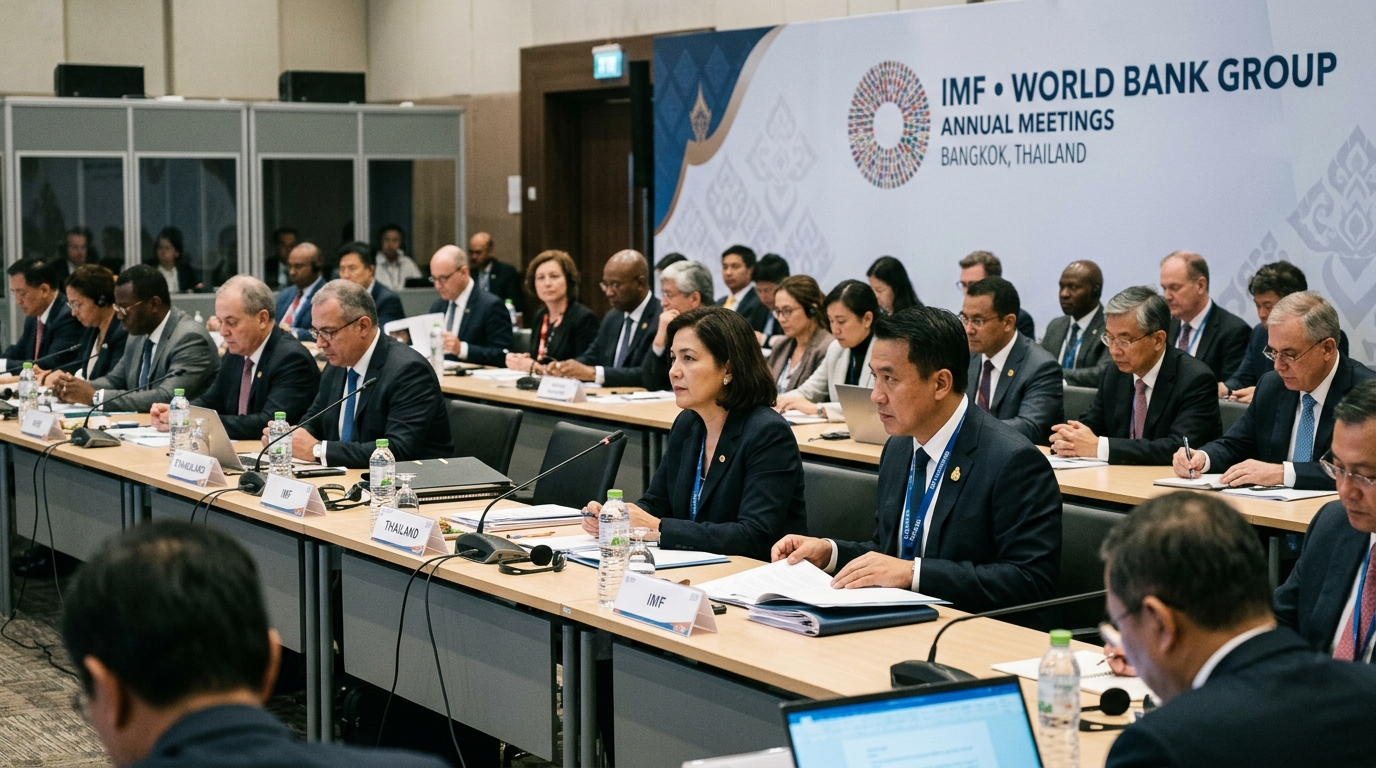
The Bangkok Standoff: Inside the High-Stakes Clash Over Global Debt and Economic Fractures
Under the humid October sky of Bangkok, Thailand, the international financial architecture is undergoing its most grueling stress test in a generation.
As the 2026 Annual Meetings of the International Monetary Fund (IMF) and the World Bank Group officially opened at the Queen Sirikit National Convention Center, representatives from 191 member nations gathered under the shadow of a perilous macroeconomic reckoning. Global public debt is careening toward an unprecedented horizon—with advanced-economy fiscal deficits ballooning and total public liabilities threatening to crush sovereign balance sheets—while escalating Middle East hostilities, dwindling global oil buffers, and intense trade friction threaten to stall global growth.
The mood inside the executive suites is far from routine diplomacy. Behind closed doors, central bank governors, finance ministers, and multilateral leaders are confronting a bitter divide. On one side of the table sit advanced economies grappling with excessive structural deficits and surging government bond yields; on the other sit emerging and developing nations bearing the brunt of high interest rates, energy price shocks, and crushing debt-service costs.
With world leaders like World Bank President Ajay Banga warning of compounding economic strains and IMF Managing Director Kristalina Georgieva rallying over 18,000 delegates to address an increasingly fragile global order, the fundamental question echoing through the halls of Bangkok is stark: Can multilateralism still deliver—or are we witnessing the permanent fragmentation of the post-WWII economic system? CNBC Africa
To grasp the intense atmosphere surrounding this year's summit, one must analyze the hard financial metrics and structural fault lines facing policymakers as discussions unfold.
The Sovereign Debt Avalanche and the Yield Shock
The primary shadow looming over the Bangkok sessions is a staggering buildup in sovereign liabilities. Years of crisis spending, defense expansions, and fiscal deficits—particularly in major Western capitals—have triggered severe anxiety across fixed-income markets.
The benchmark U.S. 10-year Treasury yield has climbed toward 5.25%, pulling global sovereign borrowing costs upward in its wake. In Europe, sovereign bond spreads have widened noticeably, reflecting investor fears over fiscal sustainability. While advanced economies struggle to contain high debt servicing costs, the shockwaves hit developing nations hardest. Emerging markets are forced to spend unprecedented portions of national revenue simply servicing foreign-denominated debt, diverting vital capital away from energy infrastructure, healthcare, and local economic development. OMFIF+ 2
Slow-moving debt restructuring mechanisms under multilateral frameworks have failed to keep pace with the crisis, leaving several low-income economies trapped in protracted negotiations between traditional bilateral lenders, private bondholders, and non-Western credit providers.
Energy Infrastructure Friction and Declining Reserves
Geoeconomic fragmentation and active military conflict have transformed from abstract risks into direct threats to physical trade. Lingering Middle East hostilities and maritime restrictions in key trade corridors have placed immense pressure on global fuel and commodity supplies.
World Bank leadership highlighted that global accessible oil storage reserves are declining at a rate of roughly 2.7 million barrels per day, leaving energy markets uniquely vulnerable to localized price spikes. Spikes in refined diesel and fertilizer prices are compounding agricultural and transport costs, directly threatening food security across import-dependent nations in Africa, Asia, and Latin America.
The AI Capital Boom vs. Economic Inequality
A central topic across the Bangkok panels focuses on artificial intelligence and its dual impact on capital deployment and economic divergence. The IMF noted that massive private capital investments in computer hardware, data centers, and power generation have provided a crucial tailwind to global growth—helping raise the IMF's 2026 global GDP forecast slightly to 3.1%.
However, this growth is strikingly unequal. A mere 32 economies currently account for roughly 95% of total global economic growth, down from 54 economies in prior years. Tech-exporting nations in East Asia are experiencing rapid expansions driven by hardware demand, while developing economies without advanced digital infrastructure face the threat of falling further behind. Furthermore, multilateral institutions warned that if massive corporate AI spending fails to generate real-world productivity gains, equity markets could face sharp downward revisions, exposing the global financial system to additional instability.
As central bankers and finance ministers attempt to draft joint statements behind closed doors, market analysts and macroeconomic strategists are evaluating how these compounding crises could evolve over the coming years. Three primary forward-looking scenarios outline the current probabilistic landscape.
Scenario A: Managed Fiscal Stabilization (Estimated Probability: ~45%)
In this baseline scenario, major economies implement targeted fiscal discipline, slowing the expansion of sovereign debt without causing an immediate growth collapse.
Central banks manage to stabilize long-term yield volatility, providing relief to global fixed-income markets. Targeted multilateral debt-relief mechanisms allow distressed developing nations to restructure short-term obligations into manageable, long-dated development bonds. Meanwhile, investments in energy grid diversification and alternative transport corridors help rebuild depleted oil reserves, allowing global growth to track near its 3.1% baseline through the end of the decade.
Scenario B: Chronic Geoeconomic Fragmentation (Estimated Probability: ~35%)
Under this scenario, ongoing geopolitical tensions prevent effective coordination on sovereign debt frameworks and global trade policies.
Energy market shocks periodically reignite inflation, forcing central banks to maintain hawkish monetary stances and elevated policy rates. High borrowing costs trigger sovereign defaults across multiple vulnerable emerging markets. Global financial markets split into distinct clearing blocs, with non-Western settlement networks operating parallel to traditional Western rails. Overall economic expansion slows significantly as transaction costs rise and trade barriers multiply.
Scenario C: The AI Valuation Correction and Sovereign Bond Panic (Estimated Probability: ~20%)
A worst-case scenario considers the simultaneous convergence of a tech valuation shock and a sovereign debt crisis.
If massive investments in artificial intelligence fail to translate into tangible productivity gains, corporate earnings fall short of expectations, triggering a potential 20% correction in global equity markets. Concurrently, persistent fiscal deficits in major Western economies push long-term government bond yields to historic highs, triggering severe tightening in global credit markets. Multilateral institutions are forced to deploy emergency liquidity facilities on an unprecedented scale to prevent widespread banking and sovereign debt contagion. Livemint
The 2026 IMF-World Bank Annual Meetings in Bangkok mark a decisive transition point for the global economy. The old model of low borrowing costs, frictionless supply chains, and fiscal expansion is no longer viable. How global leaders address record public debt, energy vulnerability, and technological disruption over the coming days will set the financial trajectory for the decade ahead. TheCable
For policymakers, corporate leaders, and global investors, four critical indicators will signal where the world economy moves next:
- Concrete Deliverables on Sovereign Debt Frameworks: Watch whether the Bangkok sessions produce binding, streamlined mechanisms to accelerate debt restructuring for low-income and vulnerable middle-income nations.
- Sovereign Bond Yield Trajectories: Track benchmark U.S. and European government bond yields for signals on whether fiscal deficit anxieties will continue tightening global financial conditions.
- Global Energy Reserve Replenishment: Monitor physical crude and refined fuel storage metrics to see if energy buffers stabilize or continue eroding toward critical thresholds.
- AI Capital Expenditure Productivity Metrics: Observe upcoming corporate earnings reports to evaluate whether multi-billion-dollar investments in digital infrastructure are yielding measurable productivity gains across the broader economy.
The discussions in Bangkok have laid bare the stakes. Restoring long-term global stability requires moving past short-term crisis containment to build a resilient, adaptable economic architecture equipped for a fragmented world.
LIVE: IMF-World Bank Annual Meetings 2026 LIVE
This live broadcast from Bangkok provides real-time coverage and official briefings from world financial leaders during the 2026 IMF-World Bank Annual Meetings.