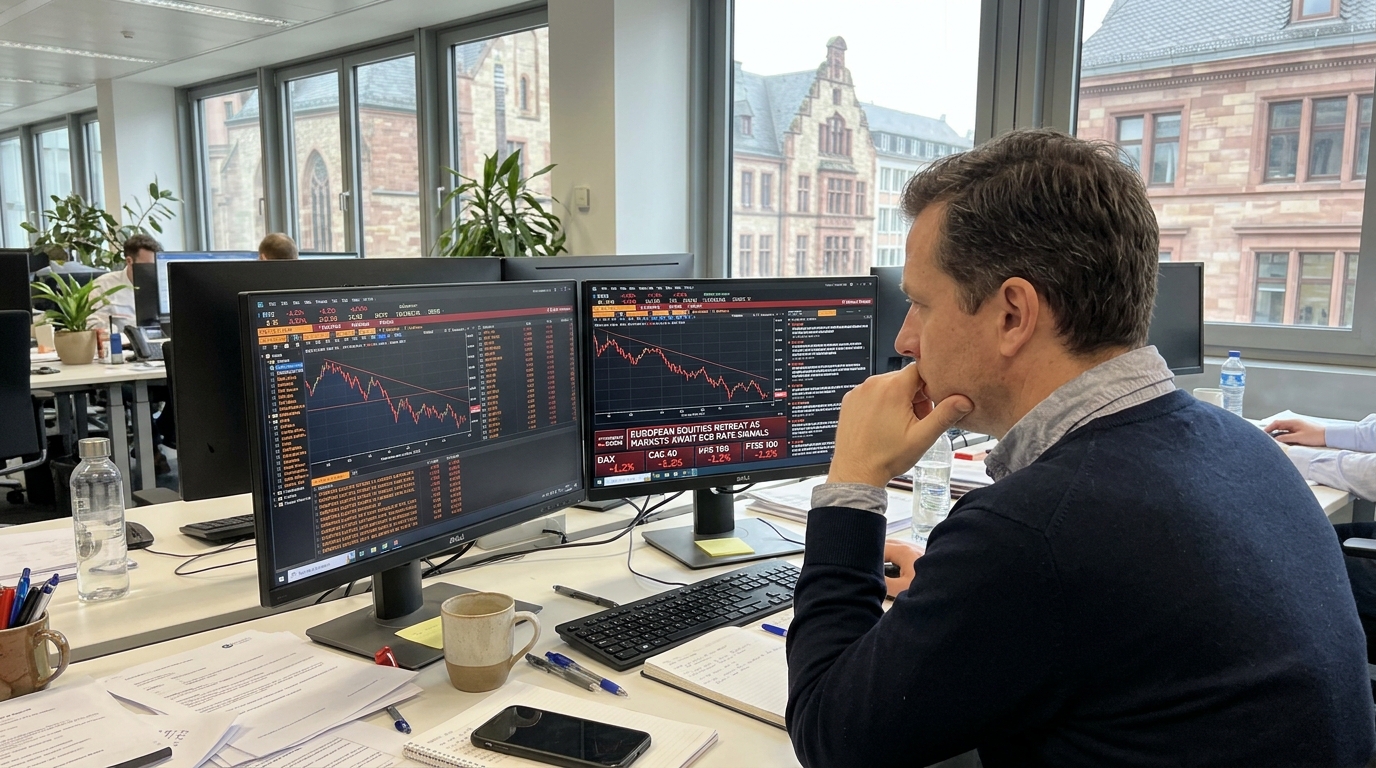
European Equities Retreat as Markets Await Central Bank Policy Rate Signals and Corporate Earnings
A heavy cloud of institutional caution has settled across the bourses of Frankfurt, Paris, London, and Milan.
After months of navigating shifting disinflation trends and an uncertain macroeconomic recovery, European equities have pulled back into a defensive crouch. Portfolio managers across major financial centers are choosing to trim exposure, freezing fresh capital deployments as they brace for a high-stakes convergence of monetary policy declarations and Q3 corporate earnings results.
The benchmark STOXX Europe 600, along with regional heavyweights like Germany’s DAX and France’s CAC 40, are experiencing a synchronized multi-session retreat. This is not an unprompted liquidity collapse or a panic-driven market flush. Instead, it represents a calculated institutional pause. Traders and multi-asset funds are unwilling to bid valuation multiples higher until central bankers clarify the future path of interest rates—and until European blue-chip corporations demonstrate that their balance sheets can withstand elevated borrowing costs, sticky input inflation, and softening consumer demand.
With the European Central Bank (ECB) preparing its latest rate decision and a wave of corporate reporting breaking across banking, industrial, and luxury sectors, European finance stands at a critical crossroads. The coming days will determine whether this equity retreat is simply a temporary breath-catcher within a broader structural recovery or the opening phase of a deeper valuation adjustment.
To understand the mechanics of the current European market pull-back, we must look at the verified economic metrics, interest rate decisions, and sector-by-sector fundamentals driving market sentiment.
The Monetary Policy Shadow: The ECB’s Delicate Calculus
At the core of the market’s hesitation is the European Central Bank’s monetary stance. Following an aggressive rate-hiking cycle that brought benchmark deposit rates into restrictive territory, the ECB has transitioned into a highly sensitive, data-dependent holding pattern.
While headline inflation across the Eurozone has moderated significantly from its multi-year peaks, core inflation—which excludes volatile energy and food inputs—remains persistent. This sticky underlying price pressure complicates the central bank’s trajectory. Money markets have been frantically recalibrating the timing, magnitude, and frequency of potential policy rate adjustments.
Investors are grappling with a clear structural divergence:
- The Hawkish Friction: Central bank officials remain hyper-vigilant regarding wage growth and services-sector inflation. Premature rate cuts risk reigniting inflationary pressures, potentially forcing policymakers into painful secondary tightening cycles down the line.
- The Growth Drag: Elevated real interest rates continue to exert severe friction on commercial bank lending, domestic credit expansion, and industrial investment across the continent.
Because equity valuations are directly anchored to risk-free benchmark yields, the lack of explicit forward guidance from ECB policymakers has driven sovereign bond yields higher, compressing equity risk premiums and prompting institutional desks to de-risk.
Corporate Earnings Under the Microscope
Compounding the monetary anxiety is the arrival of the third-quarter corporate earnings season. European equities are facing a rigorous fundamental stress test across three core pillar sectors:
- Banking & Financial Services: Eurozone lenders have benefited immensely from expanded net interest margins (NIM) over the past several quarters. However, analysts are scrutinizing earnings reports for signs that net interest income has peaked. As loan demand cools and non-performing loan (NPL) provisions tick upward, the financial sector's ability to single-handedly carry index earnings growth is being put to the test.
- Industrial Manufacturing & Export Leaders: Heavy industrial components across Germany and Northern Europe continue to navigate elevated energy input costs, supply chain realignments, and sluggish demand from key international trade partners. Earnings guidance from manufacturing giants is being parsed line-by-line for indications of margin compression.
- Consumer Discretionary & Luxury Goods: European luxury powerhouses and high-end consumer brands, which carried outsized index weightings during previous market rallies, are confronting a cooling domestic market alongside softening demand in major export destinations.
As institutional market participants digest incoming economic prints and central bank statements, research desks are evaluating three distinct forward-looking scenarios for European equity markets over the next two to four quarters.
Note: The scenarios, valuation targets, and probability assessments detailed below represent forward-looking financial analysis and economic modeling, not guaranteed market outcomes.
Scenario A: The Disinflationary "Soft Landing" Rebound (Moderate-to-High Probability)
In this optimistic scenario, upcoming economic releases confirm that Eurozone disinflation remains on track, allowing the ECB to signal a clear, structured roadmap for monetary easing. Concurrently, corporate earnings results demonstrate that European firms have successfully preserved operating margins through cost-efficiency programs and supply chain adjustments.
If this Goldilocks dynamic takes hold:
- Sovereign bond yields ease, taking pressure off equity discount rates and restoring market confidence.
- Institutional capital sidelined during the current retreat flows aggressively back into high-quality cyclical equities, industrial leaders, and green infrastructure platforms.
- The STOXX Europe 600 reclaims its recent high-water marks, driven by a widening of market breadth beyond defensive sectors.
Scenario B: The "Stagflationary Grind" and Margin Squeeze (Moderate Probability)
A second, more challenging outcome assumes that core inflation prints remain uncomfortably sticky due to energy price volatility and wage rigidity. Trapped by persistent price pressures, central banks are forced to maintain restrictive policy rates far longer than futures markets currently price in.
Under these stagflationary conditions:
- High borrowing costs continue to choke off corporate capital expenditure and domestic consumer spending.
- Corporate earnings projections face widespread downward revisions as input costs remain high while pricing power evaporates.
- Equities undergo a broader valuation contraction, with index heavyweights in rate-sensitive sectors experiencing prolonged price pressure, forcing capital into defensive havens such as utilities and healthcare.
Scenario C: The Macro Credit Tightening Drawdown (Low-to-Moderate Tail Risk)
A third, worst-case scenario models a deeper macroeconomic downturn triggered by the cumulative, lagged impact of aggressive monetary tightening. If credit contraction accelerates across the Eurozone banking sector, default rates rise, and consumer sentiment breaks down:
- Corporate earnings fall sharply across non-defensive sectors.
- Equity desks execute widespread risk-off liquidations, triggering a multi-quarter drawdown across primary European stock indexes.
- Central banks are forced to pivot to emergency rate cuts, not to manage an orderly economic normalization, but to arrest a worsening economic recession.
The current retreat across European equity markets is an operational pause as institutional capital waits for clarity. Investors are refusing to push equity multiples higher until the trajectory of monetary policy and corporate earnings visibility comes into sharp focus.
To determine whether the European stock market will resume its upward trend or face a deeper valuation adjustment, market observers must track four key macroeconomic variables in the weeks ahead:
- Core CPI and Wage Growth Metrics: Track Eurozone core inflation and labor market compensation indices. Any unexpected uptick in core price pressures will directly delay central bank easing timelines. Morningstar
- Central Bank Forward Guidance: Analyze the language of upcoming ECB policy press conferences. Shifts from strict data-dependency to proactive growth support will serve as a major green light for risk assets. TokenPost
- Corporate Margin Resilience: Watch Q3 profit margins and forward-looking guidance from major European exporters and industrial conglomerates. Look for whether companies can maintain profitability without sacrificing sales volume.
- Sovereign Bond Yield Dynamics: Keep a close eye on German 10-year Bund yields. Sustained downward movement in benchmark yields is essential to provide valuation relief for equities.
European markets are taking a breath. The upcoming policy statements and earnings reports will reveal whether the foundation beneath European equities remains solid enough to support the next leg of global market growth.
Disclaimer: This article is strictly for educational, news, and editorial purposes only and does not constitute financial, investment, legal, or tax advice. Global equity markets and foreign exchange rates carry inherent market risks and extreme volatility. Always perform independent research and consult a certified financial professional before making capital allocation decisions.