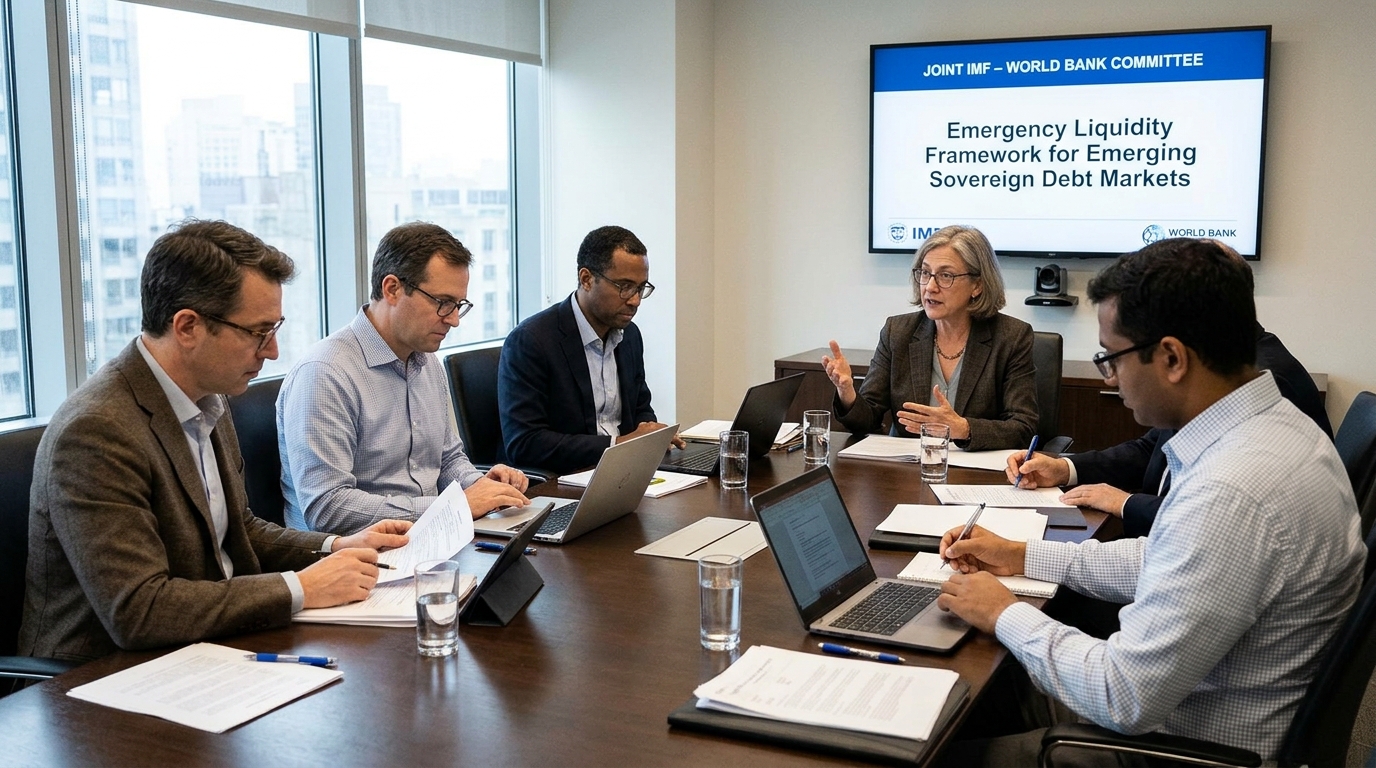
World Bank and IMF Joint Committee Outlines Emergency Liquidity Framework for Emerging Sovereign Debt Markets
For decades, the mathematical reality of sovereign debt in the Global South has followed a predictable, devastating script: when global interest rates spike, energy markets destabilize, and refinancing costs surge, a liquidity crunch in emerging markets quickly transforms into an existential solvency crisis.
That historic vulnerability has officially met its most aggressive institutional counter-strike.
At the 2026 Annual Meetings of the International Monetary Fund (IMF) and the World Bank Group in Bangkok, the joint Development Committee took the stage to outline an unprecedented Emergency Liquidity Framework. Designed specifically to insulate solvent but liquidity-starved emerging economies from being pushed over the financial cliff by external interest rate shocks, energy volatility, and currency devaluations, this structural innovation represents a fundamental shift in how the Bretton Woods institutions police global debt.
Rather than waiting for a sovereign government to deplete its foreign exchange reserves and default on international bonds before stepping in with punitive austerity programs, the new framework establishes a proactive, fast-disbursing liquidity backstop. By pairing modernized debt sustainability frameworks with immediate central bank liquidity lines and MDB balance-sheet optimization, the World Bank and IMF are attempting to sever the link between temporary market panic and long-term national bankruptcy.
Is this proactive liquidity shield the long-sought silver bullet that protects vulnerable nations from market turbulence, or will complex debt restructuring rules and systemic global headwinds challenge its ambition?
To understand why this emergency liquidity architecture was launched, one must analyze the severe financial pressures confronting emerging market debt desks in late 2026.
The Triple-Threat Stress Test
Emerging and developing economies are currently navigating a simultaneous, multi-front shockwave:
- The Refinancing Wall: Millions of dollars in sovereign bonds issued during the low-interest eras of the past decade are reaching maturity. Refinancing that debt today means accepting interest rates two to three times higher than the original coupons, swallowing vast portions of national budgets simply to service existing debt.
- Energy and Fertilizer Volatility: Ongoing regional conflicts and maritime choke-point disruptions have kept imported energy and fertilizer costs elevated. For net energy importers, paying for essential fuel in high-priced U.S. dollars rapidly drains foreign exchange reserves.
- Capital Flight and Currency Pressures: Elevated bond yields in Western capitals have created strong incentives for institutional capital to retreat from frontier markets, triggering currency devaluations across Africa, Latin America, and South Asia.
The Anatomy of the New Framework
The Emergency Liquidity Framework breaks away from traditional, slow-moving IMF structural adjustment programs by deploying three specific operational mechanisms:
- Pre-Approved Rapid Liquidity Windows: Qualified member states facing exogenous shocks—such as a sudden spike in imported oil or a sharp rise in global borrowing costs—can access immediate foreign exchange liquidity without undergoing months of drawn-out policy negotiations.
- Reformed Debt Sustainability Analysis (LIC-DSF): Following formal updates approved by the World Bank and IMF Executive Boards, the new Debt Sustainability Framework explicitly distinguishes between temporary liquidity distress and structural insolvency. This prevents inherently viable economies from being forced into unnecessary sovereign default procedures simply due to short-term market illiquidity.
- Integrated Debt Service Pause Clauses (CRDCs): The framework pushes for the broad standardization of Climate Resilient Debt Clauses and shock-contingent pauses across both official bilateral lending and private commercial eurobond contracts, automatically suspending debt service payments during catastrophic external events.
As central bank governors, international bondholders, and sovereign debt managers digest the details of the Joint Committee’s framework, geopolitical economists and global macro strategists are modeling three potential trajectories for the global financial architecture.
Note: The following scenarios reflect analytical modeling, market sentiment, and structural economic projections rather than guaranteed performance outcomes.
Scenario A: The Liquidity Buffer Success (Estimated Probability: ~50%)
- The Hypothesis: The rapid availability of pre-approved liquidity lines successfully dampens speculative panics in sovereign bond markets. Emerging market spreads narrow as private investors realize the IMF and World Bank stand ready to act as an immediate backstop. Solvent nations successfully navigate the 2026–2028 refinancing wall without suffering catastrophic currency devaluations or domestic austerity shocks.
- Market Sentiment Impact: Institutional capital flows re-enter local-currency and hard-currency emerging debt markets, recognizing that systemic default risks have been structurally curtailed.
Scenario B: The Bifurcated Safety Net (Estimated Probability: ~35%)
- The Hypothesis: Middle-income emerging markets with relatively strong institutional capacity utilize the emergency facility effectively, but low-income, heavily indebted nations remain trapped. Private creditors resist incorporating standardized debt-pause clauses into existing commercial debt, leading to a split system where stronger nations enjoy liquidity protection while vulnerable economies still face prolonged restructurings.
- Market Sentiment Impact: Credit ratings diverge sharply across the Global South. High-tier emerging markets trade at tight spreads, while lower-tier frontier nations remain frozen out of primary international capital markets.
Scenario C: Moral Hazard and Fiscal Friction (Estimated Probability: ~15%)
- The Hypothesis: The provision of low-conditionality emergency liquidity leads to political inertia, allowing some recipient governments to delay necessary domestic tax and fiscal reforms. When secondary external shocks hit, accumulated debt burdens prove unsustainable despite emergency infusions, forcing the multilateral institutions to absorb substantial credit losses and restructure the facility.
- Market Sentiment Impact: Global bondholders demand higher risk premiums across all sovereign debt, prompting major donor nations to insist on re-imposing strict, traditional austerity conditions.
The World Bank and IMF Joint Committee's Emergency Liquidity Framework represents a historic attempt to modernize the global financial safety net for an era of overlapping, continuous economic shocks. By building a circuit breaker that separates short-term liquidity bottlenecks from structural insolvency, the international community is trying to ensure that external geopolitical and interest-rate shocks do not obliterate decades of economic development. www.profilenews.com
For institutional investors, policy architects, and macro observers, four critical indicators will reveal whether this new architecture delivers real-world stability:
- Pre-Approval Qualification Volume: Track the number and geographic diversity of emerging-market nations that officially apply for and achieve pre-approved access under the new liquidity windows.
- Private Creditor Clause Adoption: Monitor the percentage of newly issued sovereign eurobonds that successfully include standardized emergency debt-pause clauses.
- Emerging Market Sovereign Spreads: Watch benchmark emerging market bond index (EMBI) spreads following the activation of early emergency credit lines to measure genuine market confidence.
- Refinancing Wall Rollover Rates: Observe the success rate and effective interest rates of middle- and low-income nations attempting to roll over maturing debt through 2027.
The era of passive crisis management in sovereign debt markets has officially ended. The battle to protect the financial stability of the Global South is now moving to the front lines of proactive liquidity intervention. IMF eLibrary - International Monetary Fund