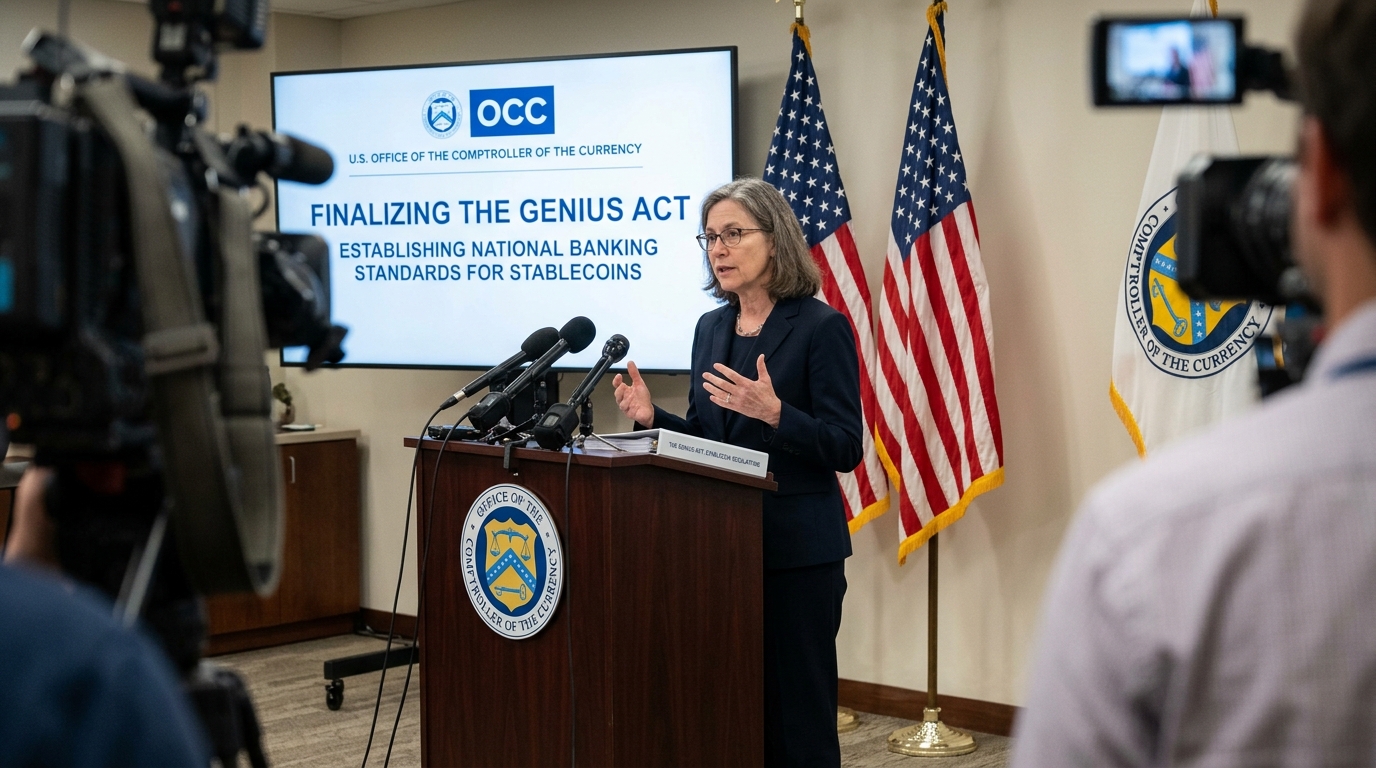
U.S. OCC Finalizes Landmark GENIUS Act Stablecoin Regulations to Establish National Banking Standards
The multi-trillion-dollar parallel universe of unregulated dollar tokens has officially hit its expiration date.
On October 21, 2026, the U.S. Office of the Comptroller of the Currency (OCC) released a landmark 12 CFR Part 15 final rule implementing the Guiding and Establishing National Innovation for U.S. Stablecoins Act—universally known as the GENIUS Act. Set to take effect on January 18, 2027, the regulation transforms payment stablecoins from speculative, offshore crypto-collateralized experiments into fully supervised, federal payment instruments governed alongside national banks.
This is the nuclear option for digital asset accountability. Under the OCC’s newly minted framework, any nonbank issuer, fintech giant, or commercial bank seeking to issue or market payment stablecoins to U.S. residents must secure explicit status as a Permitted Payment Stablecoin Issuer (PPSI).
By establishing a rigid $5 million ongoing capital floor, enforcing 100% segregated reserve backing, capping standard redemptions at two business days, and barring digital asset service providers from selling unauthorized tokens, Washington has fundamentally rewritten the rules of global monetary transport. The wild-west era of algorithmic pegs and opaque off-balance-sheet offshore reserves is over. The era of the federally chartered, auditable digital dollar has officially begun.
To navigate this seismic regulatory shift, executive C-suites, fintech founders, and institutional treasurers must cut through the political rhetoric and analyze the hard, verified mechanics of the OCC's final rule.
The Scope of the Regulatory Perimeter
The OCC’s 12 CFR Part 15 rule reaches across national banks, federal savings associations, foreign payment stablecoin issuers, and nonbank entities seeking federal PPSI qualification.
Crucially, the rule draws an absolute statutory line across the digital ecosystem:
- The Prior Approval Requirement: Beginning January 18, 2027, no entity may issue a payment stablecoin in the United States without prior federal or qualified state approval. Existing stablecoin issuers are not grandfathered; they must submit formal license applications and obtain temporary waivers to preserve operational continuity.
- Digital Asset Service Provider (DASP) Prohibition: Under the statutory authority of 12 U.S.C. § 5902, broker-dealers, exchanges, and digital wallets are legally prohibited from offering or selling stablecoins to U.S. persons unless those tokens originate from an approved PPSI or qualifying foreign issuer.
- The Wrapped Token & Deposit Boundary: The OCC explicitly clarified that tokenized bank deposits fall outside the stablecoin perimeter, while wrapped stablecoins are generally excluded from being classified as primary payment stablecoins—effectively forcing protocol architects to re-evaluate cross-chain bridging arrangements.
Capital Structure, Reserve Assets, and Operational Backstops
Departing from earlier bank-like equity proposals, the OCC finalized a customized capital and liquidity framework tailored specifically for tokenized payment rails:
- Ongoing Capital Floor: Issuers must maintain an ongoing capital floor of $5 million in GAAP equity (excluding goodwill, intangible assets, and deferred tax assets).
- The 12-Month Operational Backstop: PPSIs must hold an explicit operational backstop equal to 12 months of total operating expenses. Up to 50% of this backstop may be funded through qualifying debt instruments, providing structural flexibility for scaling firms. WilmerHale
- 100% Segregated Reserve Assets: Outstanding stablecoins must be backed 1:1 at all times by high-quality liquid assets—primarily physical U.S. currency, central bank deposits, and short-term Treasury bills. The OCC eliminated the controversial proposed requirement for mega-issuers ($25B+ market cap) to hold 0.5% of reserves as commercial insured deposits, opting instead for dynamic stress testing and tailored reserve buffers.
Redemption Mandates and the Yield Prohibition
To prevent catastrophic liquidity runs, the OCC codified a strict two-business-day maximum window for issuers to process direct holder redemption requests at par ($1.00). While the OCC eliminated an earlier proposal to automatically extend redemptions to seven days during high-volume market stress, issuers must notify regulators within 24 hours if redemptions exceed 10% of issuance in a single day.
Concurrently, the final rule codifies the GENIUS Act's statutory yield prohibition: issuers are strictly barred from paying interest or yield to holders solely for holding or retaining stablecoins. While the OCC dropped a proposed "rebuttable presumption" regarding third-party white-label yield schemes, it warned that it will aggressively evaluate application substance to block indirect yield evasions or nominal rewards workarounds.
With the January 18, 2027 enforcement deadline looming, financial strategists, banking executives, and Web3 architects are modeling how this federal rulebook will reshape global commerce over the next 36 months.
Scenario A: Institutional Banking Domination & Community Bank Alliances (Trend-Driven Probability)
Industry analysts are watching to see if the high compliance cost of securing a federal PPSI charter accelerates a massive wave of consolidation between Wall Street banks and tech-forward payment networks.
One potential scenario is that tier-one financial institutions launch dedicated bank-subsidiary issuers to capture the multi-trillion-dollar corporate settlement market. Concurrently, Comptroller leadership has emphasized that community banks can leverage subsidiary pathways to issue localized, compliant payment stablecoins without facing one-size-fits-all cost barriers. Market sentiment suggests that as bank-backed stablecoins integrate directly into FedNow and clearinghouse networks, legacy 3-day wire delays will be permanently replaced by sub-second, auditable dollar transfers.
Scenario B: Regulatory Fragmentation & Offshore Migration (Worst-Case Outlook)
While unproven, some decentralized finance advocates speculate that strict OCC oversight and the explicit ban on holder yield will push liquidity offshore into unmonitored jurisdictions.
Industry observers hypothesize that if non-U.S. platforms continue offering yield-bearing or algorithmic synthetic dollars, retail capital outside the United States could fragment away from regulated PPSI channels. In this scenario, analysts predict that U.S.-regulated issuers could dominate domestic enterprise payments while facing intense liquidity competition in international emerging markets, creating a bifurcated global digital dollar market.
Scenario C: The Programmable Corporate Treasury (Best-Case Probability)
A scenario widely celebrated among fintech strategists is that federal PPSI authorization will trigger the total modernization of enterprise working capital management.
Market commentators theorize that once Fortune 500 treasurers can rely on 100% reserve-backed, federally supervised stablecoins, corporate treasury departments will automate cash management using smart contracts. Under this operational model, global supply chains, cross-border vendor disbursements, and intra-company liquidity sweeps will settle programmatically 24/7/365, unlocking billions in dormant working capital.
The OCC’s final rule under the GENIUS Act marks the official bridge between traditional national banking oversight and decentralized financial technology. By establishing transparent, ironclad standards for capital, reserves, and redemptions, federal regulators have transformed payment stablecoins from volatile crypto commodities into core national payment infrastructure.
For bank directors, fintech founders, and enterprise risk officers preparing for the January 18, 2027 effective date, four strategic priorities demand immediate execution:
- PPSI Licensing & Waiver Strategy: Conduct an immediate readiness assessment to submit PPSI charter applications or secure temporary one-year waivers before the January deadline.
- Reserve & Liquidity Stress Testing: Upgrade data governance and reconciliation infrastructure to support real-time 100% reserve asset tracking and 2-day par redemption stress tests. Wolters Kluwer
- DASP & Distribution Due Diligence: Audit all third-party fintech, wallet, and exchange distribution agreements to ensure partner platforms interact strictly with federally approved issuers.
- Yield & Rewards Compliance Review: Re-evaluate all marketing, promotional, and affiliate rewards arrangements to ensure third-party incentives do not violate the GENIUS Act's strict interest-payment prohibitions. Morrison Foerster
The architecture of modern financial rails is being rebuilt in real time. Those who align their balance sheets with federal transparency today will lead the digital economy of tomorrow.
Editorial & Risk Disclaimer: This article is strictly for educational, informational, and analytical purposes. It does not constitute legal, tax, financial, or investment advice. Regulatory rules, OCC bulletins, and speculative scenarios reflect editorial research of public government notices and legal analyses. Readers should consult qualified banking counsel and regulatory compliance experts before taking corporate or operational action.